TRENDEFRARAtlas of the Sultans · 12 / 39 · sultan
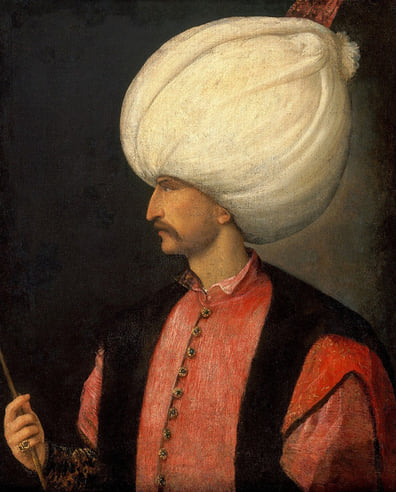
Portrait made in his lifetime — circle of Titian · 1530s
Suleiman I
Kanuni (“the Lawgiver” / “the Magnificent”)
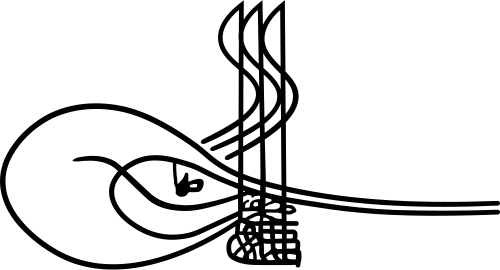
With a reign of forty-six years he ruled longer than any other sultan. He brought the state to its military, legal and cultural peak; yet the executions of his sons Mustafa and Bayezid are the gravest instances of violence within the dynasty.
Open the reign of Suleiman I on the map▶ Watch the 1-minute video: YouTube · Instagram · TikTok
Interesting fact
With a reign of forty-six years he is the longest-reigning Ottoman sultan, and his reign ended with his death on campaign. He wrote poetry as “Muhibbi” and also used the pen names “Muhib” and “Meftuni”.
Source: TDV İslâm Ansiklopedisi (Turkish), article “SÜLEYMAN I”
Life
From Trabzon to Manisa
Suleiman was born in Trabzon on 6 November 1494 (some sources give a different date). His father was Selim the Grim (Yavuz Sultan Selim), at that time sanjak governor of Trabzon, and his mother was Hafsa Sultan; the TDV article states that the reports that his mother was the daughter of the Crimean khan or of the Dulkadıroğulları are not correct. In his youth he learned the goldsmith's craft from a Greek (Rum) master, together with Yahya (Yahya Efendi of Beşiktaş), the son of Ömer Efendi.
In 1509 he was sent to the sanjak of Kefe. When his father came to the throne, he was charged with guarding the capital during the struggle for the throne with Selim's brothers; then, as the sole heir to the throne, he became sanjak governor of Manisa in April 1513. With him were his mother, his tutor Hayreddin, his lala (guardian) Kasım and his close friend Ibrahim, whom he would later make grand vizier; Mahidevran, the mother of his first son Mustafa, also appears on this list. He must also have met Hürrem Sultan, the wife to whom he would remain devoted all his life, during his last years in Manisa.
Belgrade, Rhodes and Mohács
On receiving news of his father's death he set out from Manisa, and on 30 September 1520 he took the throne in Istanbul. In the west he chose two targets: Belgrade, the key to Central Europe, and Rhodes, critical for control of the Mediterranean. Belgrade was the fortress his great-grandfather the Conqueror had been unable to take; Suleiman took it in 1521. He laid siege to Rhodes; after bloody fighting the Knights surrendered on 20 December 1522, and Suleiman received their leader, Villiers de l'Isle-Adam, and allowed them to leave the island.
Next he turned to Hungary. The pitched battle on the plain of Mohács on 29 August 1526 was short; the Hungarian king Louis II (Lajos II) died in the battle, and this defeat brought the end of the Kingdom of Hungary. Suleiman left Hungary to Szapolyai, the voivode of Transylvania (Erdel); when the Habsburg Ferdinand also claimed the Hungarian throne, he set out on campaign again in 1529 and came as far as the walls of Vienna. According to the TDV article, his priority on this campaign was to recover Buda and support Szapolyai; the view that he aimed directly to take Vienna and bring the Habsburgs to their knees is not quite accurate. When Ferdinand besieged Buda in 1541, Suleiman went on campaign once more and entered Buda on 2 September 1541; the city was now directly the seat of an Ottoman province (beylerbeyilik).
Between and after these two great campaigns he kept up the pressure in Central Europe. In 1532, in the operation known in Ottoman sources as the “Alaman seferi” (German campaign), he entered Hungary again, took the fortress of Güns (Kőszeg) and advanced towards Graz; according to the TDV article, this campaign aimed less at taking Vienna directly than at intimidating Emperor Charles V. In 1538 he campaigned in Moldavia and entered its capital, Suceava; the rebellious voivode Petru Rareş fled, and a stretch of coast important for control of the Black Sea passed under Ottoman control. After Buda, in 1543 he took Valpo, Peçuy (Pécs) and Şikloş (Siklós), Esztergom (Estergon) on 10 August, and then Tata and Istolni Belgrad (Székesfehérvár). In 1552, when the vizier Ahmed Pasha captured Tımışvar (Temesvár, Timişoara), the Ottoman frontier reached Transylvania. In the background of this policy lay the rapprochement with France against the Habsburgs: in 1525 the mother of the French king Francis I, who had been taken prisoner by Charles V, had asked Suleiman for help; in later years Barbarossa besieged the fortress of Nice together with the French fleet, and in 1553 an Ottoman–French fleet landed on Corsica.
The East, the seas and Ibrahim Pasha
He raised his close friend Ibrahim Pasha to the grand vizierate with a speed that went against custom. In the campaign of the Two Iraqs (Irakeyn), which began in 1534, Ibrahim Pasha entered Tabriz and Suleiman took Baghdad; the campaign lasted a year and a half and showed that the Safavids could not easily be eliminated. After the return, partly as a result of rivalries within the household, Suleiman had Ibrahim Pasha executed without warning in the palace on the night of 14–15 March 1536; the TDV article notes that this event may have brought about a deep change in the sultan's inner world.
In the Mediterranean he placed Barbarossa Hayreddin (Barbaros Hayreddin) at the head of the Ottoman fleet against the Habsburg navy. On 28 September 1538, at Preveza, Barbarossa defeated his long-standing rival Andrea Doria. In 1538 he sent Hadım Süleyman Pasha to India with the fleet at Suez to counter Portuguese activity in Indian waters; the small Muslim sultanates that had asked for help were the reason for this expedition. Tripoli in North Africa (Trablusgarp) was taken in 1551, and the conquest of the island of Djerba (Cerbe) in 1560 was greeted with joy in Istanbul. In the east, the flight of Shah Tahmasp's brother Elkas Mirza (Alqas Mirza) to the Ottomans turned him once again towards a campaign against Iran; in the campaign of 1554 he had the country around Yerevan (Revan) and Nakhchivan (Nahcıvan) laid waste. The long wars with the Safavids were brought to a peace by the Treaty of Amasya of 1 June 1555.
The tragedy of the princes
The second half of his reign was darkened by the rivalry between his sons. Setting out on campaign against Iran in 1553, Suleiman kept receiving reports against Prince Mustafa along the way; in October 1553, at Ereğli near Konya, Mustafa entered the imperial tent to present himself before his father and was strangled there. In April 1558 his beloved wife Hürrem Sultan died; for Prince Bayezid this meant the loss of his most powerful protector.
The tension between Bayezid and Selim turned into war: defeated on the plain of Konya on 30 May 1559, Bayezid fled first to Amasya and then, with his sons, to Safavid Iran. After long negotiations Shah Tahmasp handed him over to Ottoman envoys, and Bayezid was put to death together with his sons. The road to the throne was left to Selim.
Last campaign and character
The aged sultan suffered from severe gout (nikris). After the defeat at Malta in 1565, influenced also by his daughter Mihrimah Sultan and the grand vizier Sokullu Mehmed Pasha, he took a decision that surprised everyone and went on campaign one last time. While the siege of Szigetvár was under way, he died in his tent on the night of 6–7 September 1566, and so did not see the fortress taken. His death was skilfully concealed; it was officially announced only when Selim II reached Belgrade. The funeral prayer was led by the şeyhülislam (chief mufti) Ebüssuud Efendi, and he was buried in his tomb beside the Süleymaniye Mosque.
He wrote poetry under the pen name “Muhibbi” and left a divan. In his time the bureaucracy took on its classical form, the laws were applied across the whole country, and in the law codes customary practice began to be explained on the basis of Islamic law (şer'î). He had Mimar Sinan build many mosques and complexes: foremost among them is the Süleymaniye Complex, which with its madrasas also renewed the system of education. The mosques for his sons Mehmed and Cihangir, the Haseki Complex in the name of Hürrem Sultan, the Kırkçeşme water channels that brought water to Istanbul and the Büyükçekmece Bridge are also his works; he also completed the Sultan Selim Mosque begun in his father's name. In Baghdad he built the tomb of Imam-ı Azam (Abu Hanifa) together with the mosque and soup kitchen (imaret) beside it. Today he is best known by the title “Kanuni” (the Lawgiver); according to the TDV article, this epithet first appears in the 18th century in Dimitrie Cantemir's history of the Ottomans and became widespread in the nineteenth. With a reign of forty-six years he is the longest-reigning Ottoman sultan; by the atlas's reckoning, the territory gained in his reign is also the largest of all the sultans.
Source: TDV Encyclopedia of Islam (TDV İslâm Ansiklopedisi), “Süleyman I” (Feridun M. Emecen); the main sources of this article are Lokman's Hünername, Celalzade Mustafa, Feridun Bey's Nüzhetü'l-esrar, the campaign diaries (ruzname) and the reports of Venetian ambassadors.
Meanwhile in the world
Contemporary rulers
- Charles VHoly Roman Emperor, King of Spain · 1519–1556The Habsburg who ruled the most extensive lands of his dynasty
- Francis IKing of France · 1515–1547Valois king and great patron of Renaissance art
- Henry VIIIKing of England · 1509–1547Broke with Rome and became head of the Church of England
- Tahmasp ISafavid Shah · 1524–1576Moved the capital from Tabriz to Qazvin; promoted carpet weaving
- BaburFounder of the Mughal Empire · 1526–1530Founded the Mughal dynasty in India after victory at Panipat
- Ivan IV (the Terrible)Grand Prince of Moscow, Tsar of Russia from 1547 · 1533–1584First Russian ruler to take the title of tsar
- Jiajing EmperorEmperor of Ming China · 1521–1567Largely neglected affairs of state during his long reign
What was happening in the world?
- 1521Hernán Cortés and his Indigenous allies besieged and captured the Aztec capital Tenochtitlan, ending the Aztec state.
- 1522The Victoria, last ship of Magellan's expedition, returned to Spain under Elcano, completing the first circumnavigation of the globe.
- 1534The Act of Supremacy recognized Henry VIII as Supreme Head of the Church of England.
- 1543Copernicus's De revolutionibus, setting out a Sun-centred model of the universe, was published.
- 1545The Council of Trent, convened by Pope Paul III, opened to frame the Catholic response to the Protestant Reformation.
- 1555The Peace of Augsburg gave a permanent legal basis for Lutherans and Catholics to coexist in Germany.
Sources: britannica.com [1] [2] [3] [4] [5] [6] [7] [8] [9] [10] [11] [12] · arxiv.org [1]
Family
| Father | Selim I |
|---|---|
| Mother | Ayşe Hafsa Sultan |
| Consorts | Mahidevran Sultan, Hürrem Sultan (Roxelana) |
| Children | Şehzade Mustafa, Şehzade Mehmed, Mihrimah Sultan, Şehzade Abdullah, Selim II, Şehzade Bayezid, Şehzade Cihangir |
Major achievements
- Conquest of Belgrade (1521), Rhodes (1522), Buda (1541), Baghdad (1534), Tripoli (1551), Temesvár (1552)
- Victory at Mohács (1526) and the annexation of Hungary
- Supremacy in the Mediterranean after the naval Battle of Preveza (1538)
- Laws compiled and codified — the origin of the name ‘Lawgiver’
- The Süleymaniye complex and the age of the architect Sinan
- Alliance with France and the first trade capitulation (1536)
- Indian Ocean campaigns and the struggle with Portugal
- Marriage to Hürrem Sultan, changing palace tradition
Treaties
- Treaty of Constantinople (1533, Austria)
- Peace of Amasya (1555, Persia) — the first formal treaty between the Ottomans and Persia
- Trade capitulation with France (1536)
Grand viziers
| Name | From | To | Length |
|---|---|---|---|
| Piri Mehmed Pasha | January 25, 1518 | June 27, 1523 | 5 years, 153 days |
| Pargalı Ibrahim Pasha | June 27, 1523 | March 15, 1536 | 12 years, 262 days |
| Ayas Pasha | March 15, 1536 | July 13, 1539 | 3 years, 120 days |
| Lutfi Pasha | July 13, 1539 | May 1541? | 1-2 years |
| Hadım Süleyman Pasha | May 1541? | November 28, 1544 | 3-4 years |
| Rüstem Pasha | December 2, 1544 | October 6, 1553 | 8 years, 308 days |
| Kara Ahmed Pasha | October 6, 1553 | September 29, 1555 | 1 year, 358 days |
| Rüstem Pasha (term 2) | September 29, 1555 | July 12, 1561 | 5 years, 286 days |
| Semiz Ali Pasha | July 12, 1561 | June 29, 1565 | 3 years, 352 days |
| Sokullu Mehmed Pasha | June 29, 1565 | October 12, 1579 | 14 years, 105 days |
Battles and treaties
| Year | Event | Result / parties |
|---|---|---|
| 1520 | Revolt: Revolt of Canbirdi Gazali | Defeated at Mastaba and killed while fleeing; Damascus returned to Ottoman control |
| 1521 | Siege: Conquest of Belgrade | Belgrade conquered; the road into Hungary lay open |
| 1522 | Siege: Siege of Rhodes | The Knights of Rhodes surrendered and left the island; Rhodes passed to the Ottomans |
| 1524 | Revolt: Revolt of Ahmed Pasha | Suppressed; Ahmed Pasha was captured and killed. Grand Vizier Ibrahim Pasha was sent to Egypt to restore order (October 1524) |
| 1526 | Battle: Mohács | Decisive Ottoman victory; King Louis II killed, Buda taken without resistance |
| 1527 | Revolt: Revolt of Kalender Şah | He twice defeated Behram Pasha, governor of Anatolia (Cincife, 8 June 1527); Grand Vizier Ibrahim Pasha won over the Turkmen chiefs and defeated Kalender on … |
| 1529 | Siege: First Siege of Vienna | The siege was lifted; Buda was retaken and given to Szapolyai |
| 1530 | Siege: Capture of the Peñón of Algiers | The Spanish fortress was taken; Algiers gained a sheltered harbour |
| 1532 | Campaign: German campaign and siege of Güns | Güns was taken; Charles V did not offer battle, and the army withdrew |
| 1533 | Treaty: Treaty of Constantinople | |
| 1534 | Campaign: Conquest of Baghdad | Baghdad taken without a fight; Tabriz could not be held |
| 1534 | Siege: Capture and loss of Tunis (1534–1535) | The city was taken and lost the next year to Charles V's expedition |
| 1536 | Treaty: Trade capitulation with France | |
| 1537 | Siege: Siege of Corfu (1537) | The island was overrun but the fortress held; the siege was raised |
| 1538 | Naval battle: Preveza | Decisive Ottoman victory; the allied fleet withdrew and Ottoman supremacy in the Mediterranean was established |
| 1538 | Siege: Siege of Diu | The siege was lifted; Diu remained Portuguese |
| 1539 | Siege: Siege of Castelnuovo | The town was recovered from the Spanish |
| 1541 | Battle: Algiers expedition (1541) | The Spanish expedition ended in disaster in the face of storm and defence |
| 1541 | Campaign: Siege of Buda (1541) | The province of Buda was created; central Hungary came under direct Ottoman rule |
| 1543 | Siege: Siege of Nice (1543) | The town was taken, the citadel held; the fleet wintered at Toulon |
| 1551 | Siege: Conquest of Tripoli | The city passed to the Ottomans; the province of Tripoli was formed |
| 1552 | Siege: Conquest of Temesvár | Temesvár conquered and annexed |
| 1552 | Siege: Siege of Eger (1552) | The siege was raised; the Ottoman forces withdrew |
| 1553 | Campaign: Nakhchivan campaign (1553–1554) | The Erivan and Nakhchivan districts were laid waste; the Safavids sued for peace (Amasya, 1555) |
| 1554 | Naval battle: Battle of Hormuz | In the first clash the Portuguese fleet withdrew; a second clash followed off Muscat |
| 1555 | Treaty: Peace of Amasya | |
| 1559 | Revolt: Revolt of Prince Bayezid | Defeated by Prince Selim before Konya (30 May 1559); took refuge in Iran, was handed over to Ottoman envoys in 1562 and killed with his sons at Qazvin |
| 1560 | Naval battle: Djerba | Decisive Ottoman victory; the crusading fleet was scattered and the fortress of Djerba taken |
| 1565 | Siege: Great Siege of Malta | The siege failed and was lifted; Turgut Pasha was killed |
| 1566 | Siege: Siege of Szigetvár | The fortress was taken; Suleiman died during the siege |
Full infoboxes are in the site’s “Battles and Treaties” tab; source: TDV Encyclopedia of Islam.
Death
He died of natural causes in his tent during the siege of Szigetvár in 1566. Grand Vizier Sokullu Mehmed Pasha kept his death secret for days so that the army would not disband.
Territorial change
| Year | Region | Event | Source |
|---|---|---|---|
| 1521 | + Belgrade–Šabac | Conquest of Belgrade (1521) and Šabac | TDV İA, “BELGRAD” |
| 1522 | + Rhodes and the Dodecanese | Siege of Rhodes (1522) — the Knights of St John were expelled from the island | TDV İA, “SÜLEYMAN I” |
| 1526 | + Eastern Slavonia and Syrmia (Osijek–Vukovar) | Osijek and Syrmia after the Battle of Mohács (1526) | TDV İA, “SLAVONYA” |
| 1527 | + Lika–Krbava | Capture of Obrovac and creation of the sanjak covering Lika–Krbava (1527) | TDV İA, “KIRKA” |
| 1534 | + Baghdad–Basra | Campaign of the Two Iraqs (1534–1535) — conquest of Baghdad | TDV İA, “SÜLEYMAN I” |
| 1537 | + Požega (central Slavonia) | Conquest of Požega by Mehmed Bey, sanjak-bey of Smederevo (1537) | TDV İA, “POJEGA” |
| 1537 | + Kars–Ardahan–Artvin | Kars was definitively annexed (1537); a border settlement of 1565 left it to Persia | TDV İA, “KARS” |
| 1538 | + Yemen–Asir | Yemen campaign (1538) and the capture of Aden | TDV İA, “YEMEN”; Ágoston – Masters, Encyclopedia of the Ottoman Empire, p. 428; Iorga, Geschichte des osmanischen Reiches, II, 365 |
| 1538 | + Ochakiv (Yedisan) | Moldavian campaign (1538) — capture of the fortress of Ochakiv (Özi) | TDV İA, “ÖZÜ”; Ágoston – Masters, Encyclopedia of the Ottoman Empire, p. 491 |
| 1541 | + Buda (central Hungary) | Battle of Mohács (1526) and the annexation of Buda (1541) | TDV İA, “SÜLEYMAN I” |
| 1549 | + Western Georgia (Mingrelia–Imereti) | Campaigns in western Georgia (1549–1550) | TDV İA, “GÜRCİSTAN” |
| 1550 | + Lahsa (Eastern Arabia–Qatar) | Creation of the province of Lahsa (1550s), expansion from Basra down to Qatif | TDV İA, “LAHS” (one-year difference: TDV: attached to Basra in 1547, a province after 1553) |
| 1551 | + Benghazi–Barca | Barca comes under Ottoman rule with the Tripoli campaign (1551) | TDV İA, “BİNGAZİ” |
| 1551 | + Tripolitania | Turgut Reis conquers Tripoli (1551) | TDV İA, “SÜLEYMAN I” |
| 1551 | + Fezzan | Vassalage of Fezzan after Tripoli | TDV İA, “TRABLUSGARP” |
| 1552 | + Western Slavonia (Virovitica–Čazma) | Capture of Virovitica and Čazma (1552) — the conquest of Slavonia completed | TDV İA, “SLAVONYA” |
| 1552 | + Banat (Temesvár) | Temesvár campaign (1552) | TDV İA, “MACARİSTAN” |
| 1555 | + Habesh–Suakin (Red Sea coast) | Creation of the province of Habesh (1555), Suakin and Massawa | TDV İA, “HABEŞ EYALETİ” |
| 1565 | − Kars–Ardahan–Artvin | Kars was definitively annexed (1537); a border settlement of 1565 left it to Persia | TDV İA, “KARS” |
| 1566 | + Chios | Piyale Pasha takes Chios from the Genoese (1566) | TDV İA, “SAKIZ ADASI” |
The lands that changed hands in this period, and the battles or treaties that brought the changes, can be seen on the map: map of the reign of Suleiman I.
Cite as: Atlas of the Sultans, “Suleiman I (Kanuni (“the Lawgiver” / “the Magnificent”)): Reign Map, Wars and Conquests (1520–1566)”, https://padisahlaratlasi.com/en/sultans/i-suleyman/ (last updated 21 November 2026). Corrections · Image credits
Terms on this page: Grand vizier · Vizier · Şehzade · Sanjak
Grand viziers of this reign: Piri Mehmed Pasha · Pargalı Ibrahim Pasha · Lutfi Pasha · Rüstem Pasha · Semiz Ali Pasha · Sokullu Mehmed Pasha
Monuments of this reign: Küçükçekmece Bridge · Kilitbahir Castle · Topkapı Palace · Kurşunlu Complex (Eskişehir) · Edirnekapı Mihrimah Sultan Mosque · Karađoz Bey Mosque · Sinan Pasha Mosque (Istanbul) · Gazi Kasım Pasha Mosque · Süleymaniye Mosque (Rhodes) · Bosnalı Mehmed Pasha Mosque · Khusrawiyya Mosque · Selimiye Mosque (Konya) · all (50) →
Women of the dynasty in this reign: Hafsa Sultan · Hürrem Sultan · Mihrimah Sultan
Capital in this reign: Istanbul
State organisation: The Imperial Council (Divan-ı Hümayun) · The Grand Vizierate and the Sublime Porte · The Nişancı and the Scribal Service (Kalemiye) · The Treasury (Defterdarlık) and Ottoman Finance · The Office of Şeyhülislam · The Learned Hierarchy and the Judgeship · The Province and Sandjak System · The Timar System · The devshirme system · The Enderun and the palace organisation · The waqf system in the Ottoman Empire
Myths and misconceptions: Did the Ottomans reach their greatest extent under Suleiman the Magnificent? · Were Crimea, Wallachia and Moldavia Ottoman territory? · Was the Ottoman army made up mostly of Janissaries?