TRENDEFRARAtlas of the Sultans · Grand viziers
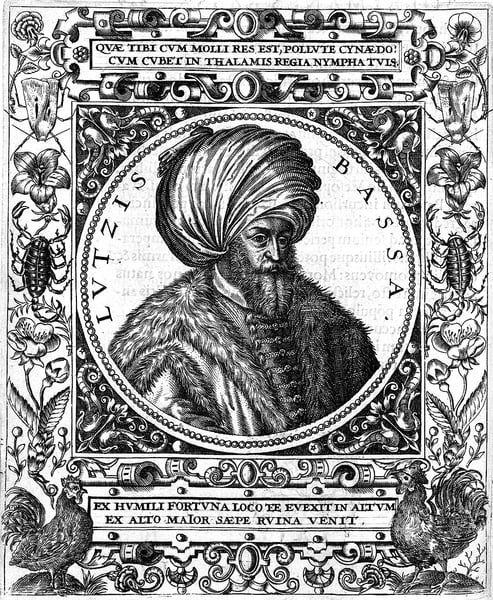
Lutfi Pasha
Grand vizier, 1539–1541
 AI

From the Enderun to the governorship-general
His date of birth is unknown; judging from the posts he held, he is estimated to have been born around 1488. As a devşirme recruit of Albanian origin he was taken into the palace in the middle of Bayezid II's reign and received a good education in the Enderun (the palace school). By his own account, at the accession of Selim I (1512) he left the palace as a müteferrika; he served as chief taster (çaşnigirbaşı), chief gatekeeper (kapıcıbaşı), standard-bearer (miralem) and sanjak bey of Kastamonu. It appears that in some studies he has been confused with another Lutfi Pasha of the same period.
In the first years of Suleiman I, while sanjak bey of Aydın, he took part in the siege of Rhodes in 1522 and was charged with repairing the fortress. He remained sanjak bey of Ioannina (Yanya) for a long time, was present at the siege of Vienna and then became governor-general of Karaman. During the campaign of the Two Iraqs he had Mimar Sinan build ships at Tatvan.
From Corfu to the grand vizierate
As third vizier he took command of the naval forces together with Barbaros Hayreddin Pasha in the Corfu campaign of 1537 and landed 25,000 soldiers and thirty cannon on the island; he fell out with Barbaros over the conduct of the campaign. When the siege was lifted he returned to Istanbul and in 1538 became second vizier. During the Moldavian campaign he introduced Mimar Sinan to the sultan, and the bridge Sinan built over the Pruth allowed the army to cross rapidly.
On 13 July 1539, upon the death of Ayas Pasha, he became grand vizier. He played an active role in the 1540 treaty that ended the war with Venice, conducted negotiations with the Habsburg envoys, and is said to have been fully acquainted with European affairs.
Reforms and dismissal
His most important measure was the change he made to the courier and post-station system, whose abuses he called the “oppression of the couriers” (ulak zulmü): by keeping state-owned horses at every station he put an end to the forcible requisitioning of horses from the people. He tried to remedy injustices in confiscations, prevented the seizure of orphans' property, and introduced the practice of holding property that passed to the treasury in trust for seven years. While preparations for the Buda campaign were under way he was suddenly dismissed in May 1541. The reason given was that he had punished a woman guilty of adultery in a way contrary to both sharia and customary law, and as a result had a violent quarrel with his wife Şah Sultan, the daughter of Selim I; he himself, however, writes that he left office of his own will. The opposing faction that his fight against bribery had raised against him is also counted among the reasons.
With an annual pension of 200,000 akçe he withdrew to his farm in Didymoteicho (Dimetoka), went on the pilgrimage, and died there in 1563.
The historian vizier
He spent the rest of his life in research and writing. His Tevarih-i Al-i Osman, which runs to 1553, is regarded as a first-hand source for the last half-century, since it rests on events he lived through himself. The Asafname is one of the first examples of the “advice to rulers” (siyasetname) genre among the Ottomans. In his Arabic Halasü'l-ümme he defended the legitimacy of the Ottoman caliphate against objections based on the hadith about the caliph having to be from the Quraysh. It also appears that he wrote some twenty works in Arabic and Turkish on questions of jurisprudence. Although he patronized scholars and poets, he was firmly attached to the religious thought of his time; his description of the Hümayunname presented to him as a time-wasting work of animal fables shows this attitude. Ali Mustafa Efendi found him proud and conceited, whereas Sehi Bey and Celalzade praise his moral virtues and his achievements in the service of the state.
Source: TDV Encyclopedia of Islam, “LUTFİ PAŞA” (Mehmet Ipşirli)
Related sultans
Cite as: Atlas of the Sultans, “Lutfi Pasha · Grand viziers”, https://padisahlaratlasi.com/en/grand-viziers/lutfi-pasha/ (last updated 21 November 2026). Corrections · Image credits