TRENDEFRARAtlas of the Sultans · 13 / 39 · sultan
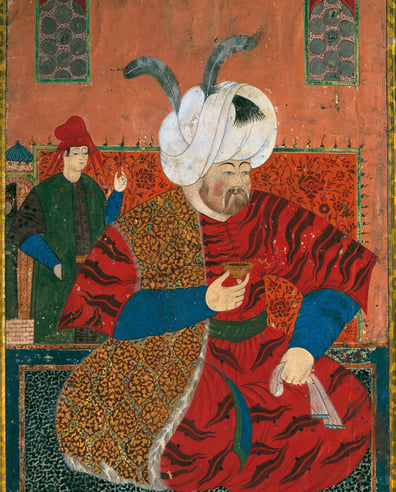
Portrait made in his lifetime — Nigari (Haydar Reis) · c. 1570
Selim II
Sarı (“the Blond”)
The first sultan not to lead campaigns; he left government to his grand vizier. Cyprus was won and a heavy naval loss at Lepanto was quickly made good — counted as proof of the empire's institutional strength.
Open the reign of Selim II on the map▶ Watch the 1-minute video: YouTube · Instagram · TikTok
Interesting fact
He was the first Ottoman ruler who never went on campaign during his eight-year reign. He spent his time at the palace in Istanbul and his winters in his beloved Edirne.
Source: TDV İslâm Ansiklopedisi (Turkish), article “SELİM II”
Life
The first sultan born in Istanbul
Selim was the son of Suleiman the Magnificent by Hürrem Sultan. He was born in Topkapı Palace on 30 May 1524, during the wedding festivities of the grand vizier Ibrahim Pasha; he is the first sultan born in Istanbul to ascend the throne. In July 1530 he was circumcised together with his two elder brothers; festivities were held in the Hippodrome (Atmeydanı) for about twenty days. His father took him on the Moldavian campaign of 1538 and the Hungarian campaign of 1541.
In 1542 he was sent to Konya as sanjak governor, and in 1544 he moved to Manisa. In Manisa his son Murad (later Murad III) was born to Nurbanu Sultan. In 1553, during his father's Iranian campaign, he learned that his elder brother Mustafa had been killed at Ereğli near Konya; he thus became Suleiman's eldest living son.
The struggle with his brother Bayezid
After Mustafa's death many people gathered around his brother Bayezid in Kütahya, and the rivalry between the two brothers turned into open conflict. Selim raised mercenary troops with his father's support; by heeding the advice of the vizier Sokullu Mehmed Pasha, whom his father had sent, he won Suleiman's trust. In the battle fought on the plain of Konya on 30 May 1559 Bayezid was defeated, and in the end he fled to Iran. At the beginning of 1562 Selim was transferred to Kütahya so as to be close to Istanbul, and there he awaited the day he would come to the throne.
Accession
Suleiman died in September 1566 during the siege of Szigetvár; Sokullu Mehmed Pasha concealed his death and sent word to Selim. Selim received the oath of allegiance in Istanbul and, borrowing 50,000 gold pieces from his sister Mihrimah Sultan, set out to join the army. He met the army at Belgrade; at Sokullu's direction he was obliged to distribute the accession bonus (cülus bahşişi) to the sultan's household troops (kapıkulu). The Janissaries, who wanted more, said they would settle the account in Istanbul.
Throughout his reign the real ruler of the state was the grand vizier Sokullu Mehmed Pasha, whom he had inherited from his father. Selim mostly preferred to stay in the background of the power struggles among the pashas; but the TDV article also notes that he was at times influential in planning military operations.
Cyprus, Lepanto and Tunis
In Edirne, where he spent the winter, he received Habsburg, Safavid, Polish, French and Venetian envoys; it was decided that peace with the Safavids should continue, and on 17 February 1568 the treaty ending the state of war with the Habsburgs (the Treaty of Edirne) was signed. At the beginning of his reign revolts broke out in Basra and Yemen (1567); the recapture of Sanaa and Aden was greeted with joy in Istanbul. The Astrakhan (Astarhan) campaign of 1569, directed by Sokullu from the capital, also included a plan to cut a canal between the Don and the Volga, but it came to nothing. The most important undertaking of Selim's reign was the Cyprus campaign: ever since his days as a prince, the sultan had regarded the taking of Cyprus as a deed worthy of his reign. The island was taken from Venice, and the conquest was completed in 1571.
Right after the conquest of Cyprus, in October 1571, the Ottoman fleet suffered a heavy defeat at the hands of the Crusader fleet at Lepanto (Inebahtı). Selim received the news in Edirne and at once ordered a new fleet to be built; the fleet was rebuilt in the course of a single winter. In 1573 peace was made with Venice. In 1574 the new fleet took Tunis from the Spanish; on 20 November 1574 Selim received Kılıç Ali Pasha, who had returned to Istanbul, and rewarded him.
Character and death
Selim wrote poetry under the pen names “Selimi” and “Talibi”; although he left no divan, his poems are counted among the fine examples of classical Ottoman (divan) poetry. Gelibolulu Ali writes that he had more than twenty-seven poets, boon companions and conversationalists around him. He showed interest in musicians and held the şeyhülislam Ebüssuud Efendi in great respect. The Selimiye Mosque in Edirne, which Mimar Sinan called his “masterpiece” (ustalık eserim), was built in his name; the complex he had begun in Konya as a prince was also completed during his reign.
In December 1574, while walking about the bath he had recently had built in the palace, he slipped and fell; afterwards he was seized by a high fever and a stomach ailment. According to another account, he fell ill because he had repented of drinking and given it up all at once. The date of his death differs in the sources: Selaniki, who served in the palace, gives 15 December 1574, Gerlach 13 December. He was buried in the tomb begun at his own order in the courtyard of the Hagia Sophia Mosque (Ayasofya), together with the five princes whom his son Murad III had put to death on coming to the throne.
Selim was the first sultan who did not go on campaign in person. Despite his short reign, the conquest of Cyprus and the swift rebuilding of the fleet after Lepanto showed that the state run by Sokullu was still powerful.
Source: TDV Encyclopedia of Islam (TDV İslâm Ansiklopedisi), “Selim II” (Feridun M. Emecen); the main sources of this article are Selaniki, Gelibolulu Ali, Mehmed b. Mehmed er-Rumi and the diary of Stephan Gerlach.
Meanwhile in the world
Contemporary rulers
- Maximilian IIHoly Roman Emperor · 1564–1576Humanist emperor tolerant toward both Catholics and Protestants
- Philip IIKing of Spain · 1556–1598Habsburg king who also held the Portuguese throne from 1580
- Elizabeth IQueen of England · 1558–1603Last Tudor monarch; her reign is called England's Golden Age
- Charles IXKing of France · 1560–1574Reigned during the Wars of Religion, overshadowed by his mother Catherine de' Medici
- Tahmasp ISafavid Shah · 1524–1576Safavid ruler who entrenched Shiʿism as the state religion
- AkbarMughal Emperor · 1556–1605Regarded as the greatest of the Mughal emperors
- Wanli EmperorEmperor of Ming China · 1572–1620During his reign Matteo Ricci established Jesuit missions in China
What was happening in the world?
- 1568The Dutch revolt against Spain began; the Eighty Years' War would last until 1648.
- 1569Flemish cartographer Gerardus Mercator introduced the map projection that became standard for navigation.
- 1569The Union of Lublin merged Poland and Lithuania into a single federated state under a joint sovereign.
- 1572Thousands of Huguenots (French Protestants) were killed in the St. Bartholomew's Day Massacre in Paris.
- 1573Oda Nobunaga drove the last Ashikaga shogun, Yoshiaki, from Kyoto, effectively ending the Ashikaga shogunate.
Sources: britannica.com [1] [2] [3] [4] [5] [6] [7] [8] [9] [10] [11] [12]
Family
| Father | Suleiman I |
|---|---|
| Mother | Hürrem Sultan |
| Consorts | Nurbanu Sultan |
| Children | Murad III, Ismihan Sultan, Gevherhan Sultan, Şah Sultan, Fatma Sultan |
Major achievements
- Conquest of Cyprus (1570–71)
- A new fleet built within two years after the fleet was burned at Lepanto
- Tunis finally taken from Spain (1574)
- The Selimiye Mosque in Edirne — the masterpiece of the architect Sinan
- Attempt at a Don–Volga canal
- The powerful grand vizierate of Sokullu Mehmed Pasha and the delegation of state affairs to viziers
Treaties
- Treaty of Adrianople (1568, Austria)
- Peace with Venice over Cyprus (1573)
Grand viziers
| Name | From | To | Length |
|---|---|---|---|
| Sokullu Mehmed Pasha | June 29, 1565 | October 12, 1579 | 14 years, 105 days |
Battles and treaties
| Year | Event | Result / parties |
|---|---|---|
| 1567 | Campaign: Ottoman expedition to Aceh (1567–1568) | Arms, ammunition and craftsmen were sent to Aceh; an Ottoman–Acehnese tie was established |
| 1568 | Treaty: Treaty of Adrianople | |
| 1569 | Campaign: Astrakhan expedition and Don–Volga canal (1569) | The canal was not dug and the siege of Astrakhan was raised; the army returned to Azov with heavy losses |
| 1569 | Campaign: Ottoman reconquest of Yemen (1569–1571) | Yemen was brought back under Ottoman control; al-Mutahhar retreated to Saada |
| 1571 | Siege: Conquest of Cyprus | Cyprus conquered; Venice gave up the island by the treaty of 1573 |
| 1571 | Naval battle: Lepanto | Heavy Ottoman defeat; the fleet was rebuilt within a short time |
| 1573 | Treaty: Peace with Venice over Cyprus | |
| 1574 | Siege: Conquest of Tunis | Tunis passed definitively to the Ottomans; Hafsid rule ended |
Full infoboxes are in the site’s “Battles and Treaties” tab; source: TDV Encyclopedia of Islam.
Death
He died in 1574 in Topkapı Palace after slipping in the bath and striking his head.
Territorial change
| Year | Region | Event | Source |
|---|---|---|---|
| 1566 | + Cyclades (Naxos) | The Duke of Naxos deposed and the duchy given to the Ottoman subject Joseph Nasi (1566) — the Cyclades came under direct control | TDV İA, “NAKŞA” |
| 1569 | + Tunis | Tunis passed to the Ottomans again in 1569; the Spanish occupation of 1573 ended with the campaign of 1574 and the city was finally annexed | TDV İA, “TUNUS” |
| 1571 | + Cyprus | Conquest of Cyprus (1570–1571) — sieges of Nicosia and Famagusta | TDV İA, “SELİM II” |
The lands that changed hands in this period, and the battles or treaties that brought the changes, can be seen on the map: map of the reign of Selim II.
Cite as: Atlas of the Sultans, “Selim II (Sarı (“the Blond”)): Reign Map, Wars and Conquests (1566–1574)”, https://padisahlaratlasi.com/en/sultans/ii-selim/ (last updated 21 November 2026). Corrections · Image credits
Terms on this page: Grand vizier · Vizier
Grand viziers of this reign: Sokullu Mehmed Pasha
Monuments of this reign: Küçükçekmece Bridge · Hagia Sophia · Selimiye Mosque (Konya) · Sokullu Mehmed Pasha Complex (Lüleburgaz) · Sulaymaniyya Takiyya (Damascus) · Behram Pasha Mosque · Banya Bashi Mosque · Emperor's Mosque · Mahmud Pasha Mosque · Selimiye Mosque and Complex (Edirne) · Uzunköprü Bridge (Silivri) · Atik Valide Mosque · all (18) →
Women of the dynasty in this reign: Hürrem Sultan · Mihrimah Sultan · Nurbanu Sultan
State organisation: The Treasury (Defterdarlık) and Ottoman Finance · The waqf system in the Ottoman Empire