TRENDEFRARAtlas of the Sultans · Grand viziers
Rüstem Pasha
Grand vizier, 1544–1553 and 1555–1561
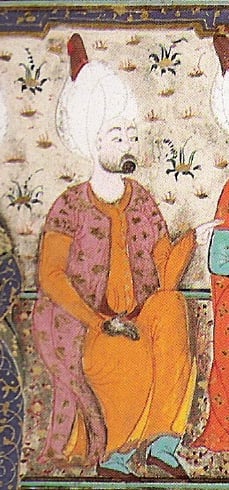 AI

From Sarajevo to the palace
He is said to have been born at the beginning of the 1500s in a village near Sarajevo; on the gravestones of his relatives the family name appears as Čigalić. There are different records saying he was Croat, Bosniak, Serb or Albanian. According to what he himself told the Venetian bailo Navagero, his first master, unable to pay his tax, handed him over as a slave to the sultan's palace at Galata, where he attracted attention and became a page (iç oğlanı). Again by his own account, his jumping out of a window to catch an object that had fallen from the sultan's hand out of the window brought him to Suleiman's notice.
He took part in the Mohács campaign as sword-bearer (silahdar), and on the return, on 12 November 1526, he became master of the horse (büyük mirahur). Probably in 1533 he was sent to the sanjak of Teke by Ibrahim Pasha, and so removed from Istanbul. After Ibrahim Pasha's execution in 1536 he was appointed governor-general of Dulkadir, Karaman and Diyarbekir.
Suleiman's son-in-law
According to tradition, those who wanted to prevent his marriage to the sultan's daughter Mihrimah Sultan spread the word that he had leprosy; the physician sent to Diyarbekir found a louse on him and decided that he did not have the disease, and for this reason he was called “kehle-i ikbal” (the louse of fortune). The article states that this story is very probably untrue and reflects later political rivalries in late sources. In 1538 he became governor-general of Anatolia, and his marriage to Mihrimah Sultan was solemnized at the end of 1539 during the circumcision festivities of Prince Bayezid. In 1541 he became second vizier.
On 2 December 1544, with the dismissal of Hadım Süleyman Pasha, he became grand vizier; some sources write that he engineered this himself. In 1545 an armistice was concluded with the Habsburgs, and in 1547 a treaty in return for Austria's paying 30,000 gold pieces a year for its Hungarian lands. In the Iranian campaign of 1548 he wanted to carry out a firearms trial with the sipahis, but the idea was abandoned.
The Prince Mustafa affair and the second grand vizierate
According to the article, while Hürrem Sultan was trying to eliminate Prince Mustafa so that her own sons could come to the throne, she found her greatest support in her son-in-law Rüstem Pasha, and the prince was killed in 1553 at Aktepe, during the Iranian campaign, through his scheming. Because of the great indignation the event caused among the soldiers he was dismissed and Kara Ahmed Pasha was appointed in his place. Even after his dismissal he largely kept his power as Suleiman's son-in-law.
When Kara Ahmed Pasha was dismissed and killed on 29 September 1555, he became grand vizier for the second time. In this period Piyale Pasha's fleet won the naval battle of Djerba (Cerbe) in 1560; in the struggle between Prince Bayezid and Prince Selim he at first supported Bayezid, and when Bayezid fell into the position of a rebel he went over to Selim's side. He died of dropsy on 12 July 1561 and was buried in his tomb in the burial ground of the Şehzade Mosque.
Wealth, endowments and assessment
He took financial measures that brought great revenue to the treasury; according to the author of the article, the accusations of bribery against him concern the gratuities (caize) recorded in the official registers. Tax farming (iltizam), criticized by Koçi Bey, became widespread in his time. He left behind an enormous fortune, 815 farms and more than 5000 volumes of books. Among his endowments, which stretched from Croatia to Medina, are his mosque in Eminönü, famous for its tiles, and his caravanserais in Edirne and Erzurum. The historians of his time generally portray him negatively because of the Prince Mustafa affair; the article, however, states that his contribution to the political and financial development of the state during his 14.5-year grand vizierate is clear.
Source: TDV Encyclopedia of Islam, “RÜSTEM PAŞA” (Erhan Afyoncu)
Related sultans
Cite as: Atlas of the Sultans, “Rüstem Pasha · Grand viziers”, https://padisahlaratlasi.com/en/grand-viziers/rustem-pasha/ (last updated 21 November 2026). Corrections · Image credits