TRENDEFRARAtlas of the Sultans · Ottoman monuments
Khusrawiyya Mosque
Monument · Mosque, Aleppo, 1546
- Type
- Mosque
- Built
- 1546
A work of Mimar Sinan
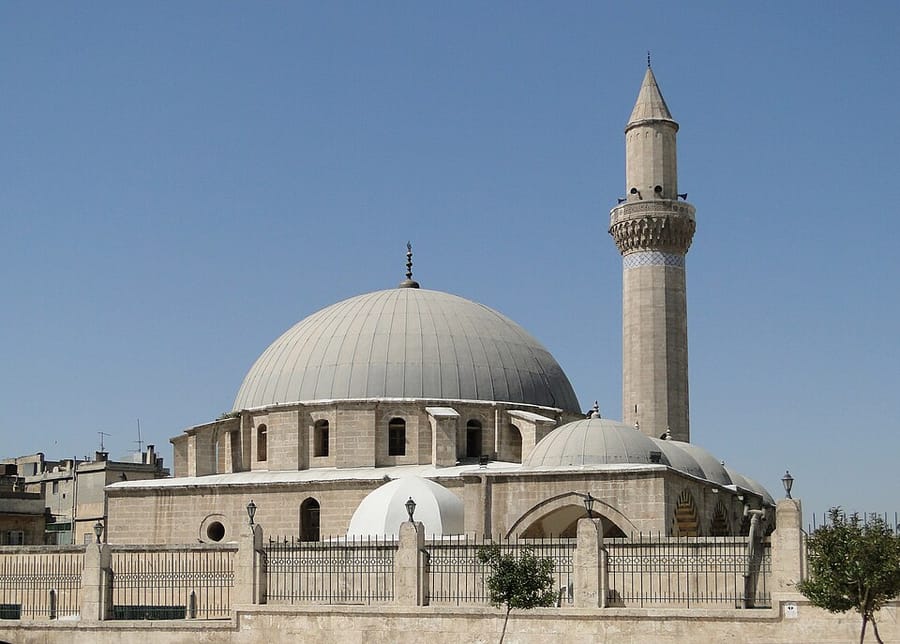

One of Sinan's earliest works
The mosque was commissioned in the reign of Sultan Suleiman the Magnificent by the vizier Deli Hüsrev Pasha. The date 1545 or 1546 in its inscription most probably marks the completion of the work. When construction began is disputed: E. Egli gives 1536–1537, while Aptullah Kuran holds that the mosque was built after Hüsrev Pasha became second vizier in 1541, most likely under the supervision of an architect sent from Istanbul, and finished after the death of the pasha, generally dated to 1545. Lists of Sinan's works record it as the “Mosque of the late Hüsrev Pasha”, and it is regarded as one of Mimar Sinan's first buildings.
Set in a walled courtyard, the mosque has a square prayer hall covered by a single lead-clad dome resting on squinches. With its domed side rooms (tabhane) on either side, it is one of the last, perhaps the very last, of the tabhane mosques that Ottoman architecture abandoned from the 16th century onwards. In front stands a five-bay domed portico, and the balcony of the stone minaret rests on muqarnas corbels. The twin madrasas flanking the mosque were altered over time; the rooms of the eastern one were cut away in 1901 when a school was built.
Tabhanes and portico
A row of windows in the buttressed drum of the dome over the prayer hall lights the interior. The domed tabhane rooms on either side of the prayer hall each have an outside entrance on the side façades as well as doors opening into the prayer hall. The portico has a colonnaded arcade. The stone minaret adjoins the right-hand tabhane; for this reason Evliya Çelebi says the minaret is “in the Rum style”, that is, the style of Anatolia and especially Istanbul. A good plan reflecting the mosque's proportions was drawn by the English architect John Warren and first published by Semavi Eyice.
M. Es'ad Talas writes that there were tiles inside the mosque, but there is not enough information about them. According to Eyice, they may have been high-quality Iznik tiles or tiles made in the south-east in the 16th century.
Evliya Çelebi and the madrasas
Describing Aleppo, where he stopped on the pilgrimage journey he began in May 1671, Evliya Çelebi devotes a fairly long section to the “Old Hüsrev Pasha Mosque”. The Tuhfetü'l-mimarin notes that there was a madrasa together with the mosque and states that the founder's tomb is in Istanbul.
According to Aptullah Kuran, the madrasa west of the mosque consists of a lecture hall, six student rooms with a portico arranged in an L shape against the hall's west wall, and a three-bay porch opposite; a second lecture hall and a three-domed porch on the east side show that a similar madrasa stood there too. Kuran does not see Sinan's style in these squat, roughly built twin madrasas and thinks they were built by a local architect after the mosque was finished. Eyice, however, notes that this description hardly matches the arcaded madrasa with coloured marble columns described by Evliya Çelebi, and that little of that building has survived.
Source: TDV Encyclopedia of Islam (TDV İslâm Ansiklopedisi), “HÜSREVİYYE CAMİİ” (Semavi Eyice)
Related sultans
Cite as: Atlas of the Sultans, “Khusrawiyya Mosque · Ottoman monuments”, https://padisahlaratlasi.com/en/monuments/khusrawiyya-mosque/ (last updated 21 November 2026). Corrections · Image credits