TRENDEFRARAtlas of the Sultans · Ottoman monuments
Bosnalı Mehmed Pasha Mosque
Monument · Mosque, Sofia, 1547
- Type
- Mosque
- Built
- 1547
A work of Mimar Sinan
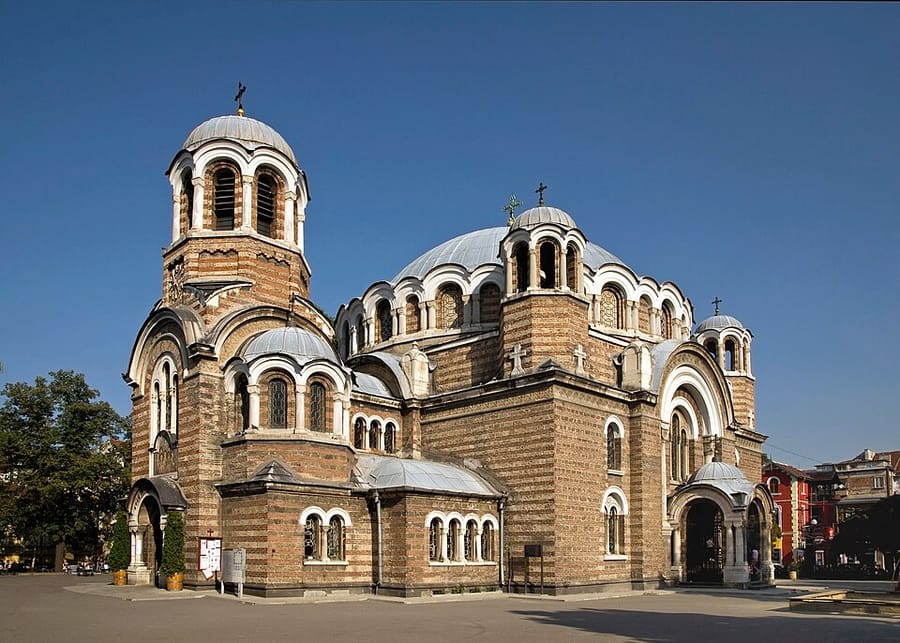

A Sinan mosque turned church
The mosque in Sofia was built by Derviş Mehmed Pasha, also known as Sofu; after serving as governor-general of Rumelia he became second vizier in 1547, and later governed Baghdad, Bosnia and Buda. Its inscription is dated 1547, and according to its endowment deed, approved in early 1548, it was the centre of a complex (külliye) with a madrasa, library, public kitchen (imaret), hospital, bathhouse and caravanserai. Listed among Sinan's works, it is Mimar Sinan's only mosque in Bulgaria.
Its square prayer hall is covered by a tall dome on corner squinches. After Sofia passed out of Ottoman rule in 1878, the minaret was dynamited on the orders of the Russian commander-in-chief, Prince Alexander Dondukov, and the mosque served for a time as a depot and arsenal; its popular name, Kara Cami (Black Mosque), is said to derive from this or from the colour of its stone. Despite a warning from Abdulhamid II, its exterior was entirely remodelled in 1901 and it was turned into the Church of the Seven Saints (Sveti Sedmochislenitsi), opened in 1903. Outside, nothing remains to show its Turkish origin, but inside the elements of Turkish architecture are clearer.
Founder and Evliya Çelebi's description
According to Peçuylu Ibrahim, Mehmed Pasha was poisoned by medicine given by a physician while serving as governor of Buda. Besides his complex in Sofia, the pasha also had charitable foundations at Yenikapı in Istanbul, in Sarajevo and in Travnik. Evliya Çelebi, who came to Sofia in 1652, describes the building, also called the Imaret Mosque, as a place of worship with a lofty dome like those of the imperial mosques, richly decorated inside and out and with a spacious courtyard; he notes that the domes of its columned porticoes were lead-covered, that its minaret was tall and slender, and that it was the work of the architect Koca Sinan. A copy of the Arabic endowment deed is in the archives of the General Directorate of Foundations, while the inscription dated 1547 was removed and placed in a museum.
Conversion into a church and present appearance
The church was opened for use on 27 July 1903; during the conversion the portico was also demolished. The other buildings of the complex were removed after 1878; only the madrasa served as a prison until it was pulled down in 1928. Old photographs of Sofia show the mosque with its imposing dome but without a minaret. Today the building stands between two main streets in a busy district of the city. Its outer walls have been encased in stone and brick, and a row of windows has been opened in the dome drum beneath a wavy eaves line reminiscent of Byzantine architecture. With weight towers, a heavy bell tower and arches and windows on the side façades, Sinan's work has been rendered unrecognisable.
Source: TDV Encyclopedia of Islam (TDV İslâm Ansiklopedisi), “BOSNALI MEHMED PAŞA CAMİİ” (Semavi Eyice)
Related sultans
Cite as: Atlas of the Sultans, “Bosnalı Mehmed Pasha Mosque · Ottoman monuments”, https://padisahlaratlasi.com/en/monuments/bosnali-mehmed-pasha-mosque/ (last updated 21 November 2026). Corrections · Image credits