TRENDEFRARAtlas of the Sultans · Ottoman monuments
Topkapı Palace
Monument · Palace, Istanbul, 1465–1478
- Type
- Palace and pavilion
- Built
- 1465–1478

A new palace at Sarayburnu
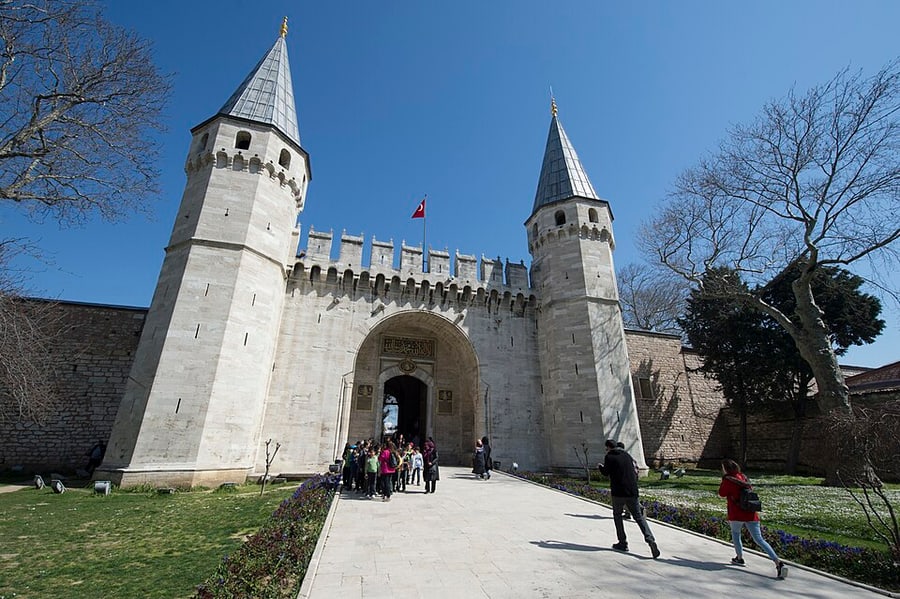
The palace was built on an area of 700 dönüms at the tip of the historic peninsula, a point overlooking the Sea of Marmara, Üsküdar and the Golden Horn and commanding the city from every side. Construction, which began after the conquest with gardens and pavilions at Sarayburnu, then called Zeytinlik (the Olive Grove), continued with the walls called Sur-ı Sultani. The sources differ on the dates of its beginning and completion; going by the date 883 (1478) on the Bab-ı Hümayun (Imperial Gate), it can be accepted that construction began earlier, probably in 1465. To distinguish it from the old palace at Beyazıt, it was long called Saray-ı Cedid-i Amire (the New Imperial Palace); later it took the name Topkapı Palace from the cannon-gate pavilion (Topkapı) on the seashore. New additions were made in every period until the mid-19th century. The palace walls, which abut the Byzantine walls, have three great gates, the main entrance Bab-ı Hümayun, the Iron Gate (Demir Kapısı) and the Hay Gate (Otluk Kapısı), and five service gates.
Three courtyards, three gates
The palace consists of the Birun (service and guard), the Divan-ı Hümayun (government), the Enderun (education) and the Harem (private life), and it took shape around three courtyards entered through the Bab-ı Hümayun, Babüsselam and Babüssaade gates. In the first courtyard, which the public and the soldiers could enter, were the bakeries, the hospital and Hagia Irene (Aya Irini), used as an arsenal. The second courtyard, called the Alay Meydanı (Parade Ground), was the administrative centre of the state: the Divan met in the Kubbealtı (Dome Chamber), and accession and festival ceremonies and the reception of ambassadors took place here. The Tower of Justice, designed in the Conqueror's time, enabled the ruler to watch the Divan without being seen. The kitchens, rebuilt by Mimar Sinan after the fire of 1574, could prepare meals for 1500 to 3000 people a day.
Enderun and Harem
In the third courtyard, entered through the Babüssaade, are the Audience Chamber (Arz Odası), the Enderun Library and the Privy Chamber (Has Oda); after the holy relics were brought in the time of Selim I (Yavuz), the Privy Chamber came to be known mostly as the Chamber of the Holy Mantle (Hırka-i Saadet Dairesi). The development of the Harem rests largely on the long reign of Suleiman the Magnificent; additions that began towards the end of the 16th century continued until the mid-19th century, producing an unplanned, intertwined structure. The most prestigious apartment was always that of the Valide Sultan (the sultan's mother). After Mehmed III, when the practice of sending princes out to govern sanjaks was abandoned, the princes began to live in the apartment in the Harem called the Şimşirlik. According to records from the Conqueror's time, the palace household numbered about 726 people; together with the Harem and those in the ruler's close service, it can be said to have exceeded 1500.
Pavilions and tiles
The Tiled Pavilion (Çinili Köşk), one of the first buildings of the palace, was completed in 1472 according to its inscription and was turned into a museum around 1875. The most important buildings of the fourth section are the Revan (Yerevan) and Baghdad pavilions built by Murad IV; the last pavilion built in the palace is the Mecidiye Pavilion of Abdulmejid. Some pavilions, such as the Gülhane Kasrı and the Şevkiye Kasrı, have not survived. The tiles of the Circumcision Room, the Audience Chamber, the Chamber of the Holy Mantle and the Harem turn the palace into a veritable museum of tiles. The Ağalar Mosque, used by the aghas of the Enderun, now serves as the manuscript library of the Topkapı Palace Museum.
Source: TDV Encyclopedia of Islam (TDV İslâm Ansiklopedisi), “TOPKAPI SARAYI” (Zeynep Tarım Ertuğ)
Related sultans
Cite as: Atlas of the Sultans, “Topkapı Palace · Ottoman monuments”, https://padisahlaratlasi.com/en/monuments/topkapi-palace/ (last updated 21 November 2026). Corrections · Image credits