TRENDEFRARAtlas of the Sultans · Grand viziers
Piri Mehmed Pasha
Grand vizier, 1518–1523
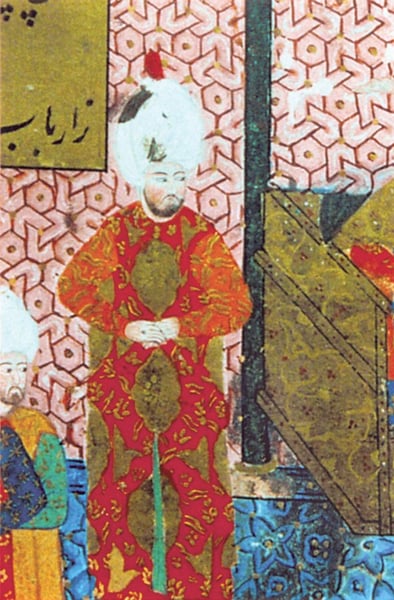 AI

Son of a scholarly family
He was probably born in Konya in 1463. He descended from the Seljuk scholar Cemaleddin Aksarayi; his father, Şeyh Cemal-i Halveti, was the founder of the Cemaliyye branch of the Halvetiyye order. He began his medrese studies in Amasya and completed them in Istanbul, and for a time worked as a clerk at the Amasya court. When Bayezid II, who knew him through his father, came to the throne, he served as kadi of Sofia, Serres (Siroz) and Galata; in the last years of the reign he moved to the post of treasury defterdar.
After the accession of Selim I he became chief defterdar (başdefterdar). He took part in the Chaldiran campaign as defterdar of Rumelia; in the council held before the battle his argument for joining battle at once was accepted and won him the sultan's appreciation. In Tabriz he was put in charge of inspecting Shah Ismail's treasury.
From vizier to grand vizier
He became a vizier on 15 October 1514. During the Janissary revolt in Amasya his house was plundered and he was dismissed on grounds of negligence, but the vizierate was soon restored to him. After bad news arrived from Diyarbekir he was dismissed together with the grand vizier and locked up in Yedikule, but he was released the same evening. During the Egyptian campaign, as guardian of Istanbul, he solved the army's pay problem and, with eighty-two ships he had prepared, sent provisions and cannon to Egypt.
After Selim I had Grand Vizier Yunus Pasha executed, he was appointed grand vizier on 25 January 1518. Left behind in the Diyarbekir region, he tried to break Iranian influence in south-eastern Anatolia, took some places in northern Iraq and had a survey (tahrir) made of the conquered areas.
Suleiman the Magnificent's first grand vizier
He kept his post until Selim I's death and also served Suleiman I as grand vizier for nearly three years. Saying that Belgrade was the lock of Europe, he insisted on its conquest and distinguished himself in the siege of 1521. The following year he also advocated the taking of Rhodes and took part in the siege; but he was put in a difficult position by the pressure that the second vizier, Ahmed Pasha, exerted on the sultan.
On the return from the campaign he was investigated on the allegation that he had taken bribes when Mamluk notables exiled from Egypt were released, and he was found guilty. According to the article, it is claimed that Ahmed Pasha had a hand in this; the situation gave an opportunity to Suleiman I, who wanted to put his close companion Ibrahim Pasha in his place. He was dismissed on 27 June 1523.
Last years in Silivri
He withdrew to his farm in Silivri and died there in the autumn of 1532; his grave is in the burial ground of the mosque he built in Silivri. It is rumoured that Ibrahim Pasha had a role in his death and had his son poison his father. The sources present him as an experienced and capable statesman; although he came from the scholarly class, he showed military ability and contributed to the building of a large shipyard in Istanbul. He had a close interest in Sufism, gave opportunities to Sufis who opposed the Safavid order, and showed closeness to the Mevlevis and Halvetis. He patronized men of the pen such as Cafer Çelebi and Celalzade Mustafa Çelebi; it is stated that he himself wrote poems under the pen name “Remzi” and collected them in a small divan, but this work has not survived. He built külliyes (mosque complexes) in Zeyrek, Çapa and Silivri, and a mosque and imaret in Konya.
Source: TDV Encyclopedia of Islam, “PÎRÎ MEHMED PAŞA” (Yusuf Küçükdağ)
Related sultans
Cite as: Atlas of the Sultans, “Piri Mehmed Pasha · Grand viziers”, https://padisahlaratlasi.com/en/grand-viziers/piri-mehmed-pasha/ (last updated 21 November 2026). Corrections · Image credits