TRENDEFRARAtlas of the Sultans · Ottoman capitals
Istanbul
Capital · 1453–1922
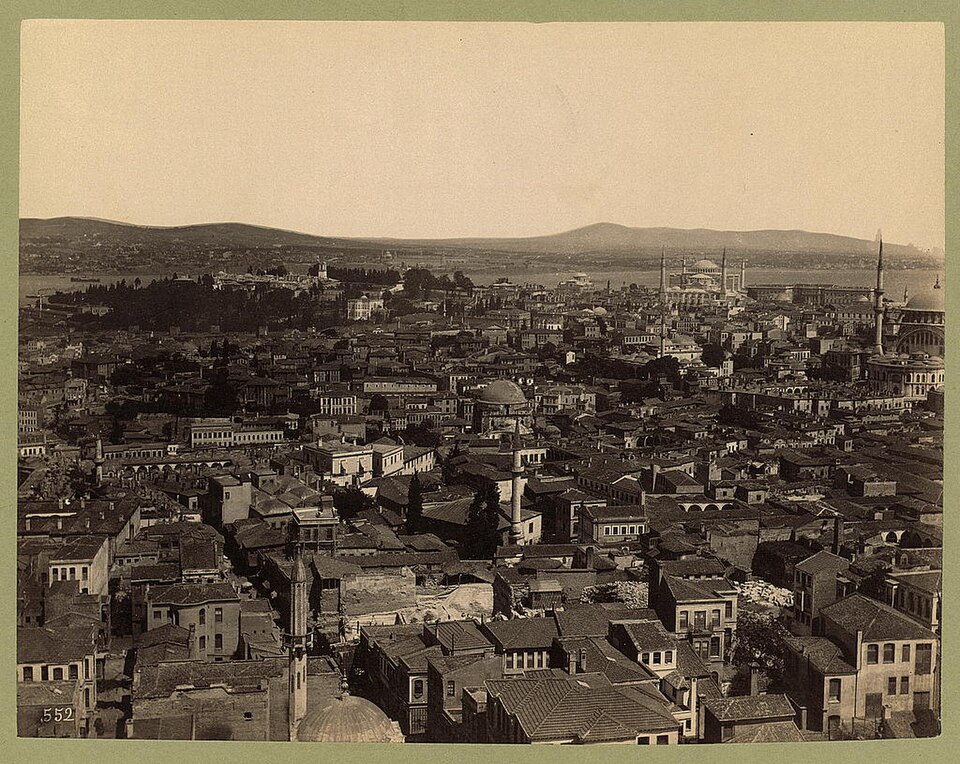

The Byzantine capital and the Ottomans
Historically, Istanbul denotes the peninsula enclosed by the Golden Horn, the Sea of Marmara and the land walls; the Ottomans called this area “nefs-i Istanbul” (Istanbul proper) and organized Galata, Eyüp and Üsküdar as judicial districts attached to it (bilad-ı selase, “the three towns”). When the centre of the Roman Empire moved here in 330, the city became, as Constantinopolis, the capital of the Eastern Roman Empire for thirteen centuries. The Ottomans often used the name Kostantiniyye on coins and in official correspondence, while the popular name Istanbul spread and became the official one. As the seat of power the city was given titles such as payitaht-ı saltanat (“seat of the sultanate”), darüssaltana and darülhilafe (“abode of the caliphate”), as well as the names Dersaadet (“Gate of Felicity”) and Asitane (“the Threshold”).
According to the section written by Feridun Emecen, Ottoman interest in Istanbul began in the earliest years of the state, but the appearance of Ottoman soldiers before the city under Orhan and Murad I was linked to alliances rather than a real siege. The first serious siege was made by Bayezid I in 1396; a renewed siege that began in the spring of 1400 ended when Timur entered Anatolia. Murad II besieged the city closely in 1422 but lifted the siege when his brother Mustafa rebelled. For Mehmed II, on his second accession, the sole objective was the Byzantine capital: taking a city whose position always hampered communication between the Ottoman lands in Rumelia and Anatolia had become a priority.
The conquest and “My throne is Istanbul”
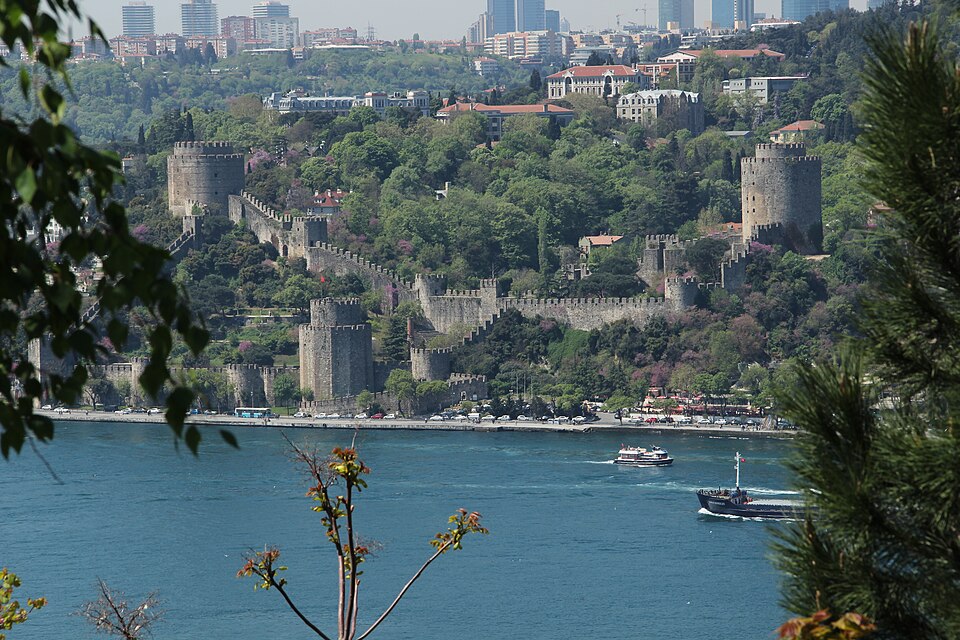
The preparations were long; in April 1452 work began on a new fortress on the European shore at the narrowest point of the Bosphorus. On 29 May 1453 the Ottoman soldiers entered the city “through the breach the cannon had opened.” As Halil Inalcık relates, Mehmed the Conqueror, who planned to make the city the capital of his state and therefore wished to prevent further damage, declared the state of war at an end on 30 May. Entering the city in ceremony that day, the sultan toured the harbour, went to Hagia Sophia, proclaimed the church the city's “great mosque” (cami-i kebir), and with the words “my throne is Istanbul” made Istanbul the centre of the state; he also performed the first Friday prayer in Hagia Sophia.
In the same passage Inalcık summarizes the sequence of Ottoman capitals: after a palace was built in Edirne in 1365–1368 by order of Murad I, Edirne became the state's centre in Rumelia and its second capital; Bursa kept its status as the principal capital and seat of the sultanate until 1402; and in 1402, when Süleyman Çelebi took refuge in Edirne with the state archives and treasury, Edirne became the capital. Once Istanbul became the first capital, Edirne in Rumelia and Bursa in Anatolia were regarded as the state's second and third capitals.

Repopulating the city
Three days after the conquest Mehmed proclaimed an amnesty (aman) allowing those who had fled to return; they were told they could live in their own houses and practise their religion freely, the patriarchate was formally restored, and Georgios Scholarios was recognized as patriarch on 6 January 1454. Before returning to Edirne, the sultan appointed Karışdıran Süleyman Bey as the city's military governor (subaşı) with 1,500 Janissaries and Hızır Bey as judge (kadı), and ordered the repair of the walls, the construction of Yedikule and of a palace for himself at Beyazıt (later the Old Palace). He settled his own share of the captives along the Golden Horn and issued decrees ordering Muslim, Christian and Jewish families from Rumelia and Anatolia to be sent to the city by forced resettlement (sürgün). An incomplete survey of December 1455 records 918 houses in twenty-two quarters, 291 of them noted as “empty” or “ruined”.
These efforts bore fruit. According to Inalcık's table, the population of 16,326 households including Galata (1477) had grown roughly fivefold by 1535, to about 80,000 households. Fernand Braudel estimates the 16th-century population at around 700,000, and Robert Mantran that of the 17th century at 650,000–750,000, or 800,000 with the suburbs; but the article notes that all these figures for the walled city seem exaggerated and that in the Byzantine period the combined population of Istanbul and Galata never exceeded 400,000.
Palace, council and endowments
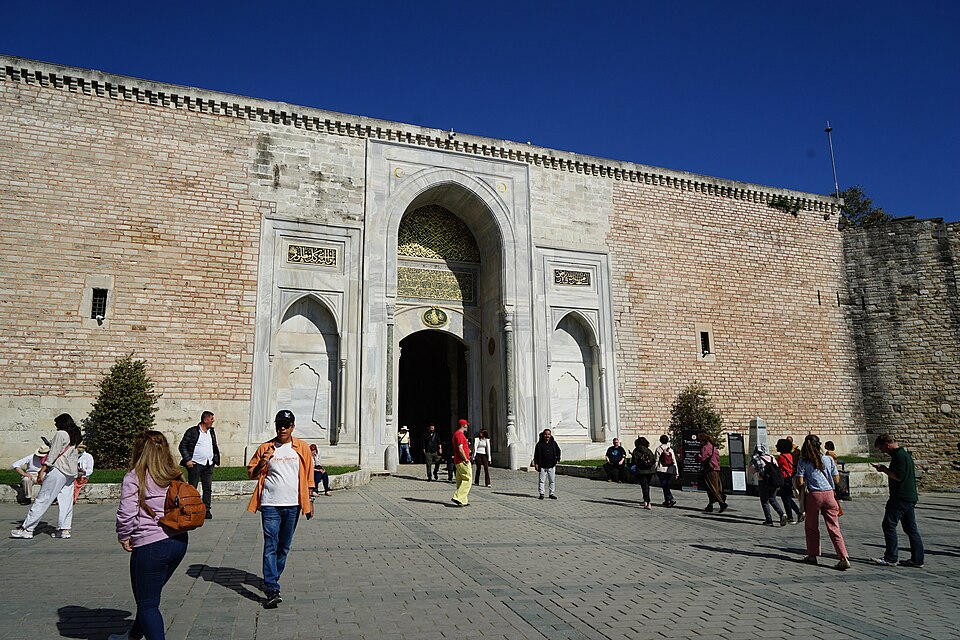
The new palace was built on a 700-dönüm site at the tip of the historic peninsula, overlooking the Marmara, Üsküdar and the Golden Horn. Since the date on the Imperial Gate (Bab-ı Hümayun) is 1478, construction is thought to have begun earlier, probably in 1465. Long called the New Imperial Palace (Saray-ı Cedid-i Amire) to distinguish it from the old palace at Beyazıt, it later became known as Topkapı Palace. Organizationally it consisted of the Outer Service (Birun), the Imperial Council (Divan-ı Hümayun) as the administrative centre, the Inner Service (Enderun) as the training area, and the Harem as the private quarters; on council days the statesmen were ceremonially received before the Gate of Salutation (Babüsselam), where the retinues of foreign envoys also waited.
The city's Ottoman-Islamic infrastructure was largely created through pious endowments. The Grand Bazaar and its bedesten, inns, weighing stations and some 2,000 shops were endowed to Hagia Sophia; the city's first administrative unit was the district of Hagia Sophia, and the other districts grew around the complexes of sultans and viziers. The Fatih Mosque and complex was completed in 1471; Eyüp, which grew around the tomb of Abu Ayyub al-Ansari, became the city's holy quarter. Under Suleiman the Magnificent a complex was founded at Avratpazarı in the name of Hürrem Sultan (1539), and the Süleymaniye Mosque and Complex, built in 1550–1557, comprises more than eighteen buildings.

Five centuries as the centre
According to Emecen, after the conquest Istanbul gradually took on the character of a Turkish-Islamic city and became a great metropolis dominated by the cosmopolitan life of an imperial centre; from the 16th century onward, urban life in the provinces constantly felt the spiritual and cultural weight of the capital. In the works of court historians the empire and its capital almost merge: accessions, departures on campaign, receptions of envoys and festivities are all narrated from Istanbul. Holding a special administrative status as the capital, the city faced no serious external danger, apart from one or two incidents, until the empire's dissolution; its most turbulent times, from the first half of the 17th century onward, came from internal events such as the killing of Osman II, the guild uprising of 1651, the Plane Tree Incident (Çınar Vakası) of 1656, the Edirne Incident of 1703 and the Patrona Halil revolt.
In the 19th century the capital faced direct external threats for the first time: in 1807 a British fleet appeared before the city, and the Kabakçı Mustafa revolt broke out the same year. Mahmud II's abolition of the Janissary corps in 1826 turned the city into a battlefield. The proclamation and implementation of the Tanzimat reforms began in Istanbul, and alongside immense palaces, buildings were put up for the bureaucracy and new schools. The establishment of the Russian headquarters at Yeşilköy in 1878 and the Bulgarian advance to Çatalca in the Balkan War were, in the article's words, the first two serious threats in the city's history.
The end of the capital
After the First World War, on 13 November 1918, the Allied fleet arrived before Istanbul and landed troops; for the first time since 1453 the city was occupied by foreign powers. When the Ankara government won the National Struggle, it was decided that the occupying forces would evacuate the city. With the departure of the last Ottoman sultan, Mehmed VI, from Istanbul on 17 November 1922, Ottoman rule effectively came to an end; the article writes that this “also determined the fate of the capital.”
The occupying forces left the city on 2 October 1923, and the Turkish army entered Istanbul on 6 October. With the abolition of the caliphate on 3 March 1924, Istanbul lost first its status as capital and then as the seat of the caliphate, yet it remained a great metropolis at the meeting point of Eastern and Western civilizations, with its economy, cultural institutions and large population.
Related sultans
Cite as: Atlas of the Sultans, “Istanbul · Ottoman capitals”, https://padisahlaratlasi.com/en/ottoman-capitals/istanbul/ (last updated 21 November 2026). Corrections · Image credits