TRENDEFRARAtlas of the Sultans · Ottoman monuments
Küçükçekmece Bridge
Monument · Bridge, Istanbul, 16th century
- Type
- Bridge
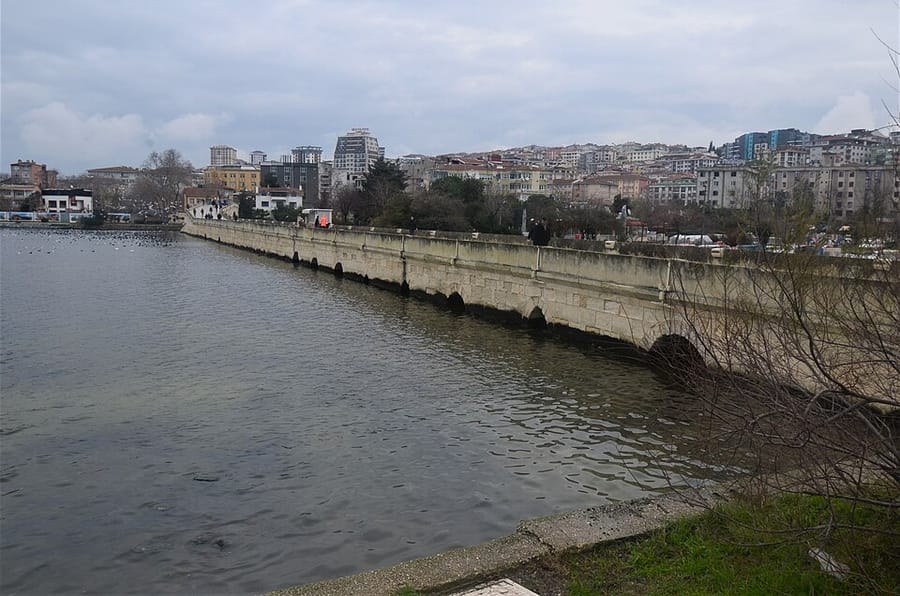

A bridge on the road to Rumelia
The bridge lies on the main road linking Istanbul with Rumelia, where Lake Küçükçekmece meets the Sea of Marmara. There was probably a wooden bridge at this crossing in Roman times, and the Byzantine emperor Justinian set the bridge on a stone arch. As it had not survived intact into the years of the conquest, Mehmed the Conqueror (Fatih Sultan Mehmed) had it repaired in the winter of 1455 because of its strategic importance. Evliya Çelebi writes that construction of the bridge was begun under Suleiman the Magnificent (Kanuni Sultan Suleiman) and completed under Selim II. Since it does not appear in the lists of Mimar Sinan's works, it has also been suggested that it may be the work of Acem Ali, chief architect before him.
According to archival documents, the bridge was also repaired in 1498–99, 1735–36 and 1861–62. In Ottoman times it became a post of the bostancı guards, who checked travel to and from Rumelia; Western sources, comparing it with the Büyükçekmece Bridge, called it Ponte Piccolo (the Small Bridge). The bridge is 210 metres long and 7.60 metres wide, and its widest arch, in the centre, spans 10 metres. Widened and levelled during the First World War, it has today largely lost its original architectural features.
The bridge in the Byzantine period
In the Byzantine period the famous Via Egnatia, which linked the capital to the west, passed over this bridge. At the same place, on a hill overlooking the lake, lay the settlement of Regium (Region), with a large imperial summer palace and its dependent buildings. The contemporary historian Procopius relates that this narrow strip of land, called Myrmex, meaning 'ant', was formerly crossed by a wooden bridge; when the timber rotted the crossing became dangerous, and Emperor Justinian removed the danger by setting the bridge on a broad stone arch. In 813 the army of the Bulgar ruler Krum damaged the bridge, and Emperor Basil I (867-886) had it repaired. It was also damaged during the Crusades.
Through travellers' eyes
Bertrandon de la Broquière, who passed here in 1433, mentions the bridge and two ruined towers at its ends. J. Covel, who saw it in 1675, writes that the stone structure, 312 paces (about 230 metres) long, had thin wooden railings along its sides. The earliest known pictorial representation of the bridge appears in the book Turquie by M. J. M. Jouannin and Jules van Gaver, published in Paris in 1840.
Source: TDV Encyclopedia of Islam (TDV İslâm Ansiklopedisi), “KÜÇÜKÇEKMECE KÖPRÜSÜ” (Enis Karakaya)
Related sultans
Cite as: Atlas of the Sultans, “Küçükçekmece Bridge · Ottoman monuments”, https://padisahlaratlasi.com/en/monuments/kucukcekmece-bridge/ (last updated 21 November 2026). Corrections · Image credits