TRENDEFRARAtlas of the Sultans · Ottoman monuments
Kurşunlu Complex (Eskişehir)
Monument · Complex, Eskişehir, 1515–1526
- Type
- Complex (külliye)
- Built
- 1515–1526

A complex on the post road
Located in the Odunpazarı quarter of Eskişehir, this complex (külliye) was founded by Çoban Mustafa Pasha and is one of the staging-post complexes on the route from Üsküdar to Payas. The inscription above the mosque door yields the date 1515 by the abjad system, yet it mentions Suleiman the Magnificent and the pasha's rank as vizier, while the endowment deed is dated 1526; the complex is therefore held to have been built between 1515 and 1526. Its architect is not known for certain; it has been suggested that it was Acem Ali. The Tuhfetü'l-mimarin, which lists the works of Mimar Sinan, names only the caravanserai, and Sinan may have merely repaired that building.
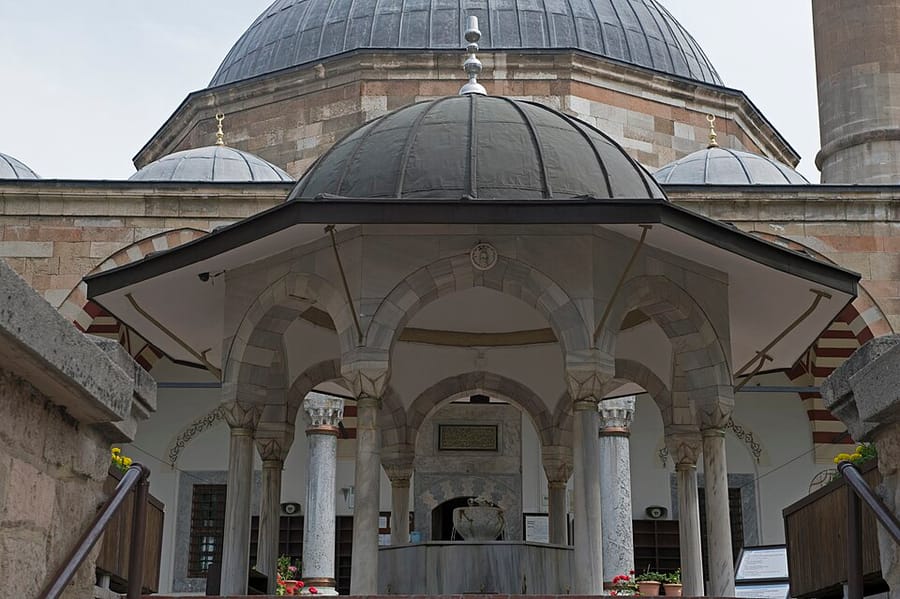
The square, single-domed mosque of cut stone has a five-bay portico in front; because all its domes are covered with lead, it became known as the Kurşunlu (Leaden) Mosque. Around it on the east, south and west, in a U-shaped arrangement, stand a zaviye (dervish hospice), a guesthouse, a refectory, a kitchen, a caravanserai and a primary school. The complex underwent a repair completed in 1832 and has been restored by the General Directorate of Foundations since 1955. The guesthouse now houses the Directorate's Eskişehir liaison office and the refectory a municipal wedding hall; the zaviye, kitchen, caravanserai and school are unused.
Units listed in the endowment deed
According to Çoban Mustafa Pasha's endowment deed, the complex comprised a mosque, a zawiya with twenty cells, a primary school, a guesthouse (tabhane), a kitchen, a woodshed, a bakery, a refectory, an almshouse, a fountain and a stable (the caravanserai). Linked to one another by walls, the buildings form an outer courtyard that opens to the surroundings through a gate on each side; because of the slope the buildings stand at different levels. The relation of the fountain to the right of the north entrance to the one in the deed cannot be established; the ablution fountain north of the mosque, with eight marble columns, was built in the 1960s.
Details of the mosque
The portico is covered by domes on pointed arches carried by six marble columns with muqarnas capitals, the arches built of alternating white and red voussoirs. The 14.90 × 14.90 m prayer hall is dim despite its many windows; the dome on an octagonal drum is reached by squinches. The painted decoration inside has been renewed in recent times. The minbar is of marble; the polygonal mihrab with a muqarnas hood is painted in oil to imitate marble, and a Mevlevi headdress appears above each of its spandrels. The single-balcony minaret stands at the north-west corner.
Zawiya, caravanserai and school
The L-shaped zawiya, popularly also called a madrasa, has cells of 2.15 × 2.60 m opening onto a portico, each with a hearth, a cupboard and a small window. The guesthouse contains four domed rooms with hearths. The 9.30 × 19.30 m refectory was used for a time as a museum; a chimney rises over the cooking area of the kitchen, which is covered by a dome on an octagonal drum.
In the caravanserai, with inner dimensions of 18.20 × 37.70 m, sixteen hearths set at the level of a raised platform running from both sides of the entrance heated the space, which was lit by twelve slit windows; six square piers in the middle are tied to the walls by arches. The portico of the primary school east of the mosque reuses columns with Byzantine capitals, and marble pieces with Byzantine ornament serve as window lintels in its east wall.
Source: TDV Encyclopedia of Islam (TDV İslâm Ansiklopedisi), “KURŞUNLU KÜLLİYESİ” (Kasım Ince)
Related sultans
Cite as: Atlas of the Sultans, “Kurşunlu Complex (Eskişehir) · Ottoman monuments”, https://padisahlaratlasi.com/en/monuments/kursunlu-complex-eskisehir/ (last updated 21 November 2026). Corrections · Image credits