TRENDEFRARAtlas of the Sultans · 11 / 39 · sultan
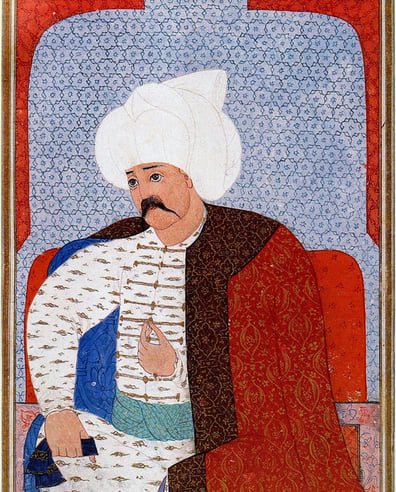
Imaginary portrait (made later) — Nakkaş Osman · 1579
Selim I
Yavuz (“the Grim”)
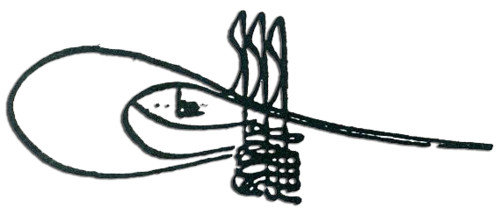
In eight years he turned the state towards the East. With the protectorate of Mecca and Medina the Ottomans became the centre of the Sunni Islamic world and changed from a Turkish-Balkan state into a universal Islamic empire.
Open the reign of Selim I on the map▶ Watch the 1-minute video: YouTube · Instagram · TikTok
Interesting fact
He knew Persian very well; his divan of Persian poems was printed in Istanbul (1889) and Berlin (1904). Official documents style him “Hadimü’l-Haremeyn”, Servant of the Two Holy Cities (Mecca and Medina).
Source: TDV İslâm Ansiklopedisi (Turkish), article “SELİM I”
Life
As a prince: from Amasya to Trabzon
Selim was most probably born in 1470 in Amasya, where his father Bayezid II was serving as sanjak governor. His mother was Ayşe Hatun, daughter of Alaüddevle Bozkurt Bey of the Dulkadıroğulları. He received a good education from an early age; at about ten he was summoned to Istanbul by his grandfather, the Conqueror (Mehmed II), together with his brothers Ahmed, Korkud, Mahmud and Âlemşah and with Oğuz Han, the son of his uncle Cem.
His first known post was the sanjak of Trabzon (1487). He stayed in Trabzon, where he had come with his mother, until 1510, some twenty-three years, and carried out building works in the city. In these years he was the prince who watched most closely, and resisted most strongly, the influence in Anatolia of the Safavid Shah Ismail, then rising in the east. Ottoman documents call him “Selim Shah”; because of his harsh temper, his courage and his boldness he was already known in his own lifetime by the epithet “Yavuz” (the Grim).
The road to the throne
Bayezid II's wish to make Selim's elder brother Ahmed his successor, and the fact that most of the viziers in the imperial council (Divan) favoured Ahmed, spurred Selim into action. In 1509 he had his son Suleiman obtain the sanjak of Kefe; then he went to Kefe without permission and crossed from there into Rumelia. He entered Edirne and followed his father to Çorlu; at Uğraşdere, Bayezid II's forces forced him to retreat with a sudden attack.
But the Janissaries were on Selim's side. Bayezid was finally compelled to give up the throne in his son's favour, and on 24 April 1512 Selim ascended the throne as the ninth Ottoman ruler. His first concern was to eliminate the brothers who could lay claim to the throne: on 15 April 1513 he defeated his elder brother Ahmed on the plain of Yenişehir; Ahmed tried to flee but was captured and killed.
Chaldiran
Selim's real target was Shah Ismail. In 1514 he set out on campaign against Iran. After the Safavid frontier was crossed, advancing through the thoroughly devastated lands that Shah Ismail had emptied put a heavy strain on the army; at one point the Janissaries pressed to turn back. At last the two armies met on the plain of Chaldiran (Çaldıran). Selim took his place at the centre of the army, protected by gun carriages, Janissaries and azaps, together with the grand vizier Hersekzade Ahmed Pasha.
In the battle fought on Wednesday, 23 August 1514, while the Ottoman wings were wavering, the forces Selim personally threw into the fight and the firearms decided the outcome; Shah Ismail was defeated and withdrew. On 6 September Selim entered the Safavid capital, Tabriz, and had the Friday sermon (hutbe) read in his name; from there he sent close to a thousand scholars and craftsmen to Istanbul. The following year he took Kemah, and he did away with Alaüddevle Bey of the Dulkadıroğulları, whom he believed to be collaborating with the Safavids, even though Alaüddevle was his own maternal grandfather; he gave the principality to Şehsuvaroğlu Ali Bey. Meanwhile the struggle with the Safavids was continuing in the Diyarbekir region: Selim sent the historian Idris-i Bitlisi to the area, and he won the Sunni tribes and the local Kurdish lords over to the Ottoman side; Bıyıklı Mehmed Bey took Amid (Diyarbakır), and Eastern Anatolia came under Ottoman rule.
Marj Dabiq, Ridaniya and Egypt
On 5 June 1516 Selim set out from Istanbul on campaign once more. At first the target seemed to be the Safavids; but when the Mamluk sultan Kansu Gavri (Qansuh al-Ghawri) brought his army into Syria and refused the Ottoman troops passage, the war was fought against the Mamluks instead. On 24 August 1516, on the plain of Marj Dabiq (Mercidabık) north of Aleppo, the Mamluk army broke apart, with firearms also playing their part; Kansu Gavri died in the battle. The Abbasid caliph Mütevekkil-Alellah (al-Mutawakkil), who was with the Mamluk sultan, also fell into Ottoman hands; Selim showed him great respect.
When the Mamluks chose Tomanbay (Tuman Bay) as sultan and regrouped, Selim crossed the desert and marched on Egypt. On 22 January 1517, in a hard-fought battle at Ridaniya at the gates of Cairo, the sultan himself came through danger and the grand vizier Hadım Sinan Pasha was killed; but the Mamluk army broke apart and the road to Cairo lay open. In Egypt Selim had a pavilion built on Ravza (Rawda) island in the middle of the Nile and stayed there; on 6 July 1517 he received Ebu Nümeyy, son of the sharif of Mecca, and formally took on the role of protector of the Haremeyn (Mecca and Medina).
The TDV article states that the reports that Selim personally took over the caliphate and bequeathed it to his descendants are of doubtful accuracy; but through the protection of the Haremeyn the Ottomans won renown in the Islamic world as the bearers of an important religious duty.
Last years and death
On his way back from Egypt he sent the Abbasid caliph Mütevekkil-Alellah, the ulema, craftsmen and the sacred relics to Istanbul with the fleet. Selim put Syria in order and returned to Istanbul in 1518. He enlarged the Istanbul dockyard and had the fleet reorganized; he is recorded to have built the Yalı Köşkü on the shore between Sirkeci and Sarayburnu. In his last months he had a fleet prepared for a new campaign; its target was very probably Rhodes or Iran. In the summer of 1520, on his way to Edirne, a large growth that appeared on his back (probably a plague bubo) kept him from going any farther than Çorlu. Despite all his physicians' efforts, after two months of hopeless treatment he died on the night of 21–22 September 1520, with his close confidant Hasan Can at his side.
His body was brought to Istanbul and buried at the place now called Sultanselim; his son Suleiman the Magnificent built his tomb and mosque there. Selim knew Persian very well and also had a good command of Arabic; he left a divan of poems in Persian. He loved reading history; in Egypt he had Kemalpaşazade translate the history of Ibn Tağriberdi (Ibn Taghribirdi).
In a reign of just over eight years, Selim added Eastern Anatolia, Syria, Egypt and the Hijaz to the Ottoman realm. By the atlas's reckoning, this is one of the largest territorial gains made under a single sultan. In the atlas, the land area gained under Selim is about 1.8 million km²; this is the largest increase after Suleiman the Magnificent's.
Source: TDV Encyclopedia of Islam (TDV İslâm Ansiklopedisi), “Selim I” (Feridun M. Emecen); the main sources of this article are Idris-i Bitlisi, Kemalpaşazade, Hoca Sadeddin, Lutfi Pasha and Haydar Çelebi's campaign diary (ruzname).
Meanwhile in the world
Contemporary rulers
- Charles VKing of Spain, Holy Roman Emperor · 1516–1556The Habsburg who ruled the widest lands
- Francis IKing of France · 1515–1547Won the victory of Marignano at the start of his reign
- Henry VIIIKing of England · 1509–1547Tudor king known for his break with the Roman Church
- Leo XPope · 1513–1521A Medici, son of Lorenzo the Magnificent
- Shah Ismail ISafavid Ruler (Iran) · 1501–1524Founder of the Safavid dynasty
- Vasily IIIGrand Prince of Moscow · 1505–1533Annexed Pskov and Smolensk to Moscow
- Zhengde EmperorMing Emperor (China) · 1505–1521Eleventh emperor of the Ming dynasty
What was happening in the world?
- 1513Vasco Núñez de Balboa crossed the Isthmus of Panama and became the first European to see the Pacific.
- 1516Thomas More's Utopia, describing an ideal society, was published in Louvain.
- 1517Martin Luther made public his Ninety-five Theses against indulgences in Wittenberg, starting the Reformation.
- 1519Magellan sailed from Spain with five ships; the expedition achieved the first circumnavigation of the globe.
- 1519Hernán Cortés sailed from Cuba with about 600 men, beginning his expedition against the Aztec realm in Mexico.
Sources: newadvent.org [1] [2] [3] [4] [5] [6] [7] [8] · iranicaonline.org [1] · kotobank.jp [1] · exploration.marinersmuseum.org [1] [2]
Family
| Father | Bayezid II |
|---|---|
| Mother | Gülbahar Hatun |
| Consorts | Ayşe Hafsa Sultan |
| Children | Suleiman I (the Magnificent), Hatice Sultan, Beyhan Sultan, Şah Sultan, Fatma Sultan, Hafize Sultan |
Major achievements
- Victories at Chaldiran (1514), Marj Dabiq and Ridaniya (1516–17)
- Destruction of the Mamluk Sultanate; annexation of Syria, Palestine, Egypt and the Hejaz
- The title 'Servant of the Two Holy Sanctuaries'; the Abbasid caliph al-Mutawakkil III was brought to Istanbul — the story of a formal transfer of the caliphate became widespread only in later centuries
- The sacred relics brought to Istanbul
- Eastern Anatolia and the Kurdish principalities attached to the state
- The empire's territory doubled in eight years
- Shipyards and cannon foundries expanded
Treaties
- A new order established in Egypt after the Mamluks
- Takeover of the Cyprus tribute from Venice
Grand viziers
| Name | From | To | Length |
|---|---|---|---|
| Koca Mustafa Pasha (term 2) | January 6, 1512 | November 23, 1512 | 322 days |
| Hersekzade Ahmed Pasha (term 4) | November 1512 | October 28, 1514 | 1-2 years |
| Dukakinzade Ahmed Pasha | December 18, 1514 | March 4, 1515 | 76 days |
| Hadım Sinan Pasha | June 18, 1515 | September 8, 1515 | 82 days |
| Hersekzade Ahmed Pasha (term 5) | September 8, 1515 | April 26, 1516 | 231 days |
| Hadım Sinan Pasha (term 2) | April 26, 1516 | January 22, 1517 | 271 days |
| Yunus Pasha | February 3, 1517 | September 13, 1517 | 222 days |
| Piri Mehmed Pasha | January 25, 1518 | June 27, 1523 | 5 years, 153 days |
Battles and treaties
| Year | Event | Result / parties |
|---|---|---|
| Treaty: A new order established in Egypt after the Mamluks | ||
| Treaty: Takeover of the Cyprus tribute from Venice | ||
| 1514 | Battle: Chaldiran | Ottoman victory; Shah Ismail withdrew and Selim entered Tabriz |
| 1515 | Battle: Turnadağ | Ottoman victory; Alaüddevle killed and the Dulkadirid principality given to Şehsuvaroğlu Ali Bey |
| 1516 | Battle: Marj Dabiq | Ottoman victory; Qansuh al-Ghawri killed, Aleppo and Syria passed to the Ottomans |
| 1517 | Battle: Ridaniya | Ottoman victory; the road to Cairo lay open and the Mamluk Sultanate collapsed |
| 1519 | Revolt: Revolt of Şah Veli (Celal) | Harshly suppressed; afterwards revolts in Anatolia were popularly called “Celali” revolts |
Full infoboxes are in the site’s “Battles and Treaties” tab; source: TDV Encyclopedia of Islam.
Death
On the road to Edirne in 1520 a large tumour on his back (probably a plague bubo) kept him at Çorlu; he died there after two months of treatment. Popular tradition calls the illness şirpençe.
Territorial change
| Year | Region | Event | Source |
|---|---|---|---|
| 1514 | + Erzurum–Bayburt–Erzincan | Battle of Chaldiran (1514) and the capture of Erzincan–Bayburt | TDV İA, “SELİM I” |
| 1515 | + Diyarbakır–Van–Urfa | Conquest of Diyarbakır after Chaldiran (1515) and the adhesion of the Kurdish lords | TDV İA, “SELİM I” |
| 1515 | + Cilicia–Maraş (Ramadan–Dulkadir) | Battle of Turnadağ (1515) — annexation of the Dulkadir principality | TDV İA, “DULKADIROĞULLARI” |
| 1516 | + Syria–Lebanon (Aleppo–Damascus) | Battle of Marj Dabiq (1516) — conquest of Aleppo and Damascus | TDV İA, “SELİM I” |
| 1516 | + Antep–Kilis | Battle of Marj Dabiq (1516); Antep and Kilis under the province of Aleppo | TDV İA, “SELİM I” |
| 1516 | + Hatay (Sanjak of Alexandretta) | Battle of Marj Dabiq (1516); Antioch and Alexandretta | TDV İA, “SELİM I” |
| 1516 | + Palestine–Jordan (Jerusalem) | Jerusalem, Gaza and Palestine after Marj Dabiq | TDV İA, “SELİM I” |
| 1516 | + Malatya | Malatya taken from the Mamluks during the Egyptian campaign (1516) | TDV İA, “MALATYA” |
| 1517 | + Egypt | Battle of Ridaniya (1517) — the end of the Mamluk Sultanate | TDV İA, “SELİM I” |
| 1517 | + Hejaz (Mecca–Medina) | Protection of Mecca and Medina after Ridaniya (1517) | TDV İA, “SELİM I” |
| 1517 | + Mosul–Shahrizor | Bıyıklı Mehmed Pasha takes Mosul (April 1517) | TDV İA, “MUSUL”; Ágoston – Masters, Encyclopedia of the Ottoman Empire, p. 394 |
| 1519 | + Algiers | Hızır Reis (Hayreddin) submits to Selim and Algiers joins the Ottoman state (1519) | TDV İA, “CEZAYİR” |
The lands that changed hands in this period, and the battles or treaties that brought the changes, can be seen on the map: map of the reign of Selim I.
Cite as: Atlas of the Sultans, “Selim I (Yavuz (“the Grim”)): Reign Map, Wars and Conquests (1512–1520)”, https://padisahlaratlasi.com/en/sultans/i-selim/ (last updated 21 November 2026). Corrections · Image credits
Grand viziers of this reign: Hersekzade Ahmed Pasha · Piri Mehmed Pasha
Monuments of this reign: Bayezid II Complex (Istanbul) · Kurşunlu Complex (Eskişehir) · Yavuz Sultan Selim Mosque
Women of the dynasty in this reign: Hafsa Sultan
State organisation: The Treasury (Defterdarlık) and Ottoman Finance · The Office of Şeyhülislam · The Province and Sandjak System · The Kapıkulu corps · The waqf system in the Ottoman Empire
Myths and misconceptions: Was the caliphate handed over to Selim I in a ceremony in Egypt in 1517?