TRENDEFRARAtlas of the Sultans · Ottoman monuments
Gazi Kasım Pasha Mosque
Monument · Mosque, Pécs, 16th century
- Type
- Mosque
- Location
- Hungary
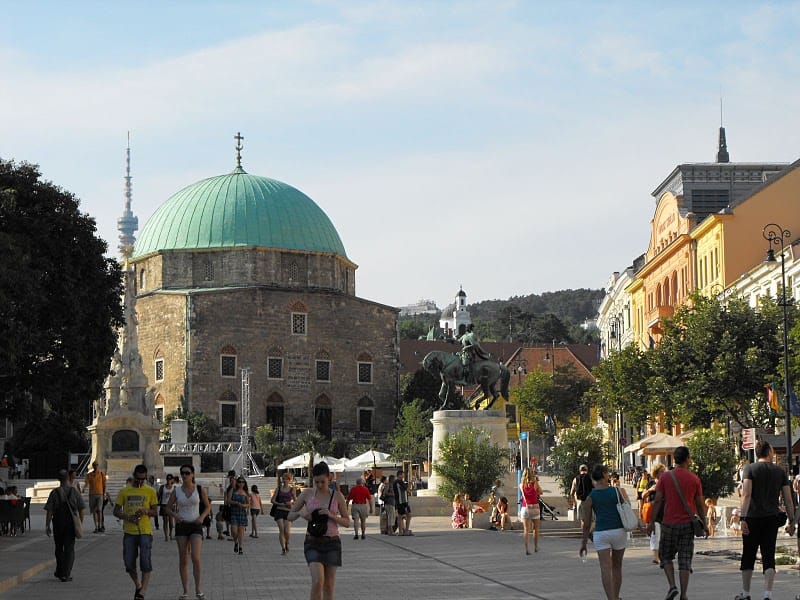

A mosque turned church in Pécs
Standing on the edge of the main square of Pécs, which also held the town's market, the mosque was built under Sultan Suleiman the Magnificent after the conquest of Hungary. It is not certain which of the Kasım Pashas of the time founded it; most probably it was the Kasım Pasha distinguished by the epithet 'Gazi', who served as district governor (mirliva) on the Mohács and Pécs frontiers and in 1552 became governor-general first of Buda and then of Temesvár. Evliya Çelebi praised its size and the beauty of its mihrab, minbar and other fittings. One of the largest Turkish buildings in Rumelia, its prayer hall is a square measuring 16.36 metres inside, covered by a dome about 16 metres across.
After Hungary was lost, its minaret was pulled down in 1776, and the building, its outer walls wrapped as if in a casing, was converted into a Baroque church. Still the largest church in the city, it underwent extensive work after 1938 to remove the additions concealing the original structure; only in 1966 did the dome regain the full appearance of an Ottoman dome. The restoration is not considered entirely successful, however; its most glaring error is the lower row of windows, made as small round (fil gözü) openings.
Founder and Evliya Çelebi's description
Gevay Antal records that Gazi Kasım Pasha was governor of Buda between 1548 and 1552; no trace remains today of the pasha's tomb, which should be in Timișoara. In recent years the foundations of a double bath were found by the street near the mosque. Evliya Çelebi gives the length of the mosque as 100 feet, which is probably an exaggeration. According to him the great dome rests on four arches, making the building similar to the Sultan Selim Mosque in Istanbul, and it had a very tall minaret and a portico with seven domes. These details, however, hardly fit the existing building. In Ekrem Hakkı Ayverdi's reconstruction the portico is drawn with six domes.
Traces in the building turned church
The walls of the building, each facade measuring 19.45 metres on the outside, are entirely of cut stone and have classical arched Turkish windows; but because the building served as a church, some of these windows were altered and others walled up. Little of the interior decoration survives; traces of inscriptions can be seen on the plaster in places. A few pieces of the kündekari (interlocking wooden) window shutters are kept in the Jászberény Museum. Two Turkish bath basins that appear to have served as baptismal fonts in the church were probably brought from the bath across the square. Together with the Yakovalı Hasan Pasha Mosque, the Ali Pasha Mosque and the Tomb of Idris Baba, the mosque makes Pécs a centre of Ottoman art deep within Europe.
Source: TDV Encyclopedia of Islam (TDV İslâm Ansiklopedisi), “KASIM PAŞA CAMİİ” (Semavi Eyice)
Related sultans
Cite as: Atlas of the Sultans, “Gazi Kasım Pasha Mosque · Ottoman monuments”, https://padisahlaratlasi.com/en/monuments/gazi-kasim-pasha-mosque/ (last updated 21 November 2026). Corrections · Image credits