TRENDEFRARAtlas of the Sultans · State organisation
The devshirme system
Institution · Source of Ottoman soldiers and administrators · 15th–18th centuries
 AI

Origins and establishment
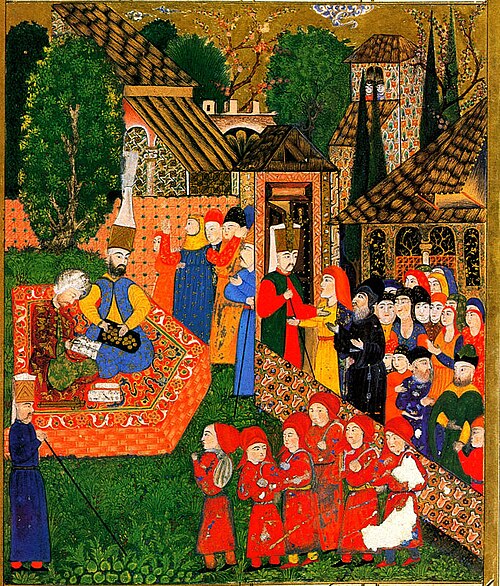
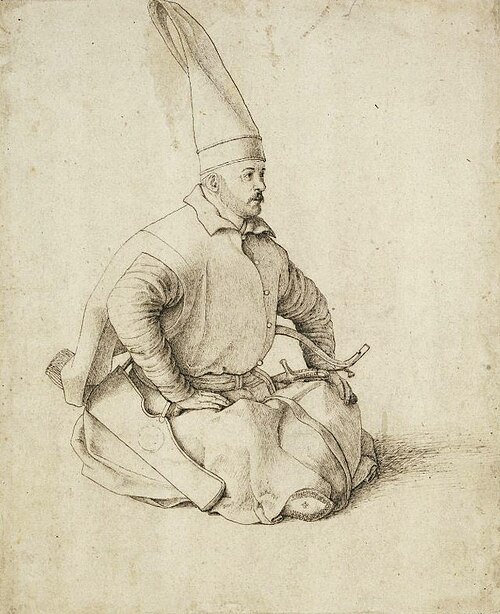
Devshirme (devşirme, “collection”) was the name given to the levy of boys from certain Christian families among the Ottoman subjects for service in various state posts, above all in the army and the palace. To supply soldiers for the Janissary Corps (Yeniçeri Ocağı), founded in the reign of Murad I, young prisoners of war had first been used under the pencik law. When conquests slowed, and halted for a time after the Battle of Ankara in 1402, a new source was needed. The devshirme, a practice not seen in earlier Islamic states, appears to have been applied under Mehmed I Çelebi (1413–1421) and made law under his son Murad II.
When the practice began is disputed. Some records link the devshirme to the reign of Bayezid I; Basilike Papoulia's study of the chronicles places the founding of the corps under Orhan, the pencik system under Murad I and the systematisation of the devshirme under Murad II. The TDV article on the Janissaries holds it more accurate to think that the devshirme and the corps took shape gradually, as overlapping processes, at the earliest in the late years of Orhan and at the latest under Murad I.
 AI

How the boys were chosen
The manpower needs of the palace troops (Kapıkulu corps) were determined by the agha of the Janissaries and submitted to the Imperial Council (Divan-ı Hümayun). On its decision, suitable youths aged eight to twenty were collected; a levy was held every three, five or seven years, as required. At first the governors-general, district governors and local judges (kadı) ran the levy. Because they abused their powers, under Mehmed II the Conqueror officials began to be sent from the capital. These were senior Janissary officers such as the turnacıbaşı, saksoncubaşı, zağarcıbaşı and haseki, accompanied by a scribe and carrying a sultan's decree of instructions and a letter from the agha of the Janissaries to the judges. Officials who took bribes to levy boys against the law were severely punished; two men who tried to hold a levy in Trabzon with a forged decree had their hands cut off.
The devshirme law set out in detail which boys could be taken. An only son was not taken, and of two sons only one was chosen. Orphans, the son of the village headman, shepherds' sons, town boys, and youths who were married or had learned a trade were exempt. Albanian, Bosnian, Greek, Bulgarian, Serbian and Croatian boys were preferred; Turkish, Kurdish, Persian, Russian, Jewish, Georgian and Roma boys were not taken, and very few Armenians were levied, only for the palace. The sons of the Bosnians who had converted to Islam en masse under Mehmed II were, at their fathers' request, taken only for the palace and the Bostancı corps. The levy was first applied in Rumelian districts such as Skopje, Bitola, Ioannina and Mostar, and from the late 15th century in Anatolia as well; certain groups with other obligations, such as pass guards and miners, were exempt.
The levy and “giving to the Turk”
On arrival the official had criers announce the levy, and the boys gathered in the district centre with their fathers and priests, bringing the baptismal registers. Taking one boy from every forty households was customary, though numbers were mostly set by need. The village, parents' names, date of birth and appearance of each boy, down to the colour of his eyes, were entered in two separate “description registers” (eşkal defteri). The cost of the red cloak and cap given to the boys was collected from the local people as “slave money” (kul akçesi); at first 90–100 akçe per boy, it later rose to 300 and even 600 akçe. The boys were sent to the capital in convoys of 100–200 called “herds” (sürü) under escorts, and an outsider who slipped into a convoy was called a saplama.
In Istanbul the boys were checked by the agha of the Janissaries at the Ağakapısı; they were circumcised, given Muslim Turkish names and freed from the poll tax (cizye). Those set aside for the palace were trained in the Edirne, Galata or Ibrahim Pasha palaces, and the most able were taken into Topkapı Palace. The rest were “given to the Turk” (Türk'e verme), placed for a time with Turkish peasants: boys from Rumelia were sent to Anatolia and boys from Anatolia to Rumelia. Working on the land, they learned Turkish and local customs, and in due course were enrolled in the Novice Corps (Acemi Ocağı) as “novice boys” (acemi oğlanı), receiving first one and then two akçe a day. The practice of giving them to Turkish families seems to have been abandoned in the 17th century.
Impact on the state's cadres
Applied successfully for about a century and a half, from the first half of the 15th century to the late sixteenth, the devshirme supplied the Ottoman state with both soldiers and administrators. Lorenzo Bernardo, Venetian envoy in Istanbul in 1584–1587, wrote that the government and command of the armies were entrusted not to nobles but to men of humble origin, from whom the sultan raised his best captains, district governors and governors-general. After Mehmed II's blow against the Turkish-born Çandarlı family, almost all grand viziers, with few exceptions, were appointed from among devshirme recruits. Mahmud, Gedik Ahmed, Makbul Ibrahim, Sokullu Mehmed, Ferhad, Lala Mehmed, Kara Murad and Kemankeş Mustafa pashas, as well as grand viziers of the Köprülü family, rose by this path.
Whether the devshirme conformed to Islamic law has been debated mainly by Western scholars. Some judged the forcible taking of dhimmi children unlawful, others saw it as a continuation of the ghulam system of earlier Islamic states, and Paul Wittek proposed an explanation based on the Shafi'i school. The article's author, Abdülkadir Özcan, notes that the recruits were children of free subjects, which makes it hard to equate the practice with slavery, and that it can be read as compulsory military service required of dhimmis; the fact that those in active service paid no poll tax supports this view. In his opinion the system arose first of all from the need for soldiers, and treating it as a tool for Turkifying or Islamising the settled population is inconsistent.
 AI

Decline and end
From the late 16th century, Janissaries' sons were admitted to the corps as “sons of servants” (kuloğlu), and outsiders were enrolled unlawfully as “servants' brothers” and “aghas' apprentices”; this loosened the devshirme, and bribery crept into it. Murad IV tried to reform the system, but from the mid-17th century levies became rare. A decree of 1666 envisaged an annual levy of 300–320 boys in the western and central Balkans. In the early 18th century about 1,000 boys seem to have been levied to replace palace gardeners (bostancı) involved in a revolt. Ahmed Cevad Pasha records that the last devshirme took place in 1751.
Levies for the palace lasted longer than those for the corps, while the Janissaries increasingly filled their ranks with their own sons and with outsiders. The Novice Corps, where devshirme boys were trained, survived until the abolition of the Janissary Corps in 1826; it was then used for a time to carry firewood to the palace and finally disappeared altogether. The devshirme is remembered as one of the main institutions that shaped the Ottoman military and administrative cadres throughout the classical period.
Source: TDV Encyclopedia of Islam, “DEVŞİRME” (Abdülkadir Özcan); “YENİÇERİ” (Kemal Beydilli)
Related sultans
Cite as: Atlas of the Sultans, “The devshirme system · State organisation”, https://padisahlaratlasi.com/en/ottoman-state-organisation/the-devshirme-system/ (last updated 21 November 2026). Corrections · Image credits