TRENDEFRARAtlas of the Sultans · 9 / 39 · sultan
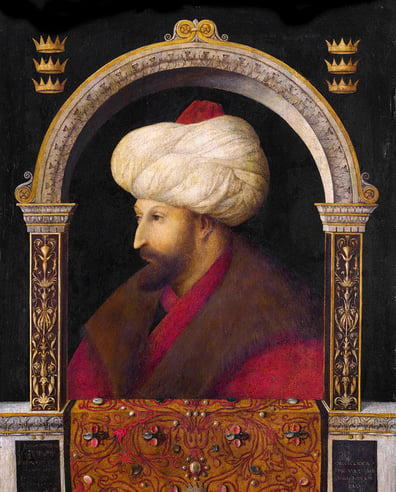
Portrait made in his lifetime — Gentile Bellini · 1480
Mehmed II
Fatih (“the Conqueror”)
The conquest of Constantinople (1453) ended the Eastern Roman Empire (Byzantium), turned the Ottoman state into an empire and moved the centre of the state permanently to Istanbul. By eliminating most of the independent states in the Balkans and Anatolia he consolidated the borders between the Danube and the Euphrates; his first reign was in 1444–1446.
Open the reign of Mehmed II on the map▶ Watch the 1-minute video: YouTube · Instagram · TikTok
Interesting fact
He knew Turkish, Greek and Slavonic. He asked Italy for a painter to make his portrait; the Venetian Gentile Bellini stayed in Istanbul in 1479–1481, painted his portrait and decorated the walls of the new palace with frescoes.
Source: TDV İslâm Ansiklopedisi (Turkish), article “MEHMED II”
Life
Childhood and first reign
Mehmed was born in Edirne (Adrianople) on 30 March 1432; he was the fourth son of Murad II. In the spring of 1443 he was sent to Manisa as governor together with his tutors (lalas) Kassabzade Mahmud and Nişancı Ibrahim Bey. At the end of the same year, with the death of his elder brother Alaeddin Ali Çelebi in Amasya, he became the sole heir to the throne.
When his father abdicated in August 1444, he became sultan at the age of twelve. But the Hungarians' breaking of the peace, the Varna campaign and rivalries within the state shook this first reign: the circle of Çandarlı Halil Pasha stood against statesmen of kul (slave-servant) origin such as Zağanos Pasha and Şehabeddin Pasha. In 1446 his father returned to the throne at Halil Pasha's summons, and Mehmed was sent back to Manisa. The five years he spent in Manisa matured him.
Second reign and the conquest of Constantinople
When his father died, Mehmed ascended the throne for the second time on 18 February 1451, at the age of nineteen. Immediately on his accession he had his infant brother Ahmed put to death; in placing in his law code (kanunname) the provision that deemed fratricide permissible “for the order of the world” (nizam-ı âlem için), his aim was to secure the indivisibility of sovereignty. The first great goal of his reign was Constantinople. Zağanos Pasha and Şehabeddin Pasha supported the conquest, while the cautious Çandarlı Halil Pasha warned of the danger of a Crusade; in the council of consultation (meşveret) convened in Edirne, the sultan's view prevailed.
In the spring of 1452 Mehmed had the fortress of Boğazkesen (Rumelihisarı) built on the European shore of the Bosphorus; completed at the end of August, it cut the city off from its sources of supply on the Black Sea. The siege, which began on 6 April 1453, lasted fifty-four days. On the morning of 29 May the Ottoman army entered the city through the breaches opened between Topkapı and Yalıkapı. After the conquest Mehmed appointed Georgios Scholarios, under the name Gennadios, as patriarch at the head of the Greek Orthodox community and had the city resettled. With the conquest of Constantinople the Ottoman principality became an empire; Mehmed came to be known as “Fatih” (the Conqueror).
Thirty years of campaigns
The Conqueror's reign passed with a campaign almost every year. In 1455 he took the silver mines of Novo Brdo in southern Serbia. In 1456, before Belgrade, which he was besieging, he threw himself into the fighting in person to prevent a rout, was wounded in the forehead and had to withdraw. In 1459 he brought Serbia under direct Ottoman rule, and that same summer the Genoese fortress of Amasra on the Black Sea surrendered without a fight. In 1460 he took the whole of the Morea except the Venetian fortresses, in 1461 Sinop and Trebizond, and in 1462 he marched against Wallachia; Vlad Drakul (Kazıklı Voyvoda, “the Impaler Voivode”), the prince of Wallachia, had attacked the Ottoman fortresses on the Danube while the Conqueror was away on the Trebizond campaign. In September 1462 he annexed the island of Lesbos (Midilli). In 1463 Bosnia was conquered. In the war with Venice that began the same year and lasted sixteen years, Negroponte (Eğriboz) was taken in 1470; in Albania the Conqueror, who campaigned twice against Skanderbeg (Iskender Bey), had the fortress of Elbasan built in the middle of the country. In 1478 he besieged Shkodër (Işkodra) in person; by the peace signed on 25 January 1479, Venice ceded Shkodër, Akçahisar (Kruja) and the islands of Lemnos and Negroponte to the Ottomans and agreed to pay 10,000 gold pieces a year in return for freedom of trade.
In the east his greatest rival was Uzun Hasan, ruler of the Aq Qoyunlu. Uzun Hasan demanded that Trebizond, Sinop and Karaman be left to him. In the battle fought at Otlukbeli in 1473 (11 August 1473), the Ottoman army had only eight days' provisions left; but before the kapıkulu troops had fully entered the fight, Uzun Hasan judged his position hopeless and fled. Karaman, too, passed completely under Ottoman rule in the early 1470s.
To make the Black Sea a “Turkish lake”, Caffa (Kefe) and the Genoese colonies in the Crimea were taken in 1475, and the Crimean Khanate was bound to the Ottomans. In 1480 Mesih Pasha besieged Rhodes but could not take it; in the same year Gedik Ahmed Pasha sailed from Vlorë (Avlonya) with 132 ships and 18,000 soldiers and on 11 August 1480 took Otranto in southern Italy. This expedition was seen as a first step towards Rome.
Statesman, patron of scholars, poet
The Conqueror made the grand viziers his absolute deputies; the weight of men of kul origin in government and the army became marked in his time. His teachers included Molla Gürani, Hocazade Muslihuddin and Molla Hayreddin; Akşemseddin had also influenced him. He knew Arabic and Persian well. After the conquest he converted eight churches in Istanbul into madrasas, opened the Hagia Sophia madrasa and in 1470 had the famous Semaniye (Sahn-ı Seman) madrasas built around the mosque that bears his name; he would inspect the madrasas in person and listen to the lessons. The two main themes of his domestic policy were the resettlement and revival of Istanbul and the strengthening of the army for campaigns. To this end people were brought to the city from Anatolia and the Balkans by forced resettlement (sürgün); in his last years thousands of villages and farmsteads held as endowments (vakıf) and private property (mülk) were taken over by the state and distributed as timars. The TDV article notes that this land reform aroused widespread discontent.
Scholars representing East and West came together in his presence. Patriarch Gennadios wrote for him his treatise setting out the Christian faith; the Greek scholar Amiroutzes of Trebizond was also at his court. The Conqueror had been asking for a painter from Italy since 1461; the Venetian Gentile Bellini stayed in Istanbul from 1479 to 1481 and painted his famous portrait. The Conqueror also wrote poetry under the pen name “Avni”. According to Halil Inalcık, the “Ottoman sultan” who united the Turkish, Iranian, Islamic and Roman traditions of kingship was born in his person.
Death
In the spring of 1481 the Conqueror crossed to Üsküdar for a new campaign, and he died on 3 May 1481 at Hünkârçayırı, between Üsküdar and Gebze. According to the TDV article his death is attributed to gout (nikris); the claim that he was poisoned rests on the interpretation of a piece of information in Âşıkpaşazâde and is not confirmed by other sources.
On his death a struggle for the throne began between his two sons, Bayezid in Amasya and Cem Sultan in Karaman. In his thirty-year second reign the Conqueror eliminated the scattered vassal principalities in Anatolia and the Balkans and built a single empire centred on Istanbul; the TDV article describes him as “the founder, in the true sense, of a new empire”.
Source: TDV Encyclopedia of Islam (TDV İslâm Ansiklopedisi), “Mehmed II” (Halil Inalcık); Tursun Bey, Âşıkpaşazâde, Kritovoulos, Doukas and Venetian documents are the main sources of this article.
Meanwhile in the world
Contemporary rulers
- Frederick IIIGerman King and Holy Roman Emperor · 1440–1493Last emperor crowned in Rome by a pope
- Louis XIKing of France · 1461–1483Strengthened royal authority and neutralized the Burgundian threat
- Ivan III (the Great)Grand Prince of Moscow · 1462–1505Gathered Russian lands under Moscow and ended Golden Horde overlordship
- Matthias CorvinusKing of Hungary · 1458–1490Hungarian king, son of John Hunyadi
- Isabella IQueen of Castile · 1474–1504Her marriage to Ferdinand of Aragon laid the basis of Spanish unity
- Ashikaga YoshimasaShogun of Japan · 1449–1473Builder of Ginkaku-ji and patron of Higashiyama culture
What was happening in the world?
- 1453The Battle of Castillon effectively ended the Hundred Years' War between England and France.
- 1455Around this year Gutenberg completed printing his famous 42-line Bible with movable type in Mainz.
- 1467The Ōnin War began in Kyoto; lasting until 1477, it shattered the shogunate's authority.
- 1469Isabella of Castile married Ferdinand of Aragon, a union that paved the way for Spain's formation.
- 1478With Pope Sixtus IV's authorization, the Spanish Inquisition was established.
- 1480After the standoff on the Ugra River, Moscow effectively ended its subordination to the Golden Horde.
Sources: britannica.com [1] [2] [3] [4] [5] · newadvent.org [1] [2] [3] · kotobank.jp [1] [2] [3]
Family
| Father | Murad II |
|---|---|
| Mother | Hüma Hatun |
| Consorts | Gülbahar Hatun, Gülşah Hatun, Sitti Mükrime Hatun (Dulkadir), Çiçek Hatun, Helene Hatun (Morea) |
| Children | Bayezid II, Cem Sultan, Mustafa, Gevherhan Sultan |
Major achievements
- Conquest of Constantinople (29 May 1453) — the end of the Eastern Roman Empire (Byzantium) and the move of the capital to Istanbul
- The law code Kanunname-i Al-i Osman is attributed to him; its dating and the authenticity of some articles (fratricide) are disputed
- Topkapı Palace, the Fatih Mosque and complex, the Sahn-ı Seman colleges, the Grand Bazaar
- Annexation of Serbia (1459), the Morea (1460), Trebizond (1461), Bosnia (1463) and the lands of Karaman and Candar
- Capture of Caffa and the Genoese colonies in Crimea; the Crimean Khanate becomes an Ottoman vassal (1475)
- Gedik Ahmed Pasha's Otranto campaign (1480) — the first place taken in Italy; the garrison withdrew in 1481, after Mehmed's death
- Victory at Otlukbeli (1473) ending the Aq Qoyunlu threat
- Gennadios Scholarios installed as Greek Orthodox patriarch (1454); the account that the 'millet system' was founded in this period has been questioned since Braude (1982)
- Hagia Sophia converted into a mosque; Istanbul resettled
Treaties
- Treaty of Constantinople with Venice (1479)
- Trade arrangements with the Genoese
Grand viziers
| Name | From | To | Length |
|---|---|---|---|
| Çandarlı Halil Pasha | 1429 | May 30, 1453 | 23-24 years |
| Zağanos Pasha | 1453 | 1455? | 1-2 years |
| Veli Mahmud Pasha | 1455/56 | 1468? | 12-13 years |
| Ishak Pasha | 1468? | 1471 | 2-3 years |
| Rum Mehmed Pasha | 1471 | 1472 | |
| Veli Mahmud Pasha (term 2) | 1472 | 1473 | |
| Gedik Ahmed Pasha | 1473/74 | 1477 | 3-4 years |
| Hoca Sinan Pasha | 1477 | 1477 | |
| Karamani Mehmed Pasha | 1478 | May 1481 | 2-3 years |
Battles and treaties
| Year | Event | Result / parties |
|---|---|---|
| Treaty: Trade arrangements with the Genoese | ||
| 1453 | Siege: Fall of Constantinople | The city was conquered; the Byzantine Empire ended and Istanbul became the capital |
| 1456 | Siege: Siege of Belgrade (1456) | The siege failed; Mehmed II was wounded |
| 1459 | Siege: Fall of Smederevo (1459) | The fortress was surrendered without a fight; the Serbian Despotate came to an end |
| 1460 | Campaign: Morea campaigns | End of the Despotate of the Morea; apart from Venice's coastal fortresses the peninsula passed to the Ottomans |
| 1461 | Siege: Conquest of Trebizond | The city surrendered; the Empire of Trebizond came to an end |
| 1461 | Event: Annexation of the Candarids (Sinop) | Sinop taken without a fight; the Candarid beylik came to an end |
| 1462 | Siege: Ottoman conquest of Lesbos | The island passed to the Ottomans; Gattilusio rule ended |
| 1462 | Campaign: Wallachian campaign (1462) | Vlad fled; his brother Radu was made voivode under Ottoman suzerainty |
| 1463 | Campaign: Bosnian campaign | The Kingdom of Bosnia ended and was annexed; Jajce fell to the Hungarians |
| 1468 | Campaign: Annexation of Karaman (1468–1474) | The Karamanid beylik was annexed; the province of Karaman was created |
| 1470 | Siege: Siege of Negroponte (1470) | One of Venice's chief Aegean bases passed to the Ottomans |
| 1473 | Battle: Otlukbeli | Ottoman victory; the Akkoyunlu army broke and Uzun Hasan withdrew |
| 1475 | Campaign: Caffa campaign | Caffa and the Crimean coast conquered; the Crimean Khanate came under Ottoman protection |
| 1476 | Battle: Battle of Valea Albă | The Moldavian army was defeated; Suceava's fortress was not taken and the army withdrew |
| 1478 | Siege: Sieges of Shkodër (1474, 1478) | The fortress withstood the sieges; it was ceded to the Ottomans by the peace of Constantinople in 1479 |
| 1479 | Treaty: Treaty of Constantinople with Venice | |
| 1480 | Campaign: Otranto campaign | Otranto was conquered; after Mehmed's death no help was sent and the Italian campaign was not pursued |
| 1480 | Siege: Siege of Rhodes (1480) | The siege was raised with heavy losses |
Full infoboxes are in the site’s “Battles and Treaties” tab; source: TDV Encyclopedia of Islam.
Death
He died in 1481 near Gebze, falling ill as he set out on a new campaign. There is a disputed tradition that he was poisoned.
Territorial change
| Year | Region | Event | Source |
|---|---|---|---|
| 1453 | + Istanbul and the Straits | Fall of Constantinople (29 May 1453) — the end of the Eastern Roman Empire; it became the capital | TDV İA, “MEHMED II” |
| 1455 | + Kosovo | Mehmed II's Kosovo campaign: Novo Brdo, Trepča and Pristina were taken, and Prizren was captured after a battle with Đurađ Branković (20 June 1455) | TDV İA, “PRİZREN” |
| 1456 | + Athens–Central Greece | Capture of Athens (1456) and Central Greece | TDV İA, “ATİNA” |
| 1458 | + Morava Serbia (Niš–Kruševac) | Mahmud Pasha's Serbian campaign (1458): Ostrovica, Rudnik and Golubac were taken; Niš had passed to the Ottomans for good in 1456 | TDV İA, “MAHMUD PAŞA” |
| 1459 | + Smederevo–Šumadija | Helena, widow of Lazar Branković, surrendered Smederevo (20 June 1459); the Serbian Despotate came to an end and Serbia was joined to Ottoman territory | TDV İA, “SEMENDİRE” |
| 1460 | + Morea (Peloponnese) | Morea campaigns (1458–1460), annexation of the Eastern Roman (Byzantine) despotates | TDV İA, “MEHMED II” |
| 1461 | + Trabzon (Pontus) | Trebizond campaign (1461) — the end of the Empire of Trebizond | TDV İA, “MEHMED II” |
| 1461 | + Kastamonu–Sinop (Candar) | Annexation of Sinop and Kastamonu (1461), end of the Candarids | TDV İA, “MEHMED II” |
| 1462 | + Aegean Islands (Lesbos–Lemnos–Samos) | Conquest of Lesbos (1462) | TDV İA, “MEHMED II” |
| 1463 | + Bosnia | Bosnian campaign (1463), removal of King Stephen Tomašević | TDV İA, “MEHMED II” |
| 1466 | + Herzegovina | After the death of Duke Stjepan of Herzegovina (1466), the quarrel between his sons was used to join most of Herzegovina to Ottoman territory (Mostar around 1466); the sanjak of Herzegovina was created in 1470 and the remaining fortresses were taken in 1482 | TDV İA, “HERSEKZÂDE AHMED PAŞA” |
| 1468 | + Karaman–Konya–Kayseri | Karaman campaigns (1468–1474), end of the principality | TDV İA, “MEHMED II” |
| 1470 | + Euboea (Negroponte) | Capture of Negroponte from Venice (1470) | TDV İA, “EĞRİBOZ” |
| 1475 | + Azov (Don mouth) | Azov taken in the Caffa campaign (1475) | TDV İA, “MEHMED II” |
| 1475 | + Caffa (southern coast of Crimea and Kerch) | Gedik Ahmed Pasha's Caffa campaign (June 1475): Caffa and the whole coastal strip were taken and the sanjak of Kefe was created; the Crimean Khanate became an Ottoman vassal | TDV İA, “KEFE” |
| 1479 | + Northern Albania (Krujë–Shkodër) | Albanian campaign after Skanderbeg's death (1479) and the capture of Shkodër | TDV İA, “MEHMED II” |
The lands that changed hands in this period, and the battles or treaties that brought the changes, can be seen on the map: map of the reign of Mehmed II.
Cite as: Atlas of the Sultans, “Mehmed II (Fatih (“the Conqueror”)): Reign Map, Wars and Conquests (1451–1481)”, https://padisahlaratlasi.com/en/sultans/ii-mehmed/ (last updated 21 November 2026). Corrections · Image credits
Terms on this page: Sanjak
Grand viziers of this reign: Çandarlı Halil Pasha · Veli Mahmud Pasha · Gedik Ahmed Pasha · Karamani Mehmed Pasha
Monuments of this reign: Anadolu Hisarı · Stone Bridge (Skopje) · Üç Şerefeli Mosque · Grand Bazaar (Kapalıçarşı) · Fethiye Mosque (Athens) · Bridge of Arta · Faik Pasha Mosque · Mahmut Pasha Mosque · Küçükçekmece Bridge · Great Mosque of Sofia · Kürkçü Han · Rumeli Fortress (Rumelihisarı) · all (27) →
Women of the dynasty in this reign: Gülbahar Hatun
Capital in this reign: Edirne · Istanbul
State organisation: The Imperial Council (Divan-ı Hümayun) · The Grand Vizierate and the Sublime Porte · The Nişancı and the Scribal Service (Kalemiye) · The Treasury (Defterdarlık) and Ottoman Finance · The Office of Şeyhülislam · The Learned Hierarchy and the Judgeship · The Timar System · The devshirme system · The Kapıkulu corps · The Enderun and the palace organisation · The waqf system in the Ottoman Empire
Myths and misconceptions: Was Istanbul always the Ottoman capital? · Were Crimea, Wallachia and Moldavia Ottoman territory? · Did fratricide begin with Mehmed the Conqueror's law code? · Did the sultan preside over meetings of the Imperial Council (Divan-ı Hümayun)? · Was the Ottoman army made up mostly of Janissaries? · Did the devshirme take every Christian child?