TRENDEFRARAtlas of the Sultans · Grand viziers
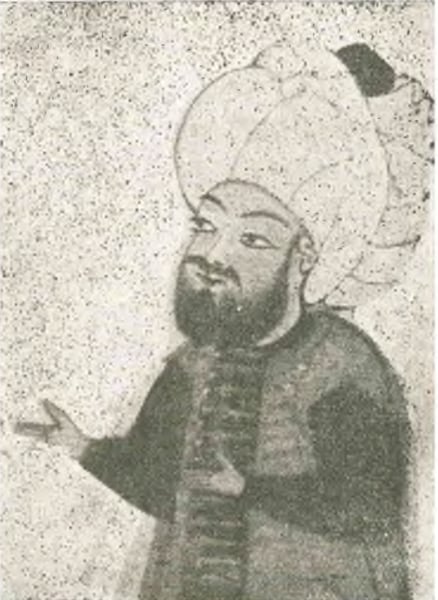
Veli Mahmud Pasha
Grand vizier, 1455/56–1468 and 1472–1473
 AI

Accounts of his origin
His origin is told differently in Ottoman and Byzantine sources. 16th-century biographical dictionaries (tezkires) make him a native of Alacahisar in Serbia, but this information is doubtful; some Byzantine sources say he was of Greek origin, others of Serbian and Bulgarian origin. According to the view most often put forward, his father was Michael Angelus of Novo Brdo, and the family is linked to the Angeloi, Serbian despots of Thessaly. In his monogram (pençe) dated 1463 his name appears as Mahmud ibn Abdülhay; he and Georgios Amiroutzes, chief chamberlain of Emperor David of Trebizond, were cousins through their mothers.
According to some sources he was taken captive around 1427 while travelling with his mother to Smederevo, was brought up under the protection of an Ottoman bey named Mehmed Ağa and was presented to the palace. He was educated in the Edirne Palace, became ağa of the corps after Mehmed II's accession, and during the siege of Istanbul served on the Edirnekapı–Yedikule section of the walls.
Grand vizier and governor-general of Rumelia
He probably became a vizier in 1454; he also took over the governorship-general (beylerbeyilik) of Rumelia in place of Dayı Karaca Bey, who fell in the siege of Belgrade in 1456, and at this time he rose to grand vizier. In 1458 he entered Serbia with Rumelian troops he had equipped at his own expense; although he could not take Smederevo, he captured the fortresses of Ostrovica, Rudnik and Güvercinlik (Golubac). In the Morea campaign of 1460 he persuaded Demetrios, the Despot of Mistra, to surrender.
The following year he received the surrender of Amasra; he was wounded in an assassination attempt in Bursa, and on recovering he took Sinop peacefully from Ismail Bey and, through the mediation of his cousin Amiroutzes, persuaded Emperor David to surrender Trebizond. In 1462 he distinguished himself in the Wallachian campaign, and in the same year he conquered Lesbos (Midilli). In the Bosnian campaign of 1463 he made an agreement with King Stjepan Tomašević at Jajce; the sultan was angered by this agreement, made without consulting him.
Dismissal, Negroponte and Otlukbeli
His failure to capture Pir Ahmed in the Karaman campaign led to accusations by his rival Rum Mehmed Pasha; when his conduct in the matter of the deportations also fed the gossip, he was removed in 1468–69 from both the grand vizierate and the governorship-general. Shortly afterwards, as sanjak bey of Gallipoli and commander of the fleet, he achieved great success in the conquest of Negroponte (Eğriboz) in 1470. In view of the threat from Uzun Hasan he became grand vizier again in 1472. Although he had a share in the victory of Otlukbeli on 11 August 1473, he was dismissed on the grounds of his negligence in the death of Has Murad Pasha in a surprise attack and his failure to have the fleeing Akkoyunlu pursued.
When he came to offer condolences on the death of Prince Mustafa, the sultan received him coldly; Mehmed II, who suspected the pasha, already at odds with the prince over a family matter, had him imprisoned in Yedikule, also at the instigation of his rivals, and had him executed shortly afterwards. The contemporary writer Muali counts among the reasons for the execution his release of the bey of Wallachia and his enmity with Prince Mustafa. The date of his death is recorded in his inscription as 1474; he lies in his tomb in Istanbul.
Saint, poet and patron
His execution caused great sorrow, especially in scholarly and artistic circles. Works such as Enveri's Düsturname and Şükrullah's Behcetü't-tevarih were written in the name of Mahmud Pasha, who was much loved by the people and called “veli” (saint). He himself wrote poems in Turkish and Persian under the pen name “Adni”. In the Istanbul district that bears his name he built a mosque, a public kitchen (imaret), a bathhouse, a medrese, the Kürkçü Han and a market of 265 shops; his bedesten (covered market) in Ankara is today the Museum of Anatolian Civilizations.
Source: TDV Encyclopedia of Islam, “MAHMUD PAŞA” (Şehabeddin Tekindağ)
Related sultans
Cite as: Atlas of the Sultans, “Veli Mahmud Pasha · Grand viziers”, https://padisahlaratlasi.com/en/grand-viziers/veli-mahmud-pasha/ (last updated 21 November 2026). Corrections · Image credits