TRENDEFRARAtlas of the Sultans · 10 / 39 · sultan
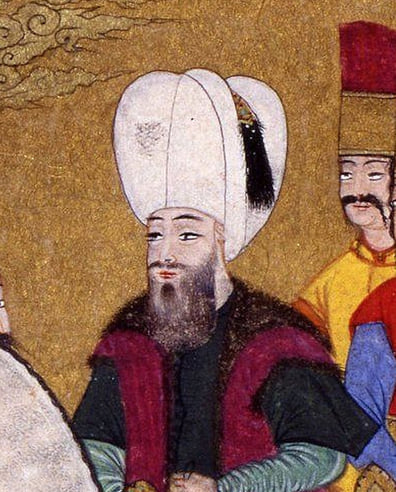
Imaginary portrait (made later) — 16th c.
Bayezid II
Veli (“the Saint”)
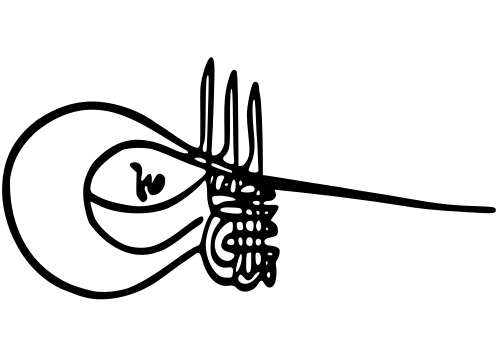
After his father's rapid conquests he let the state rest and repaired its finances and building programme. His calm, devout character earned him the name ‘Veli’ (the Saint); his reign was one of internal consolidation.
Open the reign of Bayezid II on the map▶ Watch the 1-minute video: YouTube · Instagram · TikTok
Interesting fact
An Ottoman fleet under Kemal Reis sailed to the coast of Spain and carried some of the Andalusian Muslims to North Africa and Ottoman lands. Some of the Jews fleeing the Inquisition were also settled in Ottoman territory in this period.
Source: TDV İslâm Ansiklopedisi (Turkish), article “BAYEZİD II”
Life
A prince in Amasya
Bayezid was born in Dimetoka (Didymoteicho) in 1448. He was the eldest son of Mehmed II the Conqueror (Fatih Sultan Mehmed) by Gülbahar Hatun. At the age of seven he was sent to Amasya as sanjak governor (sancak beyi); in the spring of 1457 he was circumcised in Edirne (Adrianople) together with his brother Mustafa. He studied with Muarrifzade and learned calligraphy from the famous calligrapher Şeyh Hamdullah; experienced statesmen such as Çandarlı Ibrahim and Yahya Pasha were assigned to him as tutors (lalas).
He remained in Amasya for many years and closely followed developments in the east and relations with the Aq Qoyunlu and the Dulkadirids. In his youth he led a free and easy life; at one point he fell out with his father because he used opium. His opposition to the land reforms the Conqueror carried out in Amasya, Tokat and Trebizond also strained relations between father and son.
The struggle for the throne: Bayezid and Cem
When the Conqueror died on 3 May 1481, Bayezid and his brother Cem, sanjak governor of Karaman, faced each other for the throne. The grand vizier, Karamani Mehmed Pasha, favoured Cem, while Ishak Pasha, the guardian of Istanbul, Sinan Pasha, the beylerbeyi (governor-general) of Anatolia, and the agha of the Janissaries wanted Bayezid. Bayezid, who learned of his father's death on 7 May, set out with 4,000 horsemen and reached Üsküdar on 21 May; with the support of the Janissaries he ascended the throne.
Cem proclaimed himself sultan in Bursa and proposed dividing the realm; Bayezid refused, saying that sovereignty could not be divided. Defeated at Yenişehir on 22 June 1481, Cem fled to Egypt, returned once more to Anatolia to try his luck, and finally, on 29 July 1482, took refuge with the Knights of Rhodes. Cem was held in Europe as a hostage, in France and in Rome; Bayezid went to great lengths to keep him from being released and paid an annual sum. Cem died in Naples on 25 February 1495. The first price of the struggle for the throne was the loss of Otranto: when Bayezid did not allow Gedik Ahmed Pasha to return to Italy, the isolated Ottoman garrison surrendered on 10 September 1481.
Campaigns and the seas
Because of the Cem affair, Bayezid was unable to undertake major campaigns for a long time. In the Moldavian campaign of 1484 the fortresses of Kiliya (Kili) (15 July) and Akkerman (4 August) were taken; Stefan, the prince of Moldavia, was bound to pay annual tribute, and an overland route to the Crimea was opened. The contest for supremacy over Çukurova and the Dulkadirids led to a six-year war with the Mamluks; it produced no decisive result, and in 1491 peace was made through the mediation of the ruler of Tunis.
The Ottoman fleet grew in Bayezid's time. When Venice failed to pay the annual 10,000 ducats it owed the Ottoman treasury, Bayezid, who felt freer after Cem's death, closed Ottoman ports to Venetian trade (1496); Kemal Reis's fleet attacked the Dalmatian coast, and war was declared on Venice. In this war, which lasted four years, the Ottoman fleet took Modon on 9 August 1500 and Coron on 15 August. In Bayezid's time official relations with Russia were established for the first time, and some of the Jews fleeing the Inquisition in al-Andalus (Spain) settled in Ottoman cities.
The Safavid threat and deposition
Bayezid's peaceable and cautious policy proved inadequate against the Safavid Shah Ismail, who was rising in the east. As Shah Ismail's Shiite propaganda spread through Anatolia, the one who resisted it most was Prince Selim, sanjak governor of Trebizond. 16,000 people suspected of being Shiites were deported from Anatolia to Rumelia; but the revolt of Şahkulu Baba Tekeli, which broke out in 1511, drenched Anatolia in blood from end to end. In Tokat the Friday sermon (hutbe) was even read in the name of Shah Ismail.
When it became clear that Bayezid wanted his son Ahmed to succeed him, Selim took action. In June 1511 he marched from Kiliya to Edirne; Bayezid gave him the sanjak of Smederevo (Semendire) and promised not to put Ahmed on the throne, but the agreement did not last long. In the end, under pressure from the Janissaries, Bayezid handed over the throne to Selim on 24 April 1512. The sultan who had come to the throne with the support of the Janissaries left it thirty years and eleven months later, again under their pressure.
Death and character
Bayezid left Istanbul, taking with him four yük of akçe and a few of his men, to go to Dimetoka, where he had been born; Selim accompanied him to the outskirts of the city. Travelling by litter, he could cover only 5-6 kilometres a day. He was taken ill at the village of Abalar near Çorlu and died on 10 June 1512. According to the TDV article the cause of his death is highly suspicious, and the possibility, raised by some local and foreign sources, that he may have been poisoned deserves serious consideration. He was buried beside his complex in Istanbul.
Because he devoted himself to worship and charitable works during his reign, he was called “Bayezid-i Veli” (Bayezid the Saint). Unless forced to, he kept away from war and preferred not to leave Istanbul. He commissioned many buildings in Istanbul, Amasya, Edirne and other cities: his complex in Amasya was built between 1481 and 1486, and his complex in Istanbul between 1501 and 1505, by the architect Yakub Ağa; to provide income for the endowment of this mosque, the Koza Han (1491) and the Pirinç Han (1508) were built in Bursa. His complex in Edirne, built between 1484 and 1488, consists of a mosque, madrasa, hospice (tabhane), soup kitchen (imaret) and darüşşifa (hospital). He also built bridges over the Tunca at Edirne, the Kızılırmak at Osmancık and the Sakarya at Geyve. His reign was also shaken by plague epidemics, a long famine and the Istanbul earthquake that began on 11 September 1509, lasted forty-five days and killed more than 5,000 people, remembered as the “küçük kıyamet” (the little Doomsday).
Source: TDV Encyclopedia of Islam (TDV İslâm Ansiklopedisi), “Bayezid II” (Şerafettin Turan); Âşıkpaşazâde, Oruç Bey, Ibn Kemal, Ibn Iyas and Venetian sources are the main foundations of this article.
Meanwhile in the world
Contemporary rulers
- Isabella IQueen of Castile · 1474–1504Queen who backed Columbus's Atlantic voyage
- Maximilian IHoly Roman Emperor · 1493–1519Expanded Habsburg power through marriage alliances
- Henry VIIKing of England · 1485–1509First Tudor king, who won the throne at Bosworth
- Ivan III (the Great)Grand Prince of Moscow · 1462–1505Brought Novgorod and Tver under Moscow
- Shah Ismail ISafavid Ruler (Iran) · 1501–1524Founder of the Safavid dynasty
- Julius IIPope · 1503–1513Commissioned Michelangelo's Sistine Chapel ceiling frescoes
- Hongzhi EmperorMing Emperor (China) · 1487–1505Tenth emperor of the Ming dynasty
What was happening in the world?
- 1488Portuguese navigator Bartolomeu Dias became the first European to sail around Africa's southern tip.
- 1492Granada surrendered to Castile and Aragon, ending the last Muslim emirate on the Iberian Peninsula.
- 1492Christopher Columbus crossed the Atlantic for Spain and reached the Bahamas.
- 1498Vasco da Gama sailed around Africa and reached India by sea, near Calicut.
- 1508Michelangelo began the Sistine Chapel ceiling frescoes in the Vatican, completing them in 1512.
Sources: newadvent.org [1] [2] [3] [4] [5] [6] · westminster-abbey.org [1] · britannica.com [1] · iranicaonline.org [1] · kotobank.jp [1] · exploration.marinersmuseum.org [1] [2]
Family
| Father | Mehmed II |
|---|---|
| Mother | Gülbahar Hatun |
| Consorts | Nigar Hatun, Bülbül Hatun, Şirin Hatun, Hüsnüşah Hatun, Gülruh Hatun |
| Children | Selim I (the Grim), Ahmed, Korkud, Şehinşah, Mahmud, Alemşah, Hatice, Aynişah, Gevherimüluk |
Major achievements
- Capture of Herzegovina (1482), Kilia and Akkerman (1484)
- Jews and Muslims expelled from Spain welcomed into the empire (1492)
- Istanbul rebuilt after the 1509 earthquake known as the ‘Lesser Apocalypse’
- Navy strengthened; Kemal Reis and Burak Reis taken into service
- The affair of Prince Cem managed through European diplomacy
- Şahkulu revolt suppressed
- Contributions to cultural life as a poet and calligrapher
Treaties
- Peace with the Mamluks (1491)
- Treaty with Venice (1503)
- Peace with Poland and Hungary
Grand viziers
| Name | From | To | Length |
|---|---|---|---|
| Ishak Pasha (term 2) | May 1481 | 1483 | 1-2 years |
| Koca Davud Pasha | 1483 | March 8, 1497 | 13-14 years |
| Hersekzade Ahmed Pasha | June 1497 | September 1498 | 1-2 years |
| Çandarlı Ibrahim Pasha (the Younger) | September 1498 | August 1499 | |
| Mesih Pasha | December 1499 | February 1500? | |
| Hadım Yakub Pasha | February 1500? | 1500? | |
| Mesih Pasha (term 2) | 1500? | November 17, 1501 | |
| Atik Ali Pasha | November 1501 | 1503 | 1-2 years |
| Hersekzade Ahmed Pasha (term 2) | 1503? | 1504? | |
| Koca Mustafa Pasha | 1504? | 1506 | 1-2 years |
| Atik Ali Pasha (term 2) | 1506 | July 2, 1511 | 4-5 years |
| Hersekzade Ahmed Pasha (term 3) | July 2, 1511 | September 21, 1511 | 81 days |
| Koca Mustafa Pasha (term 2) | January 6, 1512 | November 23, 1512 | 322 days |
Battles and treaties
| Year | Event | Result / parties |
|---|---|---|
| Treaty: Peace with Poland and Hungary | ||
| 1481 | Revolt: Revolt of Cem Sultan | Cem was defeated at Yenişehir (June 1481); failing to take Konya in 1482 he went to Rhodes and never returned |
| 1484 | Siege: Kilia and Akkerman | Kilia and Akkerman passed to the Ottomans; the north-western Black Sea coast was brought under control |
| 1491 | Treaty: Peace with the Mamluks | |
| 1499 | Naval battle: Zonchio (Sapienza) | The Ottoman fleet supported the siege from the sea; Lepanto surrendered on 26 August 1499 |
| 1500 | Siege: Siege of Modon (1500) | Modon was taken; one of Venice's main ports in the Morea passed to the Ottomans |
| 1503 | Treaty: Treaty with Venice | |
| 1511 | Revolt: Şahkulu Rebellion | Grand Vizier Hadım Ali Pasha fell in battle; Şahkulu's fate is unknown, his followers withdrew towards Iran |
Full infoboxes are in the site’s “Battles and Treaties” tab; source: TDV Encyclopedia of Islam.
Death
He died in 1512 on the road to Didymoteicho after handing the throne to his son Selim. It is alleged that he was poisoned.
Territorial change
| Year | Region | Event | Source |
|---|---|---|---|
| 1484 | + Budjak–Bessarabia | Kilia and Akkerman campaign (1484) — the northwestern Black Sea coast | TDV İA, “BAYEZİD II” |
| 1496 | + Montenegro | Montenegro comes under Ottoman rule (1496) | Inalcık, The Ottoman Empire: The Classical Age, p. 212 |
The lands that changed hands in this period, and the battles or treaties that brought the changes, can be seen on the map: map of the reign of Bayezid II.
Cite as: Atlas of the Sultans, “Bayezid II (Veli (“the Saint”)): Reign Map, Wars and Conquests (1481–1512)”, https://padisahlaratlasi.com/en/sultans/ii-bayezid/ (last updated 21 November 2026). Corrections · Image credits
Grand viziers of this reign: Gedik Ahmed Pasha · Hersekzade Ahmed Pasha
Monuments of this reign: Bridge of Arta · Faik Pasha Mosque · Great Mosque of Sofia · Atik Ali Pasha Mosque · Burmalı Mosque · Atik Ali Pasha Mosque (Karagümrük) · Fethiye Mosque (Nafpaktos) · Bayezid II Complex, Amasya · Sofular Mosque · Kara Davud Pasha Mosque · Bayezid II Complex (Edirne) · Alaca Imaret Mosque · all (26) →
Women of the dynasty in this reign: Gülbahar Hatun
State organisation: The Nişancı and the Scribal Service (Kalemiye) · The Office of Şeyhülislam · The Kapıkulu corps