TRENDEFRARAtlas of the Sultans · Ottoman monuments
Anadolu Hisarı
Monument · Fortress, Istanbul, 14th century
- Type
- Fortress and barracks
- Built
- 1390–1395
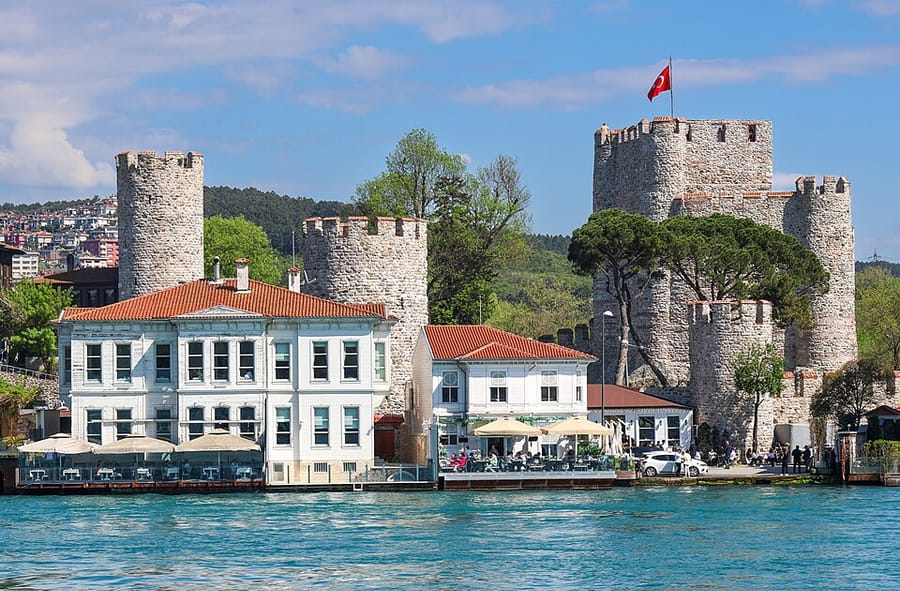

The fortress on the Asian shore
Bayezid I (Yıldırım), intent on conquering Constantinople, built this fortress at the narrowest point of the Bosphorus, on the Anatolian shore already controlled by the Ottoman beylik, on a rocky spur at the mouth of the Göksu stream. Bayezid's original fortress consisted only of the central square keep and the wall surrounding it. Its date varies in the sources: Aşıkpaşazade gives 1390–91, while Nişancı Mehmed Pasha gives 1394–95. Early sources also call it Güzelcehisar, Yenicehisar and Akçehisar.
In 1452, while building Rumeli Hisarı on the European shore, Mehmed II strengthened the castle with an outer wall with four towers on the seaward side. Its main role ended with the conquest of Istanbul; when new fortifications were built further up the Bosphorus in the 18th century it lost its function entirely and served as a prison. It was abandoned after the 1830s, and two gates of the outer wall were widened so that the coastal road could run through the courtyard. Some parts were repaired in 1928. Together with Rumeli Hisarı opposite, it is one of the defining historic features of the Bosphorus.
Names and early years
In one manuscript of Neşri the fortress is called Gözlücehisar, “observation castle”, a name considered more plausible for a stronghold built to watch the passage of the Bosphorus. The name Neo-Castrum, used in the West since the 16th century, is a translation of Yenihisar. The claim that a Byzantine fortress previously stood on the site has no basis. According to Aşıkpaşazade, Bayezid built the fortress while passing through Yoros after sending Yahşi Bey to conquer Şile, and on its completion demanded that the Byzantine emperor surrender the city. The emperor saved his position by agreeing to pay an annual tribute and to allow the Turks to found a quarter with a masjid and to keep a kadi in the city.
Because Bayezid kept a garrison there, it is thought that the fortress remained in Turkish hands even after the Battle of Ankara (1402). According to Evliya Çelebi, in the 17th century it had a commander and 200 timar-holding soldiers from the sanjak of Kocaeli, with guns positioned to fire towards Rumelihisarı and Akıntıburnu. A masjid for the garrison and an open-air prayer place endowed by Mehmed the Conqueror stood outside the walls. In the 17th and 18th centuries the fortress was also of some use against Cossack raids from the Black Sea.
Structure
According to A. Gabriel, the fortress of Bayezid's time was a defensive castle consisting of a square keep (donjon) and an enclosing curtain wall, guarding the entrance to the Göksu valley; the outer wall added by Mehmed II turned it into an offensive fortress able to fire on ships at water level. The interior of the keep is a vaulted space; beam holes in its walls show that there were three wooden floors above the basement. The keep was entered from the first floor by a drawbridge. Small towers stood at the corners of the curtain wall, with a wall-walk behind the crenellations.
The parts from Bayezid's period are built of rubble stone with courses of brick; a different technique was used in the parts from Mehmed II's time, where the arches of the gun ports are of cut stone. Until the 1830s the keep and all the towers were topped with lead-covered wooden cones. Ill-informed cement reinforcements made during the 1928 repairs damaged the monument.
Source: TDV Encyclopedia of Islam (TDV İslâm Ansiklopedisi), “ANADOLUHİSARI” (Semavi Eyice)
Related sultans
Cite as: Atlas of the Sultans, “Anadolu Hisarı · Ottoman monuments”, https://padisahlaratlasi.com/en/monuments/anadolu-hisari/ (last updated 21 November 2026). Corrections · Image credits