TRENDEFRARAtlas of the Sultans · Ottoman monuments
Grand Bazaar (Kapalıçarşı)
Monument · Market, Istanbul, from the time of Mehmed the Conqueror
- Type
- Bazaar
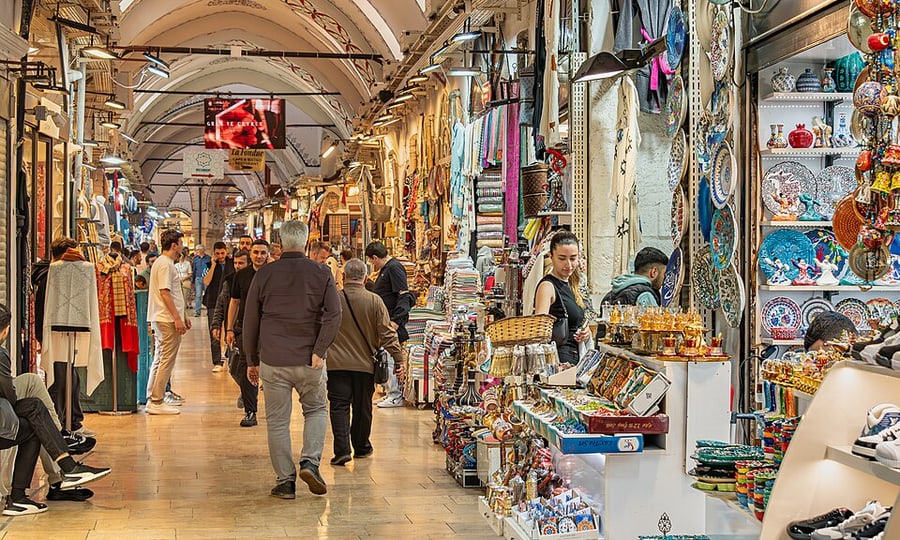

The Conqueror's bedesten
The Grand Bazaar (Kapalıçarşı, Büyük Çarşı, Çarşu-yı Kebir) is not a building established at one stroke; hans clustered around two bedestens (covered markets), the streets between them were in time covered with vaults, the shops were rebuilt in masonry and the entrances protected by gates, and so a great covered market came into being. Tursun Bey, Kritovoulos and Doukas report that the core of the market was formed immediately after the conquest. The fifteen-domed Inner Bedesten (Cevahir Bedesteni), built by the Conqueror to provide income for his endowments, now stands in the middle of the bazaar. Although the date of the twenty-domed Sandal Bedesteni is disputed, today it too is generally accepted as belonging to the Conqueror's time.
The article finds unfounded the claim that the Old Bedesten was a Byzantine building and that the bazaar continued a Byzantine market; as Mordtmann also pointed out, the Byzantine markets were elsewhere.
From timber to masonry
In a miniature by Matrakçı Nasuh dated 1537, the bazaar appears as rows of shops along open streets around the bedestens. With its shops and street coverings of timber, the bazaar burned frequently: the fires of 1515, 1539, 1546, 1652 and 1660 caused great damage, and in 1546 the masonry bedestens survived. After the fire of 3 December 1701, Mustafa II ordered in 1702 that the shops and houses be built in masonry; the covering of the streets with masonry vaults, which turned the bazaar into a covered market, began at this time. After that fires became rarer, but there was damage again in 1750, 1803 and 1826. It has also been said that in the fire of 1750 the Janissaries took to plundering, so that the damage was greater than that done by the flames, and even that they had a hand in spreading the fire.
The 1894 earthquake and the new gates
The earthquake of 1894 devastated the bazaar on a large scale. In the eighteen-month restoration ordered by Abdulhamid II, the boundaries of the bazaar were narrowed, the Çadırcılar street was left open to the sky, and some hans were left outside the bazaar. At both ends of the main street, Kalpakçılar, new gates were built in the neo-classical style bearing inscriptions written by the calligrapher Sami Efendi. Hans such as the Astarcı, Safran, Evliya, Zincirli and Kuyumcular (Goldsmiths') can today be entered only from inside the bazaar. The sebil at the Mercan Gate was built in 1738–39 by the chief black eunuch (kızlar ağası) Hacı Beşir Ağa; the three-sided Baroque marble fountain at the corner of Kalpakçılar street and Sipahi lane is counted among the fine works of the city. According to a document dated 1886–87 there were 4399 shops in the bazaar; however, the article notes that since the source of the document is not given, the figures cannot be checked.
Fires and today
The bazaar suffered great fires in 1943 and on the night of 26 November 1954; in the second, two fifths of it were destroyed. After a five-year restoration it was reopened with a ceremony on 28 July 1959, and care was taken that every shop be rebuilt so as not to project beyond its arch. According to the author of the article, the bazaar today has not been able to preserve the wealth and beauty it kept until the end of the last century: the streets of the different trades have become mixed, shop windows have replaced the shops with open counters, the booksellers (Sahaflar) moved after 1894 to their present place outside the bazaar, and Çadırcılar has turned into a market for antiques and tourist goods.
Source: TDV Encyclopedia of Islam (TDV İslâm Ansiklopedisi), “BÜYÜK ÇARŞI” [Istanbul] (Semavi Eyice)
Related sultans
Cite as: Atlas of the Sultans, “Grand Bazaar (Kapalıçarşı) · Ottoman monuments”, https://padisahlaratlasi.com/en/monuments/grand-bazaar-kapalicarsi/ (last updated 21 November 2026). Corrections · Image credits