TRENDEFRARAtlas of the Sultans · Ottoman monuments
Faik Pasha Mosque
Monument · Mosque, Arta, 15th century
- Type
- Mosque
- Location
- Greece
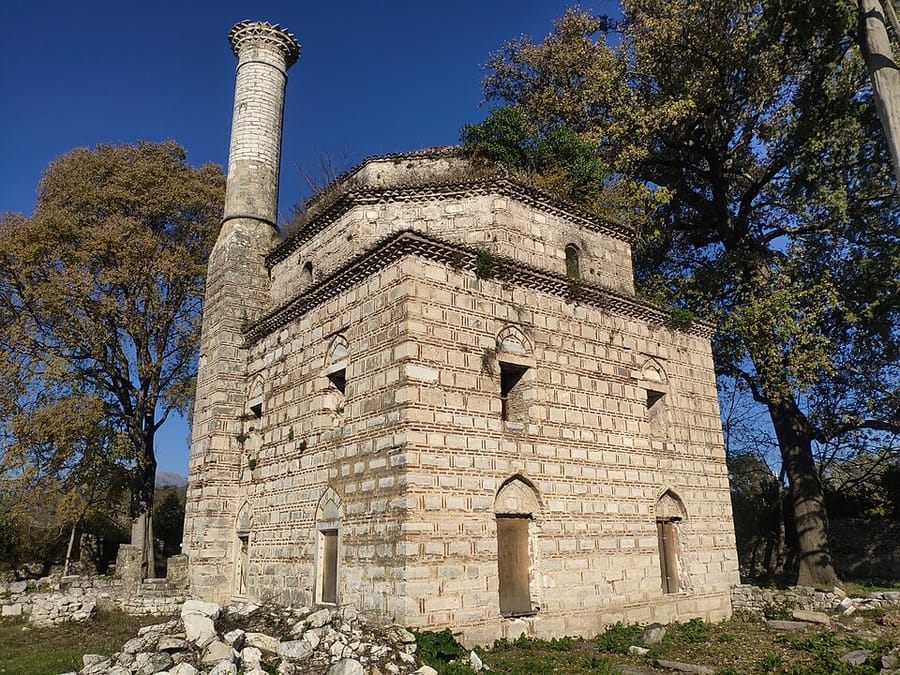

The mosque of a complex in Arta
The mosque was built at Arta in western Greece, known in the Ottoman period as Narda, by Faik Pasha, an important vizier of the reign of Sultan Mehmed II (the Conqueror). Aşıkpaşazade, writing around 1478, records that Faik Pasha intended to found a pious endowment here, and together with the endowment deed of 1492–93 this shows that the mosque was built in the late 15th century as the centre of a complex (külliye). Evliya Çelebi describes it in the village of Imaret outside the town, together with a soup kitchen, an inn and a madrasa. The nearby tomb belongs to Faik Pasha; the date 1499–1500 has been read on his gravestone.
The square, single-domed mosque measures 11.70 m on each side externally. It is carefully built of mixed cut stone and brick, and, as in the mosques of the Balkans, its dome rests on a polygonal double drum. In front stood a three-domed portico on four columns, and a brick minaret rose at its right corner. After Arta was ceded to Greece in 1881, the Ottoman monuments of the town were destroyed. By 1953 the mosque was badly ruined, and its portico has disappeared entirely. Its present state, and reports that it has been restored, remain unconfirmed.
The founder and his endowments
Faik Pasha, an important but little-known vizier of Mehmed the Conqueror's reign, gained influence in the sultan's last years and was granted extensive fiefs in December 1478. He owned fisheries at Serez, property and fiefs at Salonica and villages around Salonica; according to an entry in a land register, he endowed the revenues from these to his soup kitchen at Narda. The copy of his endowment deed states that his endowments at Salonica, Narda, Karlı ili and Yenice-i Vardar were attached to the soup kitchen at Narda.
Faik Pasha is also reported to have built a mosque and a school in the castle of Kefalonia; the island remained under Ottoman rule only briefly, between 1479 and 1500. That he left charitable works in and around Narda suggests that he may have come from this region. Evliya Çelebi writes that Imaret, the village where the mosque stands, was a Muslim village of forty houses, and that the mosque stood in the middle of a pleasure ground of vineyards and gardens.
Building technique
In the walls, bricks set vertically between the stones, as seen in buildings of the fourteenth and 15th centuries, are noteworthy. Probably in the 19th century the portico was covered by a wide tiled lean-to roof resting on slender wooden posts. Above the door with its marble frame there is a white panel, but no inscription was ever carved on it. Each facade has two windows one above the other, and one window on each of four faces of the octagonal lower drum also lights the interior.
The cession of Arta and after
Arta was among the territories ceded to Greece under Article 24 of the 1878 Treaty of Berlin; after long negotiations, on the grounds that the Muslim population's freedom of worship and security of property had been guaranteed, it was formally handed over on 6 July 1881. Photographs obtained in 1953 by the author of the entry, Semavi Eyice, show the mosque standing among trees beside the village called Merati, a corruption of Imaret. The latest photographs show that the outer eaves and the portico, with its columns, arches and domes, have disappeared without trace; no information could be obtained about buildings such as the inn and the madrasa that once surrounded it.
Source: TDV Encyclopedia of Islam (TDV İslâm Ansiklopedisi), “FÂİK PAŞA CAMİİ” (Semavi Eyice)
Related sultans
Cite as: Atlas of the Sultans, “Faik Pasha Mosque · Ottoman monuments”, https://padisahlaratlasi.com/en/monuments/faik-pasha-mosque/ (last updated 21 November 2026). Corrections · Image credits