TRENDEFRARAtlas of the Sultans · Ottoman monuments
Fethiye Mosque (Athens)
Monument · Mosque, Athens, 15th–18th century
- Type
- Mosque
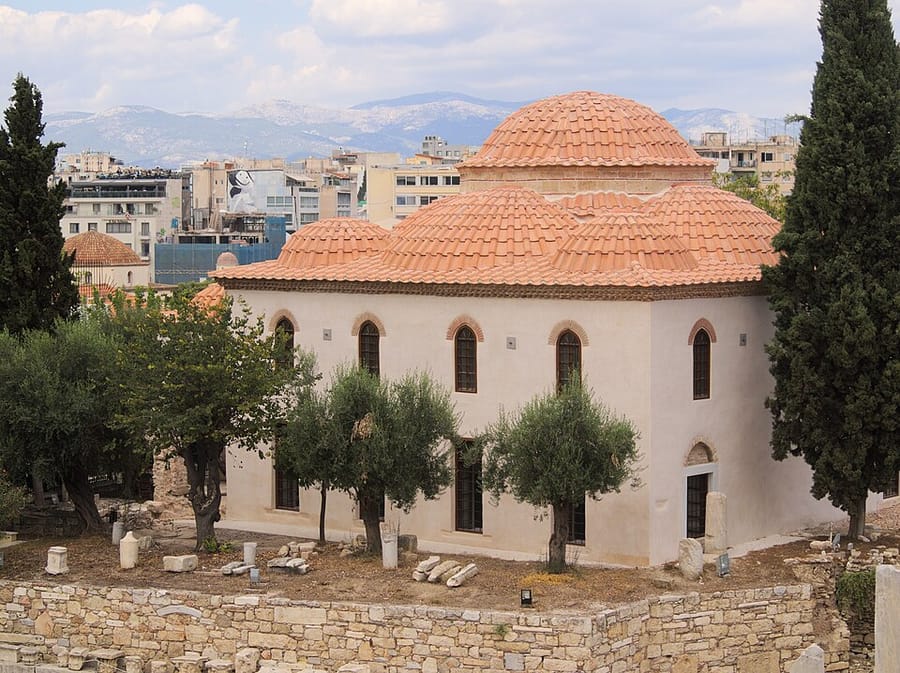

A mosque in the ancient agora
No document clearly records when this mosque, standing on the site of the ancient agora of Athens, was built. A repair certificate (hüccet) of 1791–92 states that it was restored and that it belonged to the endowment of Mehmed II the Conqueror. When the Venetians occupied Athens in 1687 the mosques are said to have been turned into churches, and when the city was retaken the old endowment buildings were revived; the Fethiye Mosque may be one of the mosques revived at that time, or it may have been built after the Venetian occupation. Its carelessly laid rubble walls enclose a square prayer hall of about 13 metres, covered by a shallow dome some 6 metres across that is supported by half-domes on four sides, with four small domes at the corners.
This system, also found in some of the great imperial mosques of Istanbul, would be of great importance for the history of Turkish architecture if the building dates entirely from the reign of Mehmed II, but nothing certain can yet be said. After Athens was handed over to the Greeks in 1833, the abandoned mosque long stood as a ruined depot within a military building. During the excavations of the agora its demolition was demanded, but the idea was dropped. Only the square base and a few steps of its minaret survive.
Portico and facades
In front of the mosque is a five-bay domed portico closed by walls at both ends. This part, which gives the impression of a later addition, has semicircular arches of the type used in 18th-century Turkish art; the capitals of its marble columns cannot be assigned to any style. In the entrance wall, on either side of the plainly arched door, are four windows below and five above, all with brick arches, and between them a pair of exterior mihrabs. The prayer hall receives light from eight windows in two tiers on each side facade and four on the qibla facade; a sawtooth brick cornice runs along the top of the walls.
Interior and roofing
In the middle of the prayer hall four marble columns carry the arches. Their capitals have nothing to do with Turkish art; their shafts take the form of a series of long, slender leaves. The shallow dome rests on an octagonal drum of cut stone. The dome, the semi-domes, the small corner domes and the portico are covered with tiles. The minaret stood on the right side of the mosque, separate from the building. A restoration by someone who did not know the building well enough destroyed some of its traces.
Documents and early depictions
Evliya Çelebi, who visited Athens in 1667–68, names the Old Mosque, the Bey Mosque and the Hacı Ali Mosque in the lower town but does not mention a Fethiye or Fatih Mosque. During the Venetian occupation, the Turkish population of the town, some 3,000 people, had migrated to Anatolia. The illustrated books of Théodose du Moncel and Antoine-Marie Chenavard, who came to Athens shortly after its surrender on 24 May 1833, show the mosque as it looked in those years, with engravings. After the idea of demolishing it was abandoned, it was also considered to repair the mosque on a small scale and give it to the Egyptian government.
Source: TDV Encyclopedia of Islam (TDV İslâm Ansiklopedisi), “FETHİYE CAMİİ” (Semavi Eyice)
Related sultans
Cite as: Atlas of the Sultans, “Fethiye Mosque (Athens) · Ottoman monuments”, https://padisahlaratlasi.com/en/monuments/fethiye-mosque-athens/ (last updated 21 November 2026). Corrections · Image credits