TRENDEFRARAtlas of the Sultans · Ottoman monuments
Great Mosque of Sofia
Monument · Mosque, Sofia, 15th century
- Type
- Mosque
- Built
- 1451–1494
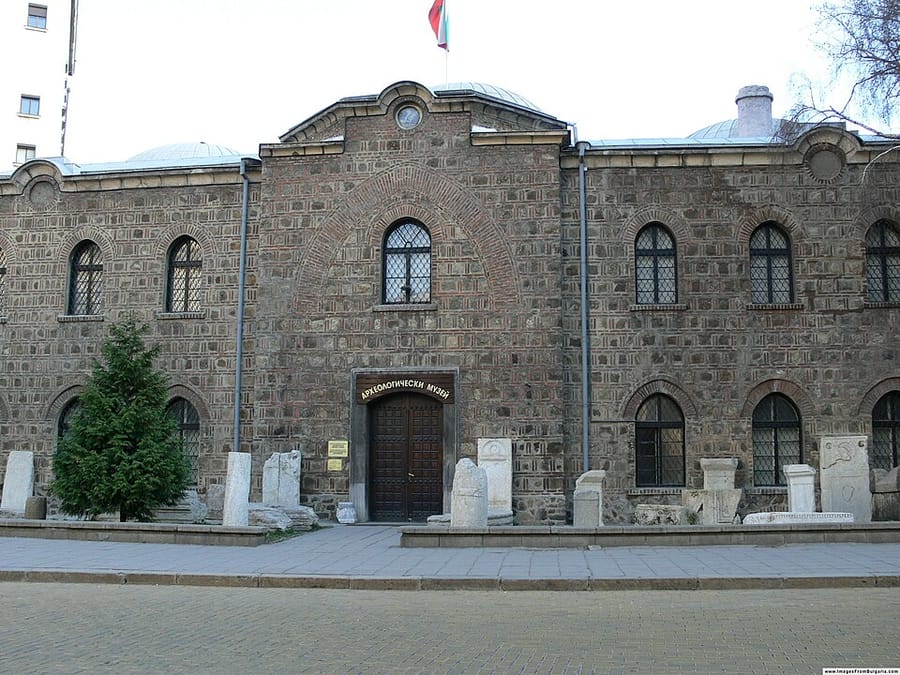

Sofia's great mosque
This great mosque (ulucami) in the very centre of Sofia was the second built in Bulgaria, after the Hudavendigar Mosque in Plovdiv (Filibe), and is one of the largest mosques in Rumelia. It was a pious foundation of Mahmud Pasha, grand vizier under Mehmed the Conqueror, and is therefore also known as the Mahmud Pasha Mosque. According to one tradition, work began in 1451 and the building was completed in 1494, after its founder's death. Built of stone and brick in the character of early Ottoman architecture, the square building is divided by four piers into nine bays, each covered by a dome 9.30 metres in diameter.
After the Russo-Turkish War of 1877–1878, when Bulgaria left Ottoman rule, the building lost its function as a mosque. Its minaret, its portico and the adjoining madrasa were removed, the shops of its endowment were sold, and the mosque was turned into a museum. A museum building and central bank buildings were erected almost against its two sides, an arched addition was made at the entrance, and the interior was completely spoiled by a concrete upper floor. The minbar, galleries and mihrab have also disappeared. Today it is an archaeological museum, its interior filled with finds.
The great-mosque tradition and the endowment
The Anatolian tradition of building a great mosque (ulucami) in the centre of major towns was continued during the Ottoman expansion into Rumelia; the building in Sofia is the second example of this tradition in Bulgaria. Evliya Çelebi, who visited Sofia in November 1652, calls it the Cami-i Atik Koca Mahmud Pasha (Old Mosque of Koca Mahmud Pasha), but describes it with exaggerated dimensions and some features that do not match reality; according to him the mosque had eighteen domes. Under the endowment conditions identified by Ekrem Hakkı Ayverdi, the great mosque was allotted 32 akçe a day, 11,500 akçe a year. A report on the Ottoman endowments in Sofia drawn up by the imperial commissioner Ali Ferruh Bey records that the mosque had been turned into a museum and that the shops belonging to its endowment had been sold.
The original interior arrangement
The plan, divided into nine bays by four piers, gave the building a medium-sized interior among great mosques. In such mosques the bay enclosed by the four central piers usually contains an ablution fountain, and Sofia probably had one too. In that case the dome above it would have been slightly higher than the others, with a lantern at its centre. After the conversion into a museum these architectural elements were entirely removed as well.
Source: TDV Encyclopedia of Islam (TDV İslâm Ansiklopedisi), “MAHMUD PAŞA CAMİİ” (Semavi Eyice)
Related sultans
Cite as: Atlas of the Sultans, “Great Mosque of Sofia · Ottoman monuments”, https://padisahlaratlasi.com/en/monuments/great-mosque-of-sofia/ (last updated 21 November 2026). Corrections · Image credits