TRENDEFRARAtlas of the Sultans · Ottoman monuments
Stone Bridge (Skopje)
Monument · Bridge, Skopje, 15th century
- Type
- Bridge
- Location
- Skopje, North Macedonia
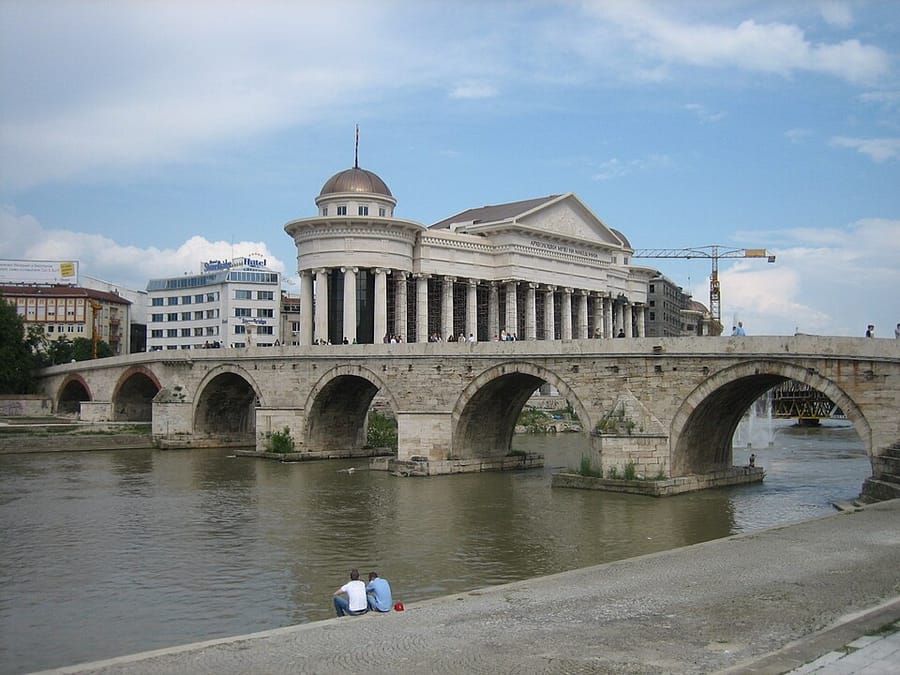

A bridge over the Vardar
The Stone Bridge over the Vardar River, which divides Skopje in two, also appears in the sources as the Bridge of Mehmed the Conqueror (Fatih Sultan Mehmed) or the Vardar Bridge. The construction date of this bridge of dressed stone is not known precisely. Evliya Çelebi writes that it was built by Mehmed the Conqueror, a view shared by Hammer and Ayverdi, whereas Şemseddin Sami and Salih Asım attribute it to Murad II. Claims that it dates from Byzantine or Serbian times are not supported by evidence, and excavations in 1972–73 found no trace of a pre-Ottoman structure. According to endowment deeds, nearby villages were exempted from taxes for nine years during construction, and masons from Serres and Thessaloniki worked on it.
Once about 210 metres long and 6.5 metres wide, the bridge now has ten arches. It underwent major repairs in 1566 and 1579; according to Evliya Çelebi, the 1579 repair took place under Murad III. It was widened in 1909 under Mehmed V (Reşad) and repaired again after the 1963 earthquake. Since 1971 it has been open only to pedestrians. In the restoration begun in 2000, original stones were replaced and the bridge's small prayer niche (mihrabiye) was destroyed; the bridge reopened in 2004, and the mihrabiye was rebuilt in 2007.
Arches and inscription kiosk
An archival document of 1566 records that the bridge had eighteen arches; Evliya Çelebi, however, speaks of fourteen and writes that four of them were repaired in the reign of Murad III after falling into ruin. Because the embankment built beside it covered some arches, ten arched openings are visible today. Owing to round arches of different widths, the bridge rises gently from both ends towards the middle; the piers have cutwaters and buttresses on both sides.
In the middle of the bridge, above a pier on the downstream side, stands the inscription kiosk. The 1579 verse inscription above a muqarnas niche was torn out and thrown away during the Austrian occupation of 1689, so its place is empty. The inscription of the 1909 widening attributes the original construction to Murad II and the widening to Sultan Reşad; this stanza was written by the Rifai sheikh Sadeddin Efendi.
Repairs over the centuries
The bridge was also repaired in 1817, 1818, 1869, 1888, 1896–97 and 1905, but the details are unknown. In 1888 four arches were completed in brick. In the 1909 works the parapet was removed and footpaths 1.90 metres wide, supported on iron brackets, were added on both sides. The 1579 inscription in the sitting kiosk was removed during repairs in the 1930s, and the 1909 inscription in the mihrab during repairs in the 1970s.
Controversy over the last restoration
During the restoration begun in 2000 the bridge's mihrab was knocked into the Vardar and broken, provoking a strong reaction from the Muslim population. After representations by the Turkish Embassy in Skopje to the Macedonian authorities and UNESCO, the work was halted and resumed in September 2002. The bridge was opened on 26 July 2004, the fortieth anniversary of the 1963 earthquake.
According to the findings, the parapet and paving stones were renewed wider and higher than the originals, the entrances of the two guard rooms in the seventh pier were blocked, and the sitting platform and inscription niche were not restored. In July 2004 experts sent from Turkey found that seventy-two of the seventy-six stones of the mihrab kiosk were still usable. Opposite the mihrab niche, rebuilt in 2007, a plaque was placed in memory of Karpoš, who rebelled against the Ottomans.
Source: TDV Encyclopedia of Islam (TDV İslâm Ansiklopedisi), “TAŞKÖPRÜ” (Muhammed Aruçi)
Related sultans
Cite as: Atlas of the Sultans, “Stone Bridge (Skopje) · Ottoman monuments”, https://padisahlaratlasi.com/en/monuments/stone-bridge-skopje/ (last updated 21 November 2026). Corrections · Image credits