TRENDEFRARAtlas of the Sultans · Ottoman capitals
Edirne
Capital · 1360s–1453
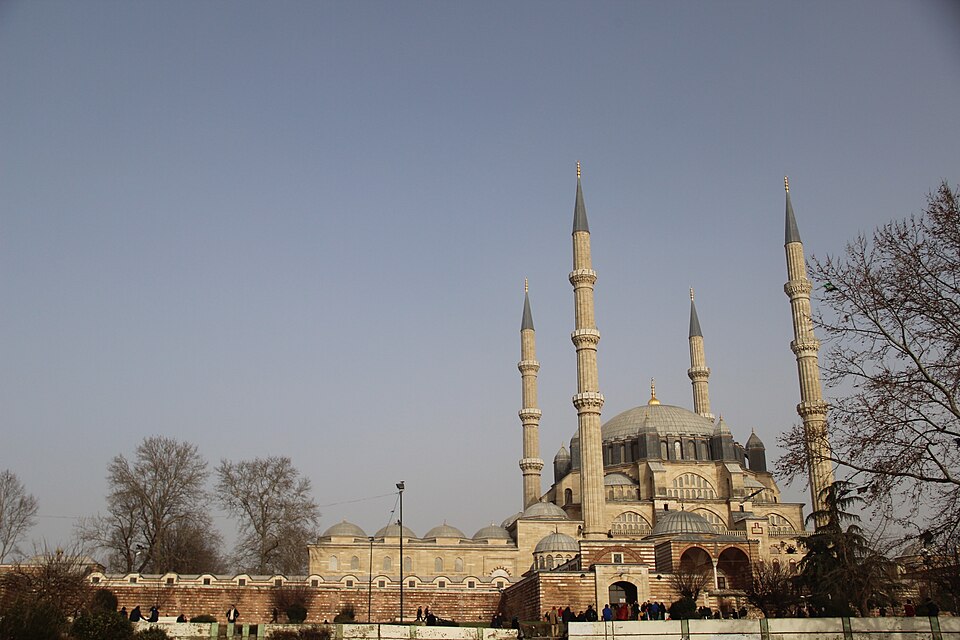

Hadrianopolis
Edirne lies in Thrace, the south-eastern extension of the Balkan peninsula, near the point where the Tundzha (Tunca) and Arda rivers join the Maritsa (Meriç). Its position on the main road linking Anatolia to Europe has given it great importance since antiquity. The first town here was founded by the Odrysians, a Thracian tribe; the Macedonians called it Orestia, and when the Roman emperor Hadrian refounded it in the second century it took the name Hadrianopolis. Rendered in Islamic sources as Edrenos or Edrenaboli, the name was fixed as “Edrene” under Murad I and probably began to be pronounced “Edirne” from the 18th century.
In the Byzantine period the city witnessed struggles between Byzantium and the Bulgarian kingdom and raids by the Pechenegs. The Ottomans' first involvement with Edirne came in 1352, when Prince Süleyman Pasha, who had crossed into Thrace as an ally of John Kantakouzenos and routed Bulgarian-Serbian forces, joined Kantakouzenos's troops at Edirne. Before the conquest Edirne was a small town consisting of the walled Kaleiçi and the settlement of Aina across the Mihal Bridge, with an estimated 10,000–15,000 inhabitants.
A disputed conquest date
The Edirne article states plainly that the date of the Ottoman conquest is disputed: 1361, 1362, 1367 and 1369 have all been proposed. Among these, the view that Edirne was taken in 1361, while Orhan Gazi was still alive, through a systematic campaign by his son Murad and Lala Şahin, has gained most weight. However, on the basis of an elegy showing that the Metropolitan Polykarpos was still in Edirne in that capacity until 1366, it has also been suggested that the conquest may have taken place after 1366 (in 1369).
Halil Inalcık's article on Murad I tells the story as follows. First the fortresses on the Istanbul–Edirne road, such as Çorlu, Lüleburgaz and Babaeski, were taken, and Didymoteicho (Dimetoka) south of Edirne was also captured, cutting the city off from all help. In the spring of 1361 Prince Murad marched on Edirne with the forces of Rumelia; the lord of Edirne, who met him at Sazlıdere, was defeated and fled by night down the Maritsa by boat to Enez. The townspeople then surrendered the city (5 May 1361). Inalcık's article on Orhan likewise notes that the literature gives dates such as 1363, 1364, 1369 and 1371, but stresses that the city was taken in 1361.
Centre of Rumelia, then capital
According to the article on Murad I, while in Rumelia Murad first resided at Didymoteicho, ordered a palace to be built in Edirne and moved there when it was finished (1369). In the article on Istanbul, Inalcık writes that this palace was built in 1365–1368 and that Edirne thereby became the state's centre in Rumelia and its second capital, while Bursa remained the principal capital until 1402. Murad built the Old Palace (Eski Saray) outside the walls and turned the church in the citadel into a mosque (the Halebi Mosque); Bayezid I also built another palace here. Used as a base for the conquest of Rumelia, Edirne was where Bayezid I prepared his siege of Constantinople.
Edirne gained its real importance during the struggle among the princes after Bayezid I's death. After the defeat at Ankara, Emir Süleyman came to Edirne with the treasury and the official records of the state, and so Edirne became the seat of government. Musa Çelebi, who seized the city, stayed two years and struck coins in his own name; then Mehmed Çelebi, who prevailed, resided in Edirne for long periods and died there. For a time the city fell to “Düzmece” (the Pretender) Mustafa, who was captured and executed in 1422.
The Edirne of Murad II and the Conqueror
The city's growth accelerated under Murad II. He held magnificent weddings for his sons here, directed his Rumelian affairs from the city and received envoys in it. Edirne also witnessed Murad II's abdication in favour of his son Mehmed and the Janissary revolt that followed. Having married Mehmed here in 1450 to Sitti Hatun, daughter of Süleyman Bey of the Dulkadir, Murad II lived in Edirne until the end of his life and died there (3 February 1451). Mehmed came from Manisa and ascended the throne in Edirne, and in the winter of 1452–1453 he had all the plans and preparations for the conquest of Constantinople made here.
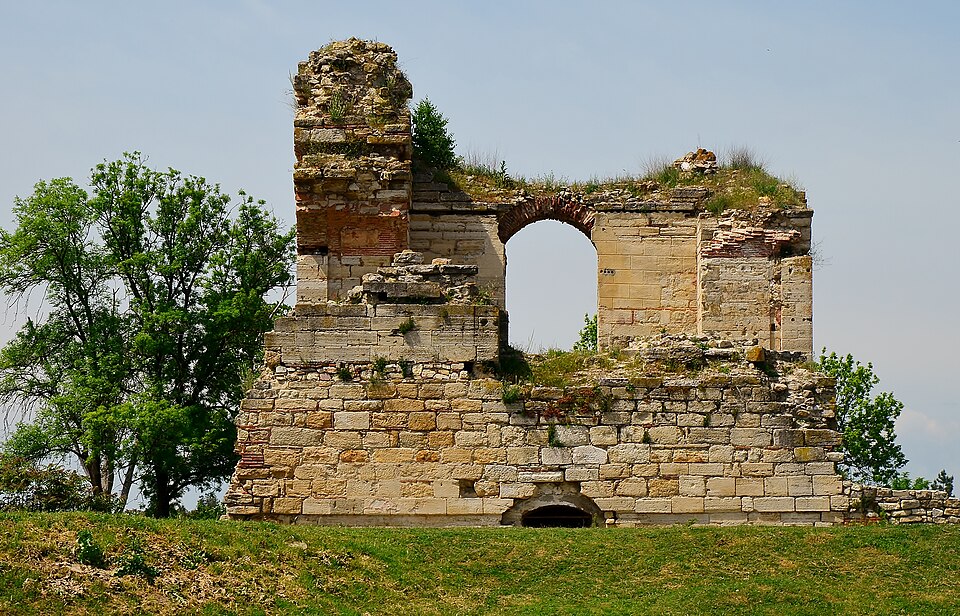
The face of the city changed in this period as well. The New Palace (Saray-ı Cedid), also known as the Tunca Palace or the Imperial Palace, on a broad plain west of the Tunca, was begun under Murad II, completed by Mehmed II and enlarged under Suleiman the Magnificent. The Yıldırım Mosque of 1399, the Old Mosque (Eskicami) begun by Emir Süleyman and completed under Mehmed I, Mehmed I's covered market (bedesten, 1418), Murad II's Muradiye Mosque (1436), his school of hadith (1435) and the Üç Şerefeli Mosque, begun in 1437 and finished in 1447, are the chief works of the century. Bertrandon de la Broquière, who saw the city in 1433, describes Edirne as large, prosperous and lively.

After 1453: the “ancient capital”
Edirne's importance long survived the conquest of Istanbul. Mehmed II used the city as a base for his Balkan operations; in the spring of 1475 he held the month-long circumcision festivities of his sons in the gardens of the New Palace and received envoys of Ragusa, the Morea, Serbia and the Byzantine despotates here. In 1512, during the struggle between Bayezid II and his son Selim, an assembly gathered in Edirne referred to it as the “ancient capital” (payitaht-ı kadim). The practice of sending a prince of the dynasty to Edirne as guardian of Rumelia during eastern campaigns continued under Suleiman the Magnificent. The city's finest monuments were built in the 16th century, above all Mimar Sinan's Selimiye Mosque; the population exceeded 20,000 in 1528 and reached 30,000 by the 1570s.
In the 17th century Edirne regained importance. Ahmed I, Osman II and Murad IV stayed here for hunting, and the city became almost a second capital. It was Mehmed IV, however, who truly made it a seat of government: he resided in Edirne during the Venetian and Polish campaigns, received many envoys here, and celebrated here the circumcision of his sons and the eighteen-day wedding of his daughter Hatice Sultan. Suleiman II died here (1691) and Ahmed II was enthroned here. Under Mustafa II all state business was conducted in Edirne; but the sultan's residence there and the great influence of the Chief Mufti (şeyhülislam) Feyzullah Efendi led to the Edirne Incident of 1703, which ended with Mustafa II's deposition.
The later centuries
Edirne, whose population in 1703 is estimated at 30,000–40,000 in sixty-five quarters, became relatively deserted from the second half of the 18th century; the fire of 1745 and the earthquake of 1751 caused great damage. The article notes that trade flourished whenever the sultans were in the city and largely faded when they returned to Istanbul. The city was occupied by a foreign (Russian) army for the first time in 1829; during the Russian occupation of 1878–1879 the New Palace was set on fire as it was evacuated. Bulgarians occupied the city in 1913 and Greeks in 1920; liberated in 1922, Edirne became a border city of the Republic of Turkey under the Treaty of Lausanne.
 AI

Related sultans
City: Edirne (Adrianople)
Cite as: Atlas of the Sultans, “Edirne · Ottoman capitals”, https://padisahlaratlasi.com/en/ottoman-capitals/edirne/ (last updated 21 November 2026). Corrections · Image credits