TRENDEFRARAtlas of the Sultans · 33 / 39 · sultan
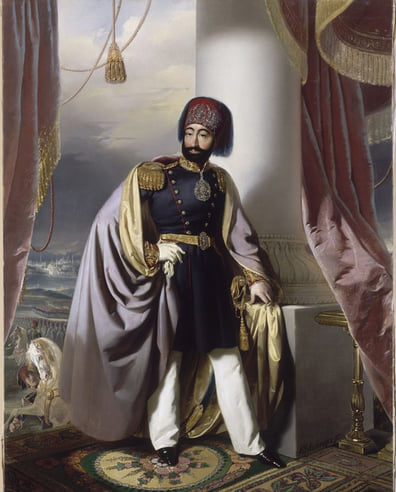
Portrait made in his lifetime — Henri-Guillaume Schlesinger · 1839
Mahmud II
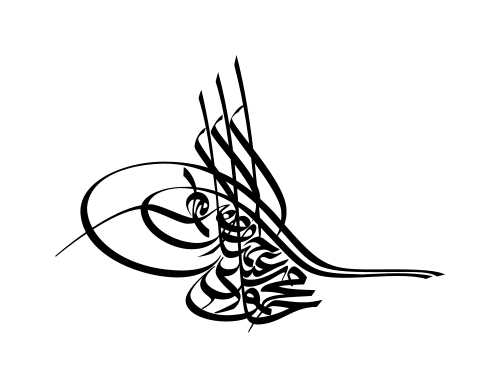
He recentralised the state: he abolished the Janissaries and founded modern ministries, schools and the census. The territorial losses were heavy (Greece, Algiers, Bessarabia), but the administrative structure he built made the Tanzimat possible.
Open the reign of Mahmud II on the map▶ Watch the 1-minute video: YouTube · Instagram · TikTok
Interesting fact
He abolished the Janissary corps in 1826. He introduced the jacket, trousers and fez for civil servants, and he was the first sultan to send students abroad.
Source: TDV İslâm Ansiklopedisi (Turkish), article “MAHMUD II”
Life
The prince who escaped death
Mahmud was born on 20 July 1785. He was the son of Abdulhamid I; according to the TDV article, the claim that his mother, Nakşidil Sultan, was of French origin is not true. The pen name “Adli” was given to him at birth. It is generally accepted that he took his ideas of reform largely from his cousin Selim III.
In 1807 Selim was deposed and Mahmud's elder brother, Mustafa IV, came to the throne. On 28 July 1808, when Alemdar Mustafa Pasha marched on the palace to restore Selim, Mustafa IV ordered that Selim and Mahmud be killed. Selim was killed; Mahmud escaped wounded and, as the last surviving male member of the dynasty, was placed on the throne the same day.
Ayans, revolts and wars
The first years of his reign passed under the pressure of the anti-reform front formed by the Janissaries and the ayans (provincial notables) who supported them. During Alemdar Mustafa Pasha's four-month grand vizierate, the “Sened-i Ittifak” (Deed of Alliance) was signed with the ayans; but shortly afterwards Alemdar was killed in a Janissary attack and the Sekban-ı Cedid corps he had tried to establish was disbanded. Through a long struggle Mahmud eliminated the powerful ayans one by one; by 1832 both the Rumelian and the Anatolian parts of the state had been largely cleared of them, including figures such as Tepedelenli Ali Pasha.
When he came to the throne, the state was at war with Russia and Britain. The war with Britain ended in 1809; the Russian war ended with the Treaty of Bucharest of 28 May 1812, and Bessarabia was lost. At the end of the Serbian uprising the Serbs were granted de facto autonomy. When the Greek uprising that began in 1821 could not be suppressed, it became an international issue: just as the forces of Muhammad Ali Pasha of Egypt (Kavalalı Mehmed Ali Pasha) were on the point of crushing the revolt, the British, French and Russian fleets burned the Ottoman-Egyptian fleet at Navarino on 20 October 1827.
The Auspicious Incident (Vaka-i Hayriye)
Knowing full well that the Janissaries would react, Mahmud established the “Eşkinci Ocağı,” a corps to be trained in the European manner, on 29 May 1826. On 15 June 1826 the Janissaries revolted; according to the TDV article, this revolt was not accidental but the work of Mahmud, who believed that “the time had now come.” The revolt was suppressed and the four-century-old Janissary corps was abolished; in its place a new army was founded, named after the Prophet the “Asakir-i Mansure-i Muhammediyye.” This event, which entered Ottoman history as the Auspicious Incident (Vaka-i Hayriye), opened the way for the reforms that marked the last thirteen years of Mahmud's reign.
Losses: Greece and Egypt
Before the new army had even been formed, Russia declared war, using the Greek question as a pretext; Russian forces advanced as far as Edirne. The Treaty of Edirne (Adrianople) of 14 August 1829 opened the way for the creation of a small Greek state centered on Athens, comprising the Morea and some islands. The French occupation of Algiers in 1830 showed that the danger of dismemberment now came from the colonial powers as well.
The greatest danger came from the governor of Egypt, Muhammad Ali Pasha. On 21 December 1832 Egyptian forces defeated and captured Grand Vizier Reşid Mehmed Pasha at Konya and advanced as far as Kütahya. Under the settlement reached at Kütahya, Mahmud was forced to leave to Muhammad Ali the lands conquered in 1516–1517, and on 8 July 1833 he signed the alliance of Hünkâr Iskelesi (Unkiar Skelessi) with Russia. On 24 June 1839 the Ottoman army was defeated once again, at Nizip.
Reforms and his death
After the abolition of the Janissaries, Mahmud reorganized the state from top to bottom: a new European-style army was established; pious foundations were brought together under the Ministry of Pious Foundations (Evkaf Nezareti, 1826); ministries (nezaret) such as Foreign Affairs, Internal Affairs and Finance were created, along with councils, foremost among them the Meclis-i Vala-yı Ahkam-ı Adliyye; in 1838 the office of grand vizier was abolished for a time and replaced by that of prime minister (başvekil); and quarantine and postal services were set up. Takvim-i Vekayi', the first official gazette, which began publication in 1831, was used to explain the reforms to the public; the TDV article regards him as the first sultan to use the press for this purpose. French became the language of instruction at the engineering schools (Mühendishane), the War College (Harbiye) and the newly opened Medical School (Tıbbiye). Students were sent abroad for the first time, a Translation Office was opened at the Sublime Porte, and the embassies in Europe, which had fallen idle in the hands of non-Muslim clerks, were made to work again under Muslim envoys. The ranks and grades of officials were defined, and it was announced that the practice of confiscation (müsadere), the seizure of the property of those exiled or executed, had been abandoned. In 1831 an empire-wide census was carried out. State officials were dressed in jackets, trousers and the fez.
He took an interest in music and calligraphy; a panel written in his own hand hangs in his father's tomb. In the last months of his reign he contracted an illness that was kept secret and was not correctly diagnosed at first; he was taken to the pavilion at Çamlıca for a change of air and died on 28 June 1839, four days after the defeat at Nizip. In accordance with his will he was buried on Divanyolu, where his son Abdulmejid built the present tomb. His successor Abdulmejid continued, a few months later, along the path his father had opened, with the Tanzimat Edict (Gülhane Edict).
Source: TDV Encyclopedia of Islam (TDV İslâm Ansiklopedisi), “Mahmud II” (Kemal Beydilli); Şanizade, Esad Efendi's Üss-i Zafer, Lutfi, Cevdet Pasha and the studies of Ali Akyıldız are the main sources of this article.
Meanwhile in the world
Contemporary rulers
- Napoleon IEmperor of the French · 1804–1815Emperor whose final defeat at Waterloo in 1815 ended his rule
- Alexander IEmperor of Russia · 1801–1825Tsar who joined the coalition against Napoleon and founded the Holy Alliance
- Nicholas IEmperor of Russia · 1825–1855Autocratic tsar whose reign began with crushing the Decembrist revolt
- VictoriaQueen of the United Kingdom · 1837–1901Long-reigning queen who gave her name to an era
- Louis-PhilippeKing of the French · 1830–1848The ‘citizen king’ brought to the throne by the July Revolution
- Fath-Ali ShahShah of Iran (Qajar dynasty) · 1797–1834Qajar shah who lost Caucasian territories in two wars with Russia
- Daoguang EmperorEmperor of China (Qing dynasty) · 1820–1850Emperor who fought opium smuggling and faced the First Opium War
What was happening in the world?
- 1812Napoleon's invasion of Russia turns into a catastrophe during the retreat from Moscow.
- 1815Napoleon is defeated at Waterloo, ending more than two decades of war in Europe.
- 1825England's Stockton and Darlington line opens as the first public railway using steam locomotives.
- 1830The July Revolution in Paris overthrows Charles X; Louis-Philippe is proclaimed king.
- 1833Britain's Slavery Abolition Act abolishes slavery throughout the empire.
- 1839Daguerre's photographic process, the daguerreotype, is announced at the Paris Academy of Sciences.
Sources: britannica.com [1] [2] [3] [4] [5] [6] [7] [8] [9] [10] [11] [12] [13]
Family
| Father | Abdulhamid I |
|---|---|
| Mother | Nakşidil Sultan |
| Consorts | Bezmialem Sultan, Pertevniyal Sultan, Nevfidan Kadın, Alicenab Kadın, Aşubcan Kadın (and many others) |
| Children | Abdulmejid I, Abdulaziz, Adile Sultan, Saliha Sultan, Mihrimah Sultan, Atiye Sultan (he had many children, most of whom died young) |
Major achievements
- Abolition of the Janissaries (the ‘Auspicious Incident’, 1826) and creation of a new army
- The imperial council system turned into ministries
- First census (1831) and Takvim-i Vekayi, the first official gazette (1831)
- Postal, quarantine and land-registry services founded
- Opening of the Imperial School of Medicine and the Military Academy
- Abolition of confiscation and guarantees of property
- Dress reform and the fez
- First students sent to Europe
Treaties
- Treaty of Bucharest (1812, Russia)
- Treaty of Adrianople (1829, Russia)
- Treaty of Hünkâr Iskelesi (1833, Russia)
- Treaty of Balta Liman (1838, Britain)
Grand viziers
| Name | From | To | Length |
|---|---|---|---|
| Alemdar Mustafa Pasha | July 1808 | November 16, 1808 | |
| Çavuşbaşı Memiş Pasha | November 16, 1808? | January 1, 1809? | |
| Yusuf Ziya Pasha (term 2) | January 1, 1809 | March 26, 1811 | 2 years, 84 days |
| Laz Ahmed Pasha | March 1811? | September 5, 1812 | 1-2 years |
| Hurşid Ahmed Pasha | September 5, 1812 | April 1, 1815 | 2 years, 208 days |
| Mehmed Emin Rauf Pasha | April 1, 1815 | January 5, 1818 | 2 years, 279 days |
| Burdurlu Derviş Mehmed Pasha | January 5, 1818 | January 5, 1820 | 2 years |
| Seyyid Ali Pasha | 1820 | 1821 | |
| Benderli Ali Pasha | March 29, 1821 | April 30, 1821 | 32 days |
| Hacı Salih Pasha | April 30, 1821 | November 10, 1822 | 1 year, 194 days |
| Deli Abdullah Pasha | November 10, 1822 | March 1823? | |
| Silahdar Ali Pasha | March 1823? | December 14, 1823 | |
| Mehmed Said Galib Pasha | December 14, 1823 | September 14, 1824 | 275 days |
| Mehmed Selim Sırrı Pasha | September 14, 1824 | October 24, 1828 | 4 years, 40 days |
| Topal Izzet Mehmed Pasha | October 24, 1828 | January 28, 1829 | 96 days |
| Reşid Mehmed Pasha | January 28, 1829 | February 18, 1833 | 4 years, 21 days |
| Mehmed Emin Rauf Pasha (term 2) | February 18, 1833 | July 2, 1839 | 6 years, 134 days |
Battles and treaties
| Year | Event | Result / parties |
|---|---|---|
| 1808 | Revolt: Alemdar Incident | Besieged at the Sublime Porte, Alemdar Mustafa Pasha set fire to the powder store and died together with hundreds of janissaries (16 November 1808); the … |
| 1809 | Treaty: Treaty of the Dardanelles | Ottoman Empire, United Kingdom |
| 1811 | Campaign: Ottoman–Wahhabi war and capture of Diriyah (1811–1818) | Mecca and Medina were recovered; Diriyah fell and the pilgrimage routes were secured |
| 1812 | Treaty: Treaty of Bucharest | Opponent: Russian Empire |
| 1815 | Revolt: Second Serbian Uprising | Suppressed the same year, but the Serbs' privileges were extended and Miloš Obrenović became supreme knez. The edict of 1830 gave Serbia autonomous government |
| 1820 | Revolt: Revolt of Ali Pasha of Yanina | Besieged by Hurşid Ahmed Pasha, Ali Pasha was killed in the fight that broke out when the order for his execution was to be carried out (14 February 1822) |
| 1820 | Campaign: Egyptian conquest of Sudan (1820–1822) | Sudan came under Ottoman–Egyptian rule through the province of Egypt |
| 1821 | Revolt: Greek War of Independence | After the burning of the Ottoman-Egyptian fleet at Navarino (1827) and the Russo-Ottoman War of 1828–29, Greece became an independent state in 1830 |
| 1823 | Treaty: First Treaty of Erzurum | Ottoman Empire, Qajar Iran |
| 1826 | Revolt: Auspicious Incident | The janissary revolt was crushed and the Janissary corps abolished (17 June 1826) |
| 1826 | Treaty: Akkerman Convention | Ottoman Empire, Russian Empire |
| 1827 | Naval battle: Navarino | The Ottoman–Egyptian fleet was destroyed (52 ships, 6,000 sailors) |
| 1829 | Treaty: Treaty of Adrianople | Opponent: Russian Empire |
| 1829 | Battle: Battle of Kulevicha (1829) | The Ottoman army was defeated; the way across the Balkans was opened to the Russians |
| 1830 | Event: French invasion of Algiers | The city of Algiers was occupied by the French; Ottoman rule, dating from 1518, came to an end |
| 1831 | Revolt: Revolt of Mehmed Ali Pasha of Egypt | The Egyptian army defeated the Ottoman army at Konya (21 December 1832); the settlement of May 1833 left Syria and Adana to Mehmed Ali. After the defeat at … |
| 1831 | Revolt: Bosnian uprising (1831–1832) | Suppressed; the kapetanates were abolished in 1835 |
| 1833 | Treaty: Treaty of Hünkâr Iskelesi | |
| 1838 | Treaty: Treaty of Balta Liman |
Full infoboxes are in the site’s “Battles and Treaties” tab; source: TDV Encyclopedia of Islam.
Death
He died of tuberculosis at Çamlıca in 1839.
Territorial change
| Year | Region | Event | Source |
|---|---|---|---|
| 1821 | − Cyclades (Naxos) | Greek revolt (1821) — the islands joined the uprising and Ottoman rule never returned; London Protocol (1830) | TDV İA, “NAKŞA” |
| 1828 | − Morea (Peloponnese) | Greek revolt (1821); after Navarino (1827) and the French Morea expedition, Ibrahim Pasha's army evacuated the Morea (October 1828); Treaty of Adrianople (1829) | TDV İA, “MAHMUD II” |
| 1828 | − Akhaltsikhe (Childir) | Paskevich took Akhaltsikhe (August 1828); Treaty of Adrianople (1829) — Akhaltsikhe to Russia | TDV İA, “AHISKA” |
| 1828 | − Anapa–Novorossiysk coast | Russian siege — Osman Pasha surrendered on 24 June 1828; with the Treaty of Edirne (1829) Anapa and the Caucasus left Ottoman rule (TDV, Anapa) | TDV İA, “ANAPA” |
| 1829 | − Athens–Central Greece | Greek revolt; after the Battle of Petra (September 1829) central Greece was evacuated — the Ottoman garrison on the Acropolis of Athens left in 1833 under the London Protocol (1830) | TDV İA, “ATİNA” |
| 1830 | − Algiers | French invasion (1830) — the end of three centuries of the Regency of Algiers | TDV İA, “MAHMUD II” |
| 1833 | − Euboea (Negroponte) | Under the London Protocol (1830) the Ottoman garrison handed the island over to Greece in 1833 | TDV İA, “EĞRİBOZ” |
The lands that changed hands in this period, and the battles or treaties that brought the changes, can be seen on the map: map of the reign of Mahmud II.
Cite as: Atlas of the Sultans, “Mahmud II: Reign Map, Wars and Conquests (1808–1839)”, https://padisahlaratlasi.com/en/sultans/ii-mahmud/ (last updated 21 November 2026). Corrections · Image credits
Terms on this page: Janissaries · Tanzimat
Grand viziers of this reign: Alemdar Mustafa Pasha
Monuments of this reign: Orhan Gazi Mosque · Mahmut Pasha Mosque · Galata Mevlevi Lodge · Semiz Ali Pasha Mosque · Atik Valide Mosque · Zal Mahmud Pasha Mosque · Hekimoğlu Ali Pasha Mosque · Hala Sultan Tekke · Beylerbeyi Mosque (Istanbul) · Yıldız Palace · Et'hem Bey Mosque · Selimiye Barracks · all (19) →
Women of the dynasty in this reign: Nakşidil Sultan · Bezmialem Valide Sultan · Pertevniyal Valide Sultan
Capital in this reign: Istanbul
State organisation: The Imperial Council (Divan-ı Hümayun) · The Grand Vizierate and the Sublime Porte · The Nişancı and the Scribal Service (Kalemiye) · The Treasury (Defterdarlık) and Ottoman Finance · The Office of Şeyhülislam · The Learned Hierarchy and the Judgeship · The Province and Sandjak System · The Timar System · The Kapıkulu corps · The Enderun and the palace organisation · The waqf system in the Ottoman Empire · The Tanzimat and the renewal of government
Myths and misconceptions: Was the tughra the sultan's own handwritten signature?