TRENDEFRARAtlas of the Sultans · 34 / 39 · sultan
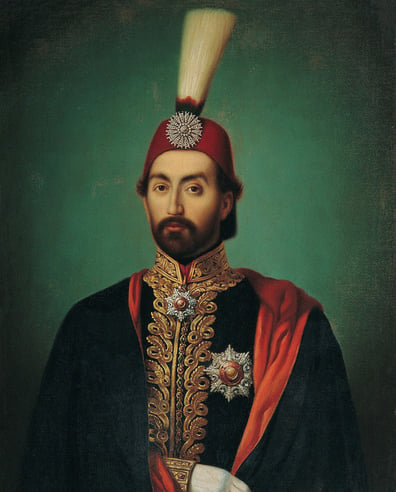
Portrait made in his lifetime — mid-19th c.
Abdulmejid I
The sultan of the Tanzimat: equality before the law, modern codes, the telegraph, the railway and the decision to found a university all belong to his reign. The Crimean War was won without territorial loss, but the first foreign loan was also taken and financial dependence began.
Open the reign of Abdulmejid I on the map▶ Watch the 1-minute video: YouTube · Instagram · TikTok
Interesting fact
He was brought up like a European prince, could read and speak French and was interested in Western music. He came to the throne in 1839 at sixteen; Dolmabahçe Palace (1856) and Küçüksu Pavilion (1857) were built in his reign.
Source: TDV İslâm Ansiklopedisi (Turkish), article “ABDÜLMECİD”
◆ The Ottoman coat of arms was adopted in his reign, in 1857. Explore the Ottoman coat of arms piece by piece, in 3D →
Life
Like a European prince
Abdulmejid was born in Istanbul on 25 April 1823. His father was Mahmud II and his mother Bezmialem Valide Sultan. Great care was taken over his education, and, in the words of the TDV article, he was raised “just like a European prince.” He learned French well enough to speak it and understand what he read; he followed developments in Europe closely and discussed various subjects with the foreigners he met. He admired Western music and the Western way of life.
When his father died on 28 June 1839, he came to the throne on 1 July 1839 at the age of sixteen. The state was living through one of its most difficult times: the army had been defeated by Egyptian forces at Nizip, and the grand admiral (kaptanıderya) Ahmed Fevzi Pasha had taken the fleet to Egypt and handed it over to Muhammad Ali Pasha. Aware of his inexperience, the young sultan promised the leading statesmen that he would listen to their advice.
The Tanzimat Edict
Foreign Minister Mustafa Reşid Pasha, who had been holding talks in London and Paris, returned to Istanbul at once. To win European support on the Egyptian question, he persuaded the young sultan to proclaim a reform program that would satisfy the European powers. The Gülhane Hatt-ı Hümayunu prepared by Mustafa Reşid Pasha, that is, the Tanzimat Edict (Gülhane Edict), was read out on 3 November 1839 before all the community leaders and the foreign envoys. The edict promised security of life, property and honor, the fair collection of taxes and a regular system of military service. According to the TDV article, this marked the beginning of a new era in Ottoman history; but in a sense the state also came under the tutelage of the European powers.
The Egyptian question was settled by the London Convention of 15 July 1840, signed among Britain, Russia, Austria and Prussia with France left out: the governorship of Egypt was left to Muhammad Ali Pasha on a hereditary basis, while the lands he had occupied and the Ottoman fleet were taken back. Under the London Straits Convention of 13 July 1841 the Straits were closed to warships in time of peace. After the revolutions of 1848, Hungarian nationalists who had fought for independence against Austria took refuge in Ottoman territory; despite Austrian and Russian threats of war, Abdulmejid refused to hand over the refugees, and this stance won the Ottomans great sympathy in Europe.
With the Tanzimat, the state's administrative organization was also rebuilt. For education, the Meclis-i Maarif-i Umumiyye (Council of Public Education) was formed in 1845 and the Mekatib-i Umumiyye Nezareti for primary and secondary schooling in 1847; the Ministry of Education (Maarif Nezareti) was established in 1857. Nizamiye courts, in which Muslim and non-Muslim members served together, were opened; through translation and adaptation from the West, a penal code was enacted in 1840, a commercial code in 1850 and a land code on 6 June 1858. The Council of Ministers (Meclis-i Vükela) grew in importance, and the practice of officials swearing an oath of loyalty to the state was introduced.
The Crimean War and the Reform Edict
When Russia demanded the protectorate of the Ottoman Orthodox and was refused, it occupied Wallachia and Moldavia; on 4 October 1853 war was declared on Russia. In this war, known as the Crimean War, Britain, France and Piedmont sided with the Ottomans. To meet the heavy costs of the war, a foreign loan was taken for the first time on 24 August 1854; other loans followed.
Before the Congress of Paris opened, the European powers had a reform edict complementing the Tanzimat proclaimed: the Reform Edict of 1856 (18 February 1856). The war ended with the Treaty of Paris of 30 March 1856, and the Ottoman state was admitted into the community of European states. In this period, in 1857, Abdulmejid adopted, with a few minor changes, the Ottoman coat of arms prepared at the request of Queen Victoria. He became the first sultan to return a visit by going to the French embassy, and the first to accept a foreign ruler's decoration, Napoleon III's Légion d'Honneur.
Schools, palaces and debts
Great strides were made in education under Abdulmejid: rüşdiye (middle) schools were opened, the first teachers' college (Darülmuallimin) was founded in 1848, and the first girls' rüşdiye opened in Istanbul in 1858. Schools of agriculture, forestry and telegraphy and a school of midwifery were established; in 1851 the Encümen-i Daniş, regarded as the first academy of sciences, convened. An attempt to open a Darülfünun (university), however, did not succeed.
Part of the foreign loans was spent on palaces and pavilions: Dolmabahçe Palace (1856), the Beykoz Pavilion (1855) and the Küçüksu Pavilion (1857). The Küçük Mecidiye (1849) and Teşvikiye (1854) mosques are also important buildings of the period; his mother, Bezmialem Valide Sultan, built the Gureba Hospital in 1845, and in the same year the new Galata Bridge entered service. From 1848 onwards Ottoman finances entered a period of continuous crises. In 1859 the “Kuleli Incident,” which aimed to depose the sultan and put Abdulaziz in his place, was suppressed before it began.
His death
Like his father, Abdulmejid contracted tuberculosis, and he died at the Ihlamur Pavilion on 25 June 1861, aged only thirty-eight. He was buried next to the tomb of Selim I (Yavuz Sultan Selim). He was succeeded by his brother Abdulaziz. Four of his sons, Murad V, Abdulhamid II, Mehmed V (Reşad) and Mehmed VI (Vahdeddin), later became sultans; the last four sultans to ascend the Ottoman throne were his sons.
Source: TDV Encyclopedia of Islam (TDV İslâm Ansiklopedisi), “Abdülmecid” (Cevdet Küçük); Lutfi Efendi, Cevdet Pasha's Tezakir and Maruzat, and Ottoman archival documents are the main sources of this article. Information on the coat of arms: Selman Can, Türklük Bilgisi Araştırmaları 24 (2000).
Meanwhile in the world
Contemporary rulers
- VictoriaQueen of the United Kingdom · 1837–1901Queen during Britain's rise to the height of world power
- Nicholas IEmperor of Russia · 1825–1855Tsar who ruled for thirty years as a strict autocrat
- Alexander IIEmperor of Russia · 1855–1881Reforming tsar who emancipated the serfs in 1861
- Napoleon IIIEmperor of the French · 1852–1870Nephew of Napoleon I and founder of the Second Empire
- Franz JosephEmperor of Austria · 1848–1916Habsburg emperor who came to the throne during the 1848 revolutions
- Naser al-Din ShahShah of Iran (Qajar dynasty) · 1848–1896Qajar shah who introduced telegraph, postal service and Western-style schooling
- Xianfeng EmperorEmperor of China (Qing dynasty) · 1850–1861Qing emperor shaken by the Taiping Rebellion and Anglo-French pressure
What was happening in the world?
- 1848The Revolutions of 1848: popular uprisings break out in Paris, Vienna, Berlin and Italian cities.
- 1851The Great Exhibition, regarded as the first modern world's fair, opens in London's Crystal Palace.
- 1853American Commodore Matthew Perry's ships arrive in Japan, pressing the country to open to foreign trade.
- 1857A great rebellion against British rule begins at Meerut in India and spreads widely.
- 1859Charles Darwin publishes On the Origin of Species, setting out evolution by natural selection.
- 1861Alexander II's manifesto abolishes serfdom in Russia.
Sources: britannica.com [1] [2] [3] [4] [5] [6] [7] [8] [9] [10] [11] [12] [13]
Family
| Father | Mahmud II |
|---|---|
| Mother | Bezmialem Sultan |
| Consorts | Servetseza Kadın, Tirimüjgan Kadın, Rahime Perestu Kadın, Şevkefza Kadın, Gülcemal Kadın, Düzdidil Kadın (and many others) |
| Children | Murad V, Abdulhamid II, Mehmed V (Reşad), Mehmed VI (Vahideddin), Cemile Sultan, Refia Sultan, Fatma Sultan (and many others) |
Major achievements
- The Tanzimat Edict (1839) and the Reform Edict (1856) — proclaiming equality before the law
- Penal, commercial and land codes enacted
- Construction of Dolmabahçe Palace
- First telegraph line (1855) and the first railway concession (Izmir–Aydın)
- First Ottoman paper money (kaime) and the Imperial Ottoman Bank
- Decision to found a university (Darülfünun)
- Entry into the European state system with the Crimean War and the Treaty of Paris
- First foreign loan (1854) — a turning point for the finances
Treaties
- London Straits Convention (1841)
- Treaty of Paris (1856)
Grand viziers
| Name | From | To | Length |
|---|---|---|---|
| Mehmed Emin Rauf Pasha (term 2) | February 18, 1833 | July 2, 1839 | 6 years, 134 days |
| Koca Hüsrev Mehmed Pasha | July 2, 1839 | June 8, 1840 | 342 days |
| Mehmed Emin Rauf Pasha (term 3) | June 8, 1840 | December 4, 1841 | 1 year, 179 days |
| Topal Izzet Mehmed Pasha (term 2) | December 5, 1841 | August 30, 1842 | 268 days |
| Mehmed Emin Rauf Pasha (term 4) | August 30, 1842 | September 28, 1846 | 4 years, 29 days |
| Mustafa Reşid Pasha | September 28, 1846 | April 28, 1848 | 1 year, 213 days |
| Ibrahim Sarım Pasha | April 30, 1848 | August 12, 1848 | 104 days |
| Mustafa Reşid Pasha (term 2) | August 12, 1848 | January 26, 1852 | 3 years, 167 days |
| Mehmed Emin Rauf Pasha (term 5) | January 26, 1852 | March 5, 1852 | 39 days |
| Mustafa Reşid Pasha (term 3) | March 5, 1852 | August 5, 1852 | 153 days |
| Ali Pasha | August 5, 1852 | October 3, 1852 | 59 days |
| Damad Mehmed Ali Pasha | October 3, 1852 | May 14, 1853 | 223 days |
| Mustafa Naili Pasha | May 15, 1853 | May 29, 1854 | 1 year, 14 days |
| Kıbrıslı Mehmed Emin Pasha | May 29, 1854 | November 23, 1854 | 178 days |
| Mustafa Reşid Pasha (term 4) | November 23, 1854 | May 2, 1855 | 160 days |
| Ali Pasha (term 2) | May 2, 1855 | November 1, 1856 | 1 year, 183 days |
| Mustafa Reşid Pasha (term 5) | November 1, 1856 | August 1, 1857 | 273 days |
| Mustafa Naili Pasha (term 2) | August 2, 1857 | October 22, 1857 | 81 days |
| Mustafa Reşid Pasha (term 6) | October 22, 1857 | January 7, 1858 | 77 days |
| Ali Pasha (term 3) | January 11, 1858 | October 18, 1859 | 1 year, 280 days |
| Kıbrıslı Mehmed Emin Pasha (term 2) | October 18, 1859 | December 23, 1859 | 66 days |
| Mütercim Mehmed Rüşdü Pasha | December 24, 1859 | May 27, 1860 | 155 days |
| Kıbrıslı Mehmed Emin Pasha (term 3) | May 28, 1860 | August 6, 1861 | 1 year, 70 days |
Battles and treaties
| Year | Event | Result / parties |
|---|---|---|
| 1841 | Treaty: London Straits Convention | |
| 1847 | Treaty: Second Treaty of Erzurum | Ottoman Empire, Qajar Iran |
| 1852 | Battle: Montenegrin–Ottoman wars (1852–1862) | Old borders restored in 1853; defeat at Grahovo in 1858; Montenegro accepted Ottoman terms in 1862 |
| 1853 | Naval battle: Battle of Sinop | Heavy loss for the Ottoman squadron in harbour: twelve ships sunk, more than 2,000 dead |
| 1854 | Siege: Siege of Silistra (1854) | The Russian siege failed; the town was held |
| 1855 | Siege: Siege of Sevastopol | Sevastopol fell to the allies; the way to peace talks was opened |
| 1856 | Treaty: Treaty of Paris | Ottoman Empire, Russian Empire (end of the Crimean War) |
| 1859 | Revolt: Kuleli incident (1859) | The coup plot was uncovered; death sentences were commuted to life imprisonment |
Full infoboxes are in the site’s “Battles and Treaties” tab; source: TDV Encyclopedia of Islam.
Death
He died of tuberculosis in 1861 at thirty-eight.
Territorial change
The lands that changed hands in this period, and the battles or treaties that brought the changes, can be seen on the map: map of the reign of Abdulmejid I.
Cite as: Atlas of the Sultans, “Abdulmejid I: Reign Map, Wars and Conquests (1839–1861)”, https://padisahlaratlasi.com/en/sultans/i-abdulmecid/ (last updated 21 November 2026). Corrections · Image credits
Terms on this page: Tanzimat
Grand viziers of this reign: Mustafa Reşid Pasha · Ali Pasha
Monuments of this reign: Hagia Sophia · Galata Mevlevi Lodge · Yıldız Palace · Teşvikiye Mosque · Muhammad Ali Mosque · Dolmabahçe Mosque · Küçük Mecidiye Mosque · Tomb of Mahmud II · Dolmabahçe Palace · Hırka-i Şerif Mosque · Ihlamur Pavilion · Ortaköy Mosque
Women of the dynasty in this reign: Bezmialem Valide Sultan
Capital in this reign: Istanbul
State organisation: The Grand Vizierate and the Sublime Porte · The Enderun and the palace organisation · The Tanzimat and the renewal of government