TRENDEFRARAtlas of the Sultans · Ottoman monuments
Selimiye Barracks
Monument · Barracks, 1800–1803; rebuilt 1829
- Type
- Fortress and barracks
- Built
- 1800–1829
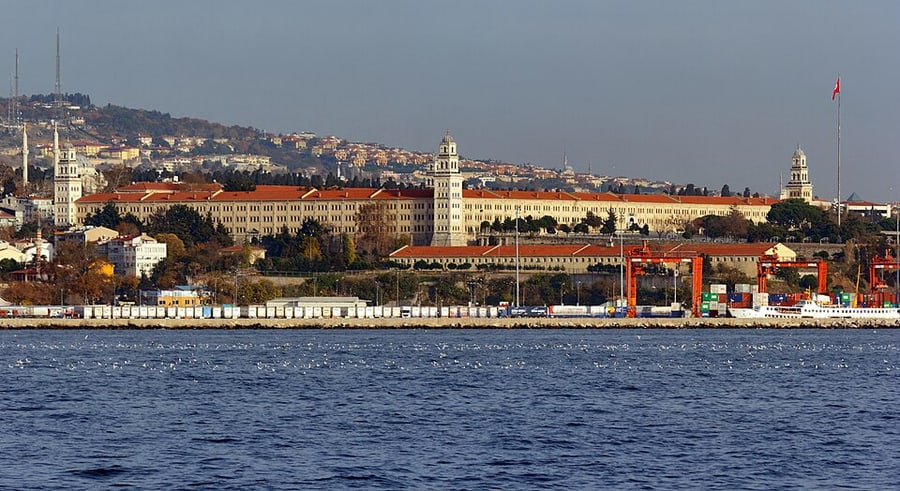

Selim III's Nizam-ı Cedid barracks
The barracks were first built by Sultan Selim III in 1800–1803 on the site of the Kavak Palace in Üsküdar. The sultan, who launched the Nizam-ı Cedid (“New Order”) movement, intended this building as the military home of the new order. The first barracks, completed with their annexes in 1803, were a third the size of the present building; even so they were very large for their time and, according to the author of the article, marked the beginning of the era of great barracks in Istanbul.
This first two-storey building with an inner courtyard did not yet have towers at its corners. On the sea side there were a drill ground, two royal pavilions, a mosque, and service units such as a hospital, a kitchen and a laundry. The preliminary survey register bears the signature of the chief architect Mehmed Arif Ağa. Unlike the others, the barracks housed a mehter (military band) company, artillerymen and a cavalry unit. The building bore no special name in Selim III's time; it came to be called Selimiye only after 1830.
Destruction and rebuilding
When the Nizam-ı Cedid was brought to an end by the revolt of Kabakçı Mustafa in 1807, a decree was issued for the barracks to be turned into a han, and the decorated door canopies were demolished. Repaired after Mahmud II came to the throne in July 1808, the building was given to the soldiers of the Sekban-ı Cedid, but it was burned by the Janissaries in the revolt of November 1808. In 1809 its ruins and land were put up for sale.
With the abolition of the Janissary Corps on 15 June 1826, preparations were made to rebuild the barracks, and the land that had been sold was expropriated. The new building, with stone walls, a gate on each of its four façades and towers at its corners, was opened with a magnificent ceremony on 27 January 1829. The architect in charge was the chief court architect Seyyid Abdülhalim Efendi. The present building measures 267 × 198 metres; it is nearly square in plan, with an inner courtyard, and has three storeys.
Restorations and historical events
The inscriptions on the gates dated 1828, 1842 and 1853 point to repairs in different periods. In 1841 the open corridors on the courtyard side were closed in and rebuilt in masonry. In the fire that broke out on the night of 26 October 1847 the north and west wings burned; in the repair the other walls too were built in masonry. In the 1960–1965 restoration the floors, except for the lowest storey, were converted to reinforced concrete.
The first discharge ceremony in the Ottoman army was held here on 26 March 1844. During the Crimean War the barracks were given to British soldiers and used as a hospital; Florence Nightingale, who came to care for the wounded, stayed in the tower reserved for the sultan. The barracks sheltered the victims of the Üsküdar fire of 1887, and later refugees and immigrants. When Istanbul was occupied in 1920 they came under Italian control; during the Turkish War of Independence (Millî Mücadele) weapons were smuggled from here to Anatolia.
The present state
Left empty for a time in the first years of the Republic, the barracks became a military middle school in 1959. Since 1964 they have been the headquarters of the First Army Command of the Turkish Armed Forces. The tower where Florence Nightingale stayed is preserved today as a museum and is open to visitors.
Source: TDV Encyclopedia of Islam (TDV İslâm Ansiklopedisi), “SELİMİYE KIŞLASI” (M. Gözde Ramazanoğlu)
Related sultans
Cite as: Atlas of the Sultans, “Selimiye Barracks · Ottoman monuments”, https://padisahlaratlasi.com/en/monuments/selimiye-barracks/ (last updated 21 November 2026). Corrections · Image credits