TRENDEFRARAtlas of the Sultans · Ottoman monuments
Et'hem Bey Mosque
Monument · Mosque, Tirana, 1793–1823
- Type
- Mosque
- Built
- 1793–1823
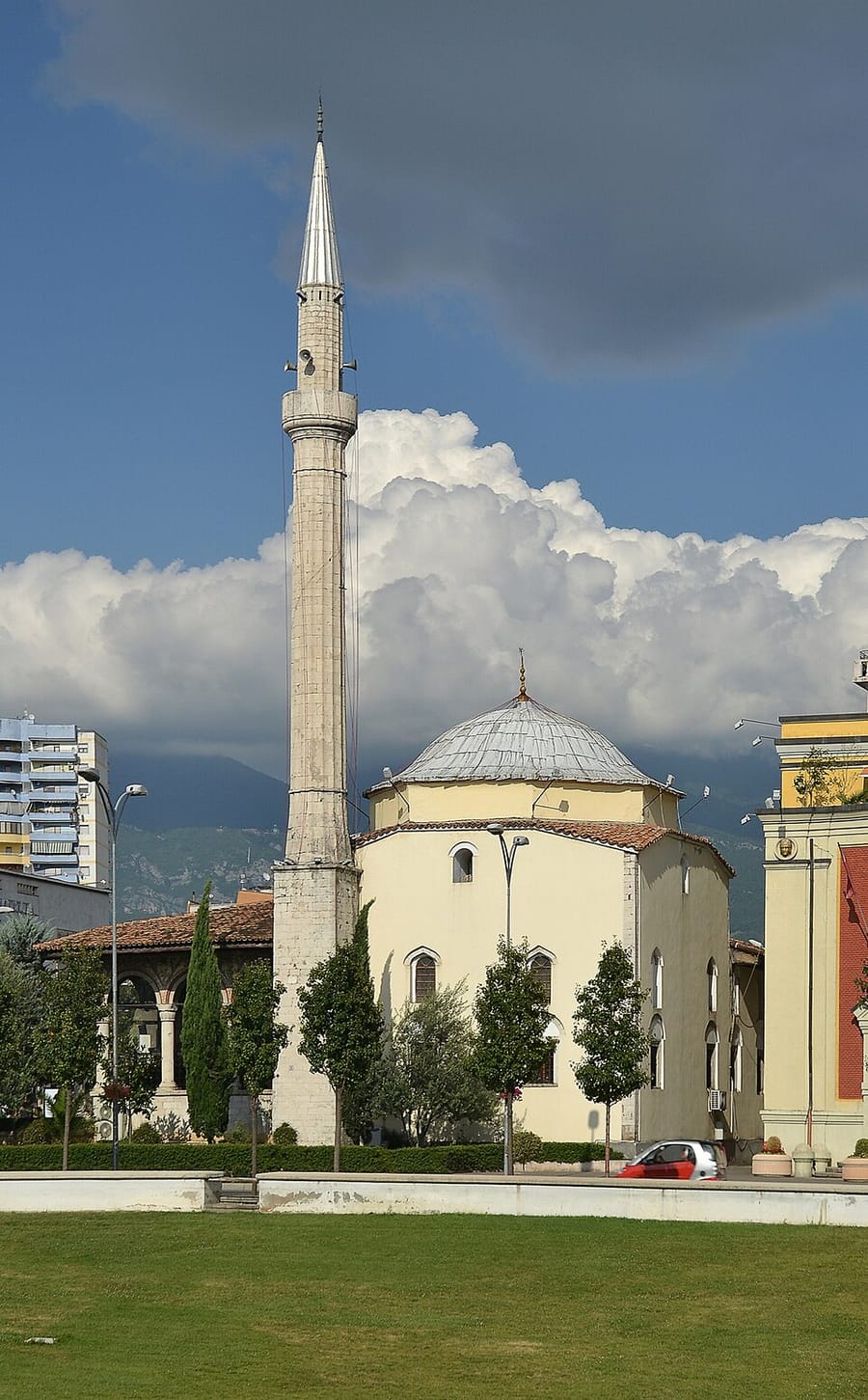

Tirana's painted mosque
The mosque stands on the central square of Tirana, beside the clock tower. According to its inscription it was built by Molla Bey in 1793–94 as a square hall covered by a single dome, though its minaret was left unfinished. After Molla Bey died in 1808, his son Haji Et'hem Bey completed the mosque in 1822–23, when the timber-roofed porticoes wrapping two of its sides were also added. A second verse inscription recording its completion was written by the poet Suzi Çelebi.
Squinches carry the transition to the dome, and the mosque lacks the domed portico usual in Ottoman mosques. Its most striking feature is the painted decoration, including fruit and landscape scenes, that covers the interior and the inner walls of the porticoes almost without a gap. The minaret, half destroyed in 1944, was later repaired. Closed to worship in 1966, the mosque survived because it was used as a museum, and it reopened for prayer in the 1990s.
Founder and years of closure
Citing an endowment record, Ekrem Hakkı Ayverdi writes that the mosque's founder was the son of Şaban. The first inscription relates in verse that Molla Bey succeeded in completing the dome but could not finish the minaret. Closed to worship by Enver Hoxha's regime in 1966, the mosque was not destroyed like many others elsewhere in the country; in March 1968 it could be visited only after permission had been obtained with difficulty.
Arcades and pictorial painting
The later wooden-roofed arcades wrap around the entrance façade and one side façade; their column capitals follow no particular style, and the arches carried by the columns are semicircular. Like many examples in the Balkans, the minaret is extremely tall, with a fluted shaft and a plain balcony; it was damaged in the fighting at the end of the German occupation in 1944.
The inscription at the crown of the dome is written within a spiral frame shaped like a snail shell and surrounded by Baroque motifs. It is unclear which places the landscape paintings in the arch spandrels, on the entrance façade and on the side wall depict; some show mosques with twin minarets. The mosque also once had a richly painted wooden minbar and gallery. Ottoman in its building methods, the mosque reflects, through the coloured decoration of its interior and exterior, a taste widespread in the Balkans and also seen in Macedonia and Bulgaria.
Source: TDV Encyclopedia of Islam (TDV İslâm Ansiklopedisi), “EDHEM BEY CAMİİ” (Semavi Eyice)
Related sultans
Cite as: Atlas of the Sultans, “Et'hem Bey Mosque · Ottoman monuments”, https://padisahlaratlasi.com/en/monuments/et-hem-bey-mosque/ (last updated 21 November 2026). Corrections · Image credits