TRENDEFRARAtlas of the Sultans · Ottoman monuments
Galata Mevlevi Lodge
Monument · Mevlevi lodge, Istanbul, 1491
- Type
- Dervish lodge
- Built
- 1491
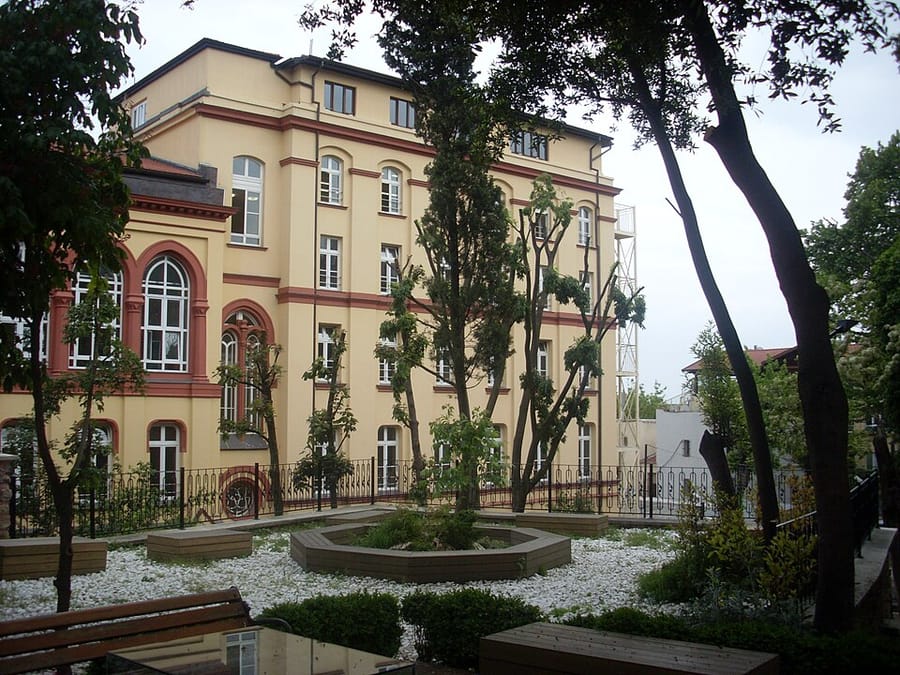

Istanbul's most senior Mevlevi lodge
Also known as the Kulekapı Mevlevihane, the lodge was founded in 1491 by Iskender Pasha, a statesman of the reigns of Mehmed the Conqueror and Bayezid II, on part of his hunting estate; he endowed it with his properties in Vize. Left without a sheikh and ruined after 1548, it was revived by a major repair under Sheikh Sırrı Abdi Dede in 1608. After the great Tophane fire of 1765 Mustafa III had it rebuilt, and in 1791–92 Selim III renewed its buildings at the petition of the poet Sheikh Galib, giving the complex its present layout.
In 1819 Halet Efendi built the present gateway, the sebil and library building and the tombs. After a fire in 1824, Mahmud II had the lodge rebuilt in 1835. The present main building, housing the semahane (ritual hall), the sheikh's quarters and the dervish cells, was built for Abdulmejid by Menas Kalfa in 1859–60; at its centre is an octagonal ritual floor. After the dervish lodges were closed in 1925 the main building served as a community centre (halkevi); following a long restoration it opened as the Museum of Divan Literature on 27 December 1975.
Layout of the complex
To the right of the main gate on Galipdede street stands Halet Efendi's sebil-school, and to the left the tomb of Kudretullah Dede and a row of shops. Faced with white marble, the gate, the sebil-school and the tomb are among the earliest examples of the Ottoman Empire style. The inscription on the outer face of the gate was placed by Mahmud II in 1834–35; its text is by Mehmed Lebib and its ta'liq calligraphy by Yesarizade Mustafa Izzet. The text of the inscription on the inner face, recording Selim III's renewal, is by Sheikh Galib. The sebil-school, which combines a water dispensary, a fountain, a timekeeper's room and a library-school, is the last example of its type in Ottoman architecture.
The gate leads to a stone-paved courtyard in the middle of which rises a cypress said to have been planted by Divane Mehmed Çelebi. West of the courtyard are the cistern and ablution fountain built by Adile Sultan in 1847, to the north the Hasan Ağa Fountain of 1649, and to the east the tomb where Ankaravi and Sheikh Galib are buried, together with the graveyard. The vaulted retreat cell next to the tomb, reached down steps, was very probably a holy spring belonging to the Byzantine monastery that once stood on the site.
The semahane
The present main building by Menas Kalfa covers an area of 28 × 19 m and consists of two timber storeys over a masonry basement. The octagonal sema area at its centre has sides of 5 m and a height of 8.30 m; its openings are divided by wooden columns with Ionic capitals on the ground floor and composite capitals above. Contrary to the established practice in dervish lodges, the women's gallery is on the ground floor and opens to the semahane through latticed windows that allow a view only when standing. The dervish cells are arranged in the basement on the four-iwan plan of Turkish domestic architecture.
The pastel painted decoration of the eight-segment ceiling and the mihrab, and the porphyry-imitation paint on the columns and walls, reflect the eclectic taste of Abdulmejid's reign; with its large crystal chandelier, the semahane resembles the palaces of the period more than a dervish building.
Its sheikhs and later history
In this lodge, where the ceremony was held on Tuesdays and Fridays, Divane Mehmed Çelebi is usually named as the first sheikh, but Iskender Pasha's endowment deed assigns the trusteeship to Sheikh Yunus Efendi. When Sırrı Abdi Dede was removed in 1610–11, he founded the Kasımpaşa Mevlevihane. The sheikhs also included the famous composer and ney player Kutbünnayi Osman Dede. Surrounded in the 19th century by the Levantine quarters of Pera, the lodge was listed in tourist guides among the places one must see. In 1945–1947 the Beyoğlu marriage office was built on the eastern part of the graveyard, and the wooden tombs at the semahane entrance, the harem and the kitchen were removed at that time.
Source: TDV Encyclopedia of Islam (TDV İslâm Ansiklopedisi), “GALATA MEVLEVÎHÂNESİ” (M. Baha Tanman)
Related sultans
Cite as: Atlas of the Sultans, “Galata Mevlevi Lodge · Ottoman monuments”, https://padisahlaratlasi.com/en/monuments/galata-mevlevi-lodge/ (last updated 21 November 2026). Corrections · Image credits