TRENDEFRARAtlas of the Sultans · Ottoman monuments
Hekimoğlu Ali Pasha Mosque
Monument · Mosque, Istanbul, 1734–1735
- Type
- Mosque
- Built
- 1734–1735
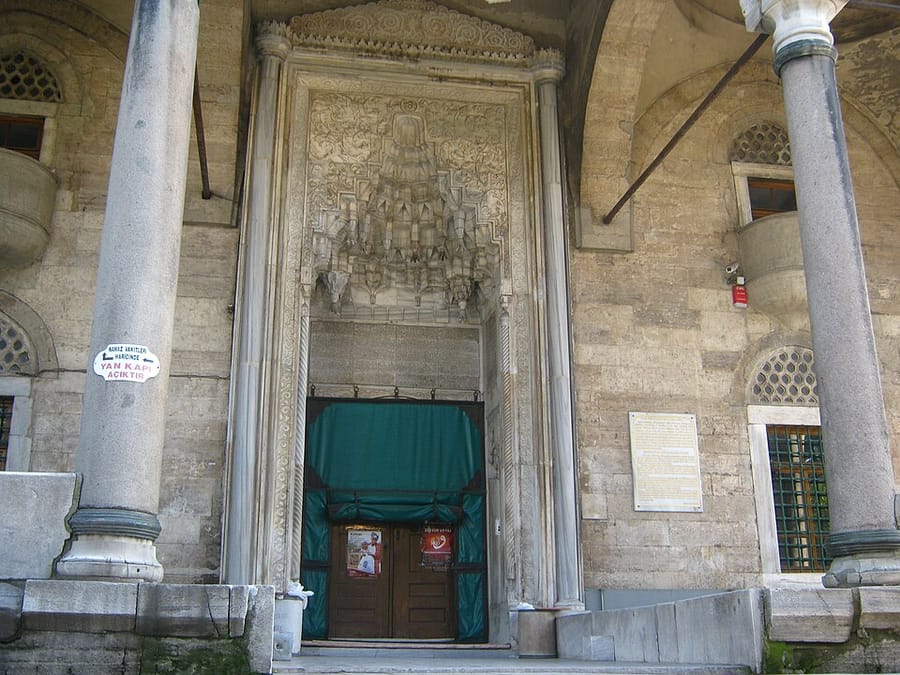

A grand vizier's complex in Davutpaşa
This mosque in the Davutpaşa quarter of the Fatih district is the centrepiece of a complex (külliye) that Hekimoğlu Ali Pasha, one of the grand viziers of Mahmud I, had built in 1734–35 by two architects, Çuhadar Ömer Ağa and Hacı Mustafa Ağa; the complex also includes a dervish lodge, a library, a tomb, a sebil and fountains. Because the Abdal Yakub lodge that had stood on the site was revived during construction, the mosque also served as that lodge's ritual hall, and three small retreat cells were set into its walls. Built of cut küfeki limestone, its prayer hall is covered by a dome resting on six piers and by six semi-domes.
Most of the underglaze tiles on its walls were made in the Tekfur Palace workshops. The 1734–35 foundation inscription above the door was composed by Şeyhülislam Ebu Ishakzade Ishak Efendi and written by the calligrapher Cihangirli Mustafa Efendi. The mosque was repaired in 1783 under Abdulhamid I and in the 1830s under Mahmud II; the present painted decoration dates from the Mahmud II restoration and was renewed with cruder workmanship in 1900. The minaret was destroyed in the 1830s and rebuilt, fell again during repairs in 1962 and was rebuilt the same year. The wooden royal pavilion and most of the outer courtyard walls, apart from the southern gate, have not survived.
Roof system and gallery
The six piers carrying the dome are twelve-sided in section; two stand at the corners of the mihrab projection and four are free-standing. Leaving the piers free allowed the prayer hall to be widened to the east, west and north. Outside, the piers rise between the half domes as octagonal weight turrets capped with ribbed cupolas. The prayer hall is lit by five rows of windows. The gallery, resting on columns with muqarnas capitals, surrounds the hall on three sides except for the mihrab projection; its marble balustrades bear a geometric pattern formed by intersecting dodecagons. The south-east end of the gallery is arranged as the sultan's loge; the baroque ornament verging on rococo of the wooden projection there points to the repair of 1783.
Mihrab, minbar and tiles
The marble mihrab, a seven-sided niche, has a hood of pendant muqarnas; on either side is a Kadiri-Eşrefi crown and at the top centre a Kadiri rose. Above the doorway of the finely worked marble minbar is painted a composition of large naturalistic flowers reflecting the style of the period. Some blue-and-white Kütahya tiles are used among the tiles, and there is a panel depicting the Kaaba, notable for its use of depth and light and shade. At the end of the monumental thuluth band of the Throne Verse is the signature el-fakir Hasan hane-i hassa, of a calligrapher about whom nothing is known. The retreat cells set into the walls measure 1.60 × 1.70 metres. On the west face of the minaret base is a sundial made by Halifezade Ismail in 1761–62.
Tomb, library and sebil
The western part of the two-domed tomb was built for Abdal Yakub, Sheikh Ibrahim and other notables of the dervish lodge, the eastern part for Hekimoğlu Ali Pasha, his wife Muhsine Hatun and family members; on the street façade is an inscription of 1758 by the poet Hıfzi. The books of the library, built on an upper storey above the courtyard gate and covered by a coved vault, are in the Süleymaniye Library, while some illuminated volumes and its wooden inscription are in the Museum of Turkish and Islamic Arts. The inscription of the five-sided sebil (water dispensary), dated 1733–34, is by the poet Vehbi; the structure was last restored in the 1980s.
Related sultans
Cite as: Atlas of the Sultans, “Hekimoğlu Ali Pasha Mosque · Ottoman monuments”, https://padisahlaratlasi.com/en/monuments/hekimoglu-ali-pasha-mosque/ (last updated 21 November 2026). Corrections · Image credits