TRENDEFRARAtlas of the Sultans · State organisation
The Tanzimat and the renewal of government
Institution · Reform of central and provincial administration · 1830–1878
 AI

The classical order: the Divan and the Pasha's Gate
In the classical period the brain of Ottoman government was the Imperial Council (Divan-ı Hümayun), and so it remained until the second half of the 17th century. Thereafter the Imperial Council became a symbolic body limited to ceremonies such as accession bonuses, the payment of troops and the reception of envoys, and government shifted to the grand vizier's residence, the “Pasha's Gate” (Paşakapısı). In the late 18th century the organisation headed by the grand vizier began to be called the Bab-ı Ali; in European writings, as the Sublime Porte and Hohe Pforte, the term became the name of the Ottoman government.
Before the ministries existed, three senior officials served under the grand vizier at the Porte. The steward of the grand vizier (sadaret kethüdası, kahya bey) dealt with internal affairs and had correspondence with the provinces prepared. The chief scribe (reisülküttab) headed the bureaucracy; the beylikçi, tahvil and ruus offices answered to him, and the amedi office founded in the 1770s worked as his private secretariat. The chief çavuş (çavuşbaşı) handled justice and police matters, having petitions to the grand vizier examined and referred to the courts. The real transformation of these institutions began after Mahmud II abolished the Janissary Corps in 1826.
Mahmud II and the founding of ministries
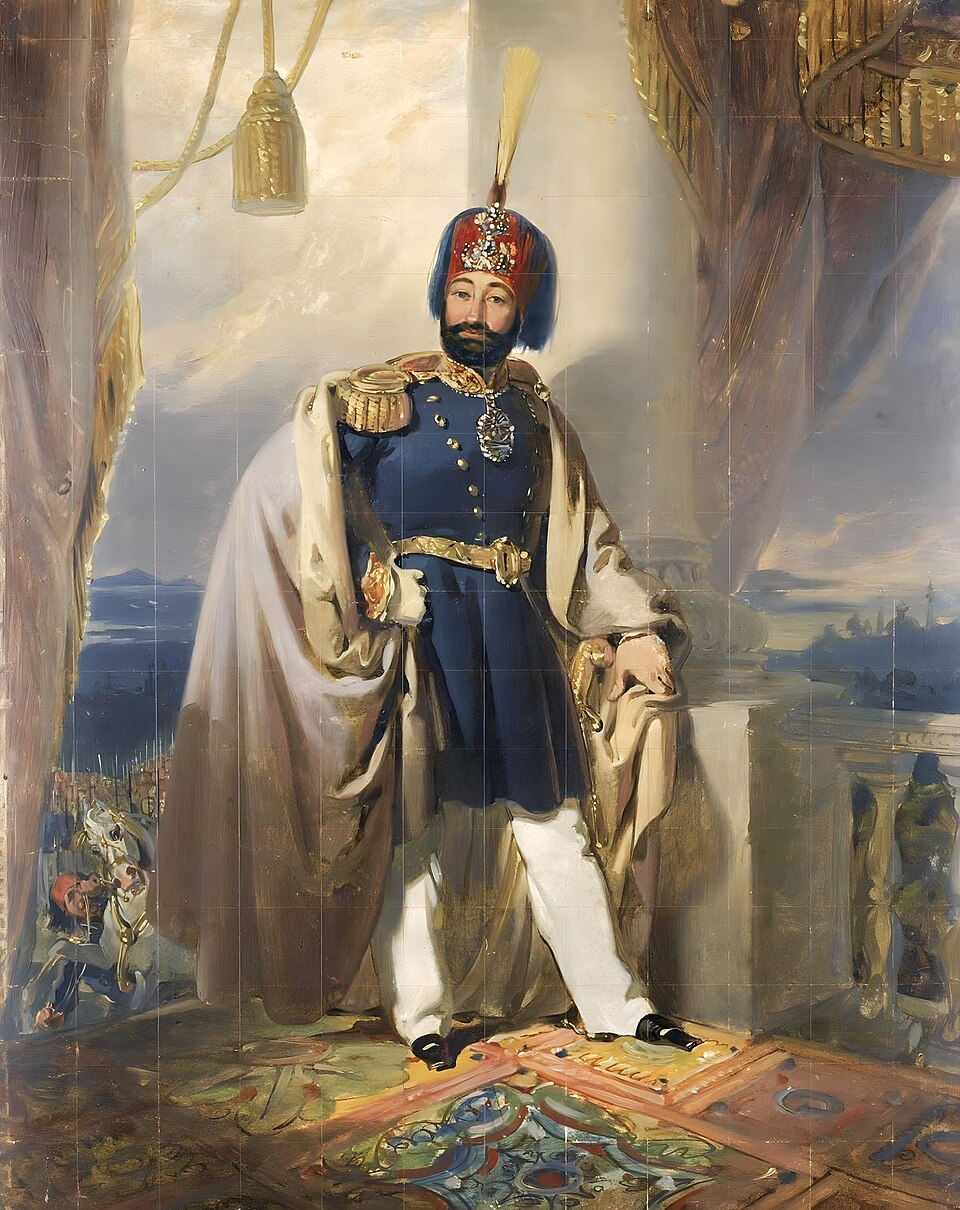
According to the TDV article on the Tanzimat, recent research shows that its first measures can be traced back to 1830. From the early 1830s Mahmud II completely changed the central organisation. The office of serasker replaced that of the agha of the Janissaries, and the Ministry of Imperial Endowments was opened in October 1826. In the palace the office of silahdar was abolished in 1831 and the private secretariat became the chief secretariat of the Mabeyin. The bodies at the Porte were renamed and turned into ministries (nezaret), specialised units with more clearly defined duties.
In 1835 the stewardship of the grand vizier became the Ministry of Civil Affairs (Mülkiye Nezareti), renamed the Ministry of the Interior (Dahiliye Nezareti) a year later; the same year a decree turned the office of chief scribe into the Ministry of Foreign Affairs (Umur-ı Hariciye Nezareti). These two ministries remained the Porte's two core bodies until the end of the empire. The office of chief çavuş was renamed the Ministry of Petitions (Deavi Nezareti) in 1836 and abolished when the Ministry of Justice was founded in 1870. On 28 February 1838 the Imperial Treasury and the Mansure Treasury were merged as the Ministry of Finance, confiscation was abolished and officials were given salaries. On 24 March 1838 the Supreme Council (Meclis-i Vala) was set up to deliberate on reforms, and on 24 May 1839 the Ministry of Trade was opened.

The Gülhane Rescript
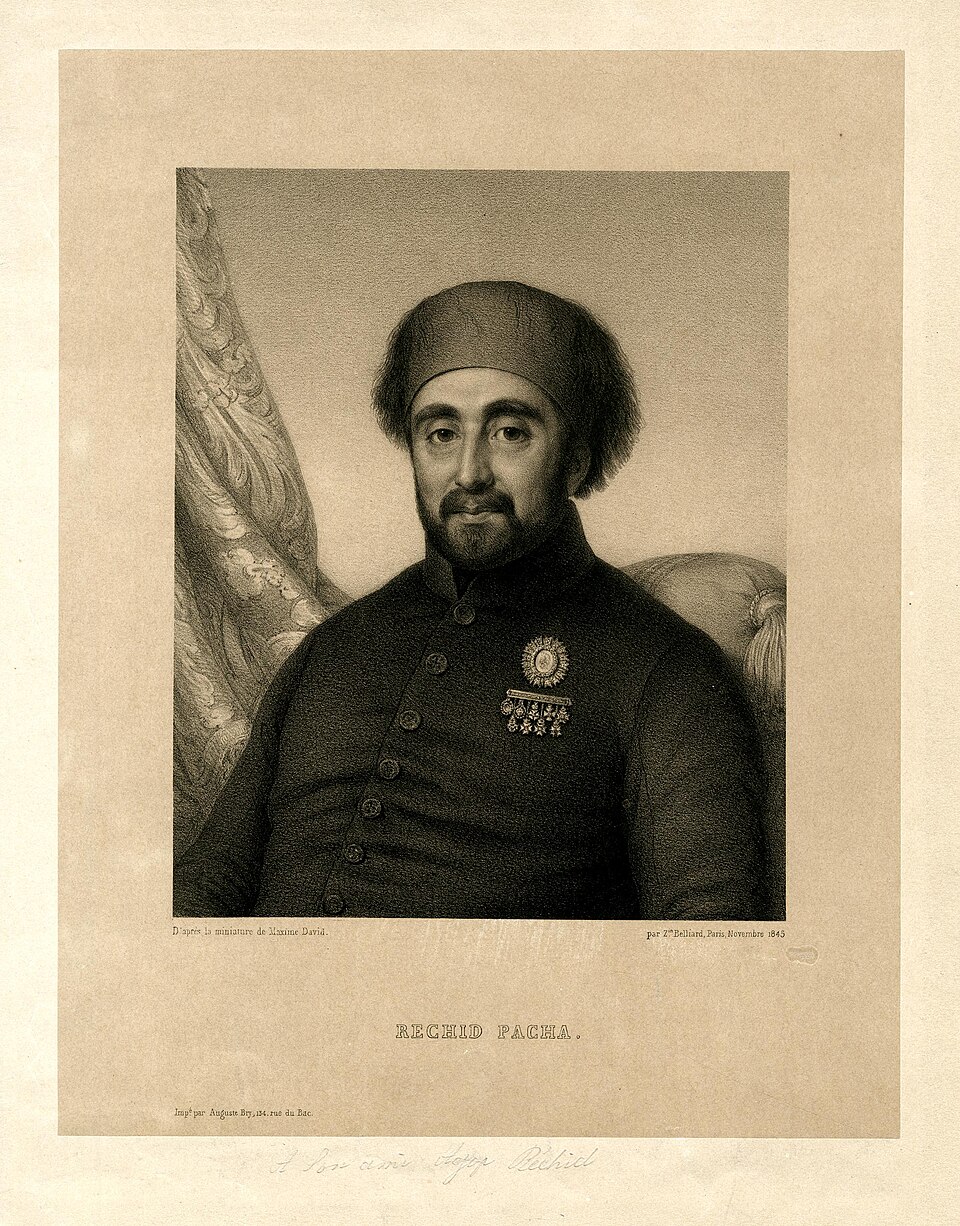
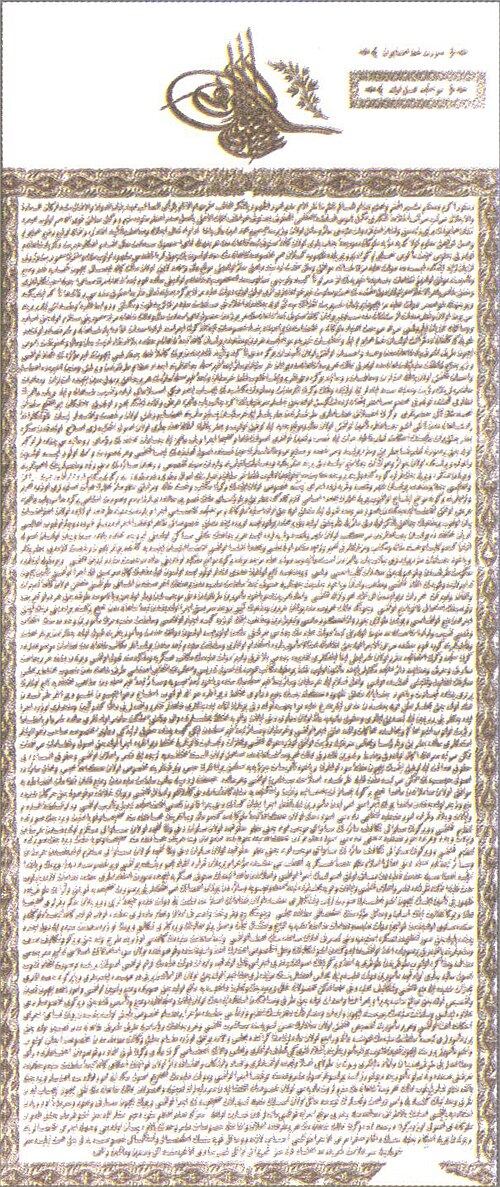
Under Abdulmejid, who succeeded Mahmud II, Foreign Minister Mustafa Reşid Pasha read on 3 November 1839, on the Gülhane square, the imperial rescript known as the Tanzimat Edict, before dignitaries, ulema, patriarchs, the chief rabbi, guild representatives and envoys; the sultan watched from the Gülhane Pavilion. The edict declared that new laws would rest on security of life, the protection of property, honour and dignity, taxation according to each person's means and a military service limited to four or five years. No one would be put to death without trial, and all subjects, Muslim and non-Muslim alike, would enjoy these rights equally. Abdulmejid swore in the Chamber of the Holy Mantle to abide by the principles proclaimed.
The article's author, Ali Akyıldız, stresses that attributing the edict to Mustafa Reşid Pasha alone is mistaken. Similar principles already appeared in Abdulmejid's accession rescript of 17 July 1839, and half of the seals on the report of the thirty-eight-member consultative council that met at the Porte before the edict belonged to ulema. In Akyıldız's view the edict was the product of the Ottoman state's internal dynamics more than of foreign influence. It was announced throughout the country, but for fear of reactions it was first applied in places near the centre such as Edirne, Bursa, Izmir, Ankara, Aydın, Konya and Sivas.

New institutions and provincial order
In finance, tax farming (iltizam) was abolished and tax collection entrusted to collectors (muhassıl) sent from the centre; councils representing Muslim and non-Muslim inhabitants were set up in district centres. But resistance by local notables and tax farmers and a lack of qualified staff caused the system to fail, and tax farming was restored at the start of 1842. In the army, conscription by lot was adopted in 1843, active service was limited to five years and reserve service to seven, and five armies were formed. A Ministry of Posts was created in 1840, a Marshalate of Police in 1845, a Council of Public Education and a Ministry of Public Schools in 1846; a state archive (Hazine-i Evrak) was set up at the Porte, and the first state yearbook (salname) appeared in 1847. The Supreme Council of the Tanzimat, which took over legislation, was founded in 1854, and the Istanbul municipality (şehremaneti) in 1855.
The Reform Edict (Islahat Fermanı) proclaimed on 18 February 1856 gave non-Muslims rights of full equality with Muslims. The Provincial Regulation (Vilayet Nizamnamesi) of 1864, modelled on the French system, reorganised the provinces into vilayet, sancak, kaza and village, with administrative councils at each level in which local officials and community leaders sat. After a successful trial in the Danube province, the system was extended in 1867 to the whole country except Yemen and Baghdad, and the General Provincial Administration Regulation followed in 1871. On 5 March 1868 the Council of Judicial Ordinances was split into the Council of State (Şura-yı Devlet), modelled on the French Conseil d'État and chaired by Midhat Pasha, and the High Court of Justice (Divan-ı Ahkam-ı Adliye), chaired by Ahmed Cevdet Pasha. That year a commission under Ahmed Cevdet Pasha began preparing the Mecelle, a civil code based on Hanafi law.
Towards constitutional rule and assessment
When the Tanzimat ended is debated; dates such as 1871, 1877 and 1881 have been proposed, but the general view is that the period closed with the suspension of parliament in 1878. The Constitution (Kanun-ı Esasi), prepared by a commission under Midhat Pasha and comprising 119 articles under twelve headings, came into force on 23 December 1876; it provided for a two-chamber parliament made up of an elected Chamber of Deputies (Meclis-i Mebusan) and a Senate (Meclis-i Ayan) appointed by the sultan. Parliament opened with a ceremony at Dolmabahçe Palace on 19 March 1877, but Abdulhamid II prorogued it indefinitely on 13 February 1878. In the second half of the 19th century the yearbooks listed the grand vizierate, the Council of State and the ministries of the Interior and Foreign Affairs as the Porte's body; after the founding of the Republic the Porte's buildings were given to the Governorship of Istanbul.
In Ali Akyıldız's assessment the Tanzimat reforms were less planned and programmatic than responses to practical needs. The reformers lacked officials able to understand and apply the reforms, a sound financial base and enough time; education was taken up late, and no effective tax collection system was built. Interference by the envoys of the Great Powers, power struggles among bureaucrats and opposition from opponents of reform at times slowed the changes, and the new institutions were often altered. Even so, the ministries, the provincial system, the councils and the new laws formed a lasting transformation that carried Ottoman government from the classical council order to a modern system of ministries.
Source: TDV Encyclopedia of Islam, “TANZİMAT” (Ali Akyıldız); “BÂBIÂLİ” (Mehmet Ipşirli)
Related sultans
Cite as: Atlas of the Sultans, “The Tanzimat and the renewal of government · State organisation”, https://padisahlaratlasi.com/en/ottoman-state-organisation/the-tanzimat-and-the-renewal-of-government/ (last updated 21 November 2026). Corrections · Image credits