TRENDEFRARAtlas of the Sultans · 37 / 39 · sultan
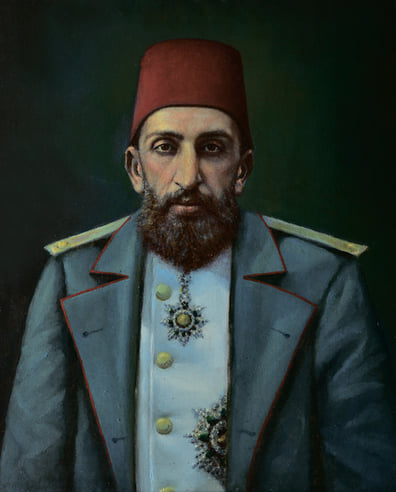
Photograph — 1899
Abdulhamid II
His thirty-three-year reign saw both the greatest territorial loss and the most intensive investment in schools, railways and the telegraph. Proclaiming and then suspending the constitution, rule through a centralised intelligence network and the cost of the 1877–78 war make him the most controversial sultan in Ottoman history.
Open the reign of Abdulhamid II on the map▶ Watch the 1-minute video: YouTube · Instagram · TikTok
Interesting fact
He built the Hejaz Railway from Damascus to Medina. After his deposition and exile to Salonica he spent his time at the Alatini Villa doing carpentry and metalwork.
Source: TDV İslâm Ansiklopedisi (Turkish), article “ABDÜLHAMİD II”
◆ The final, best-known form of the Ottoman coat of arms was arranged at his request in 1882. Explore the Ottoman coat of arms piece by piece, in 3D →
Life
His years as a prince
Abdulhamid was born on 21 September 1842. His father was Abdulmejid I and his mother Tirimüjgan Kadınefendi. When he lost his mother at the age of eleven, Piristu Kadınefendi, who had no children of her own, became a mother to him on his father's orders. He was taught by private tutors. His uncle Abdulaziz allowed him to grow up in a free environment and took him on his journeys to Egypt and Europe.
He spent his years as a prince with considerable freedom; he took an interest in economic matters, farmed and raised livestock on his estate, and, according to the TDV article, his fortune exceeded 100,000 gold liras when he came to the throne. His fondness for carpentry lasted all his life.
The constitution and the war of 1877–78
Having reached an understanding with Midhat Pasha and his associates, who wanted to establish a constitutional government and had deposed Abdulaziz and Murad V for this reason, Abdulhamid came to the throne on 31 August 1876. The state was in its most critical days. On 23 December 1876, the day the European powers met in Istanbul, the first constitution of the Ottoman state, the Ottoman constitution (Kanun-ı Esasi), was proclaimed with a 101-gun salute. Shortly afterwards Midhat Pasha was dismissed and, on 5 February 1877, exiled abroad; the first Ottoman Chamber of Deputies (Meclis-i Mebusan) was opened by the sultan on 19 March 1877, after elections had been held.
In April 1877 Russia declared war; the Romanians, Serbs, Montenegrins and Bulgarians sided with Russia. Despite the resistance of Gazi Osman Pasha at Plevna (Plevne) and Gazi Ahmed Muhtar Pasha in the east, the Russo-Turkish War of 1877–78 (“93 Harbi”) was lost and the Russians approached Istanbul. Relying on the authority granted to him by the constitution, Abdulhamid prorogued the Chamber of Deputies indefinitely on 13 February 1878. The Treaty of San Stefano of 3 March 1878 was revised at the Congress of Berlin following Britain's objection. In this process the administration of Cyprus was temporarily handed over to Britain; under the Treaty of Berlin, Serbia, Montenegro and Romania became independent and the administration of Bosnia-Herzegovina passed to Austria.
Thirty years of absolute rule
After the Chamber was closed, the government of the state was increasingly concentrated in Yıldız Palace, in the hands of the sultan. According to the TDV article, the deposition of the two previous sultans had turned the suspicion that he too would be deposed into a fixed idea; the Çırağan raids of 1878 heightened this anxiety. To be informed of everything that went on, he set up a powerful network of informers (hafiye, known for their jurnal reports) and imposed strict censorship on the press.
Abroad, the losses continued: in 1881 France seized Tunis, and in 1882 Britain seized Egypt; in 1885 the Bulgarians took Eastern Rumelia. To deal with the Ottoman debts, the Ottoman Public Debt Administration (Düyun-ı Umumiye) was established by the Decree of Muharram of 20 December 1881, and part of the state's revenues was placed under the management of the creditors. Against efforts to spread Arab nationalism and to call the caliphate into question, Abdulhamid pursued a policy of “Islamic unity” that brought the office of caliph to the fore. The Hejaz Railway, running from Damascus to Medina, became the symbol of this policy. The war with Greece in 1897 was won.
Schools, railways, hospitals
The most lasting marks of his reign were seen in education. According to the TDV article, Western-style primary and secondary education became widespread in this period: rüşdiye (middle) schools were opened in all the provinces and most of the sanjaks, and numerous idadi (high) schools in Istanbul alone; to train specialized officials, higher and vocational schools were founded, such as the Mekteb-i Mülkiyye (School of Civil Administration), the Mekteb-i Hukuk (School of Law), the Sanayi-i Nefise Mektebi (School of Fine Arts), the Hendese-i Mülkiyye (School of Civil Engineering), the schools of finance and commerce, the Halkalı Higher School of Agriculture, a school for the deaf-mute and the blind, and girls' industrial schools; the Darülfünun (university) was reopened with faculties of science and letters. At the Medical School (Tıbbiye) the language of instruction was changed from French to Turkish; the Haydarpaşa Medical School, the Şişli Etfal Hospital, built with his own money, and the Darülaceze (poorhouse), part of whose costs he met from his own purse, were founded. The Müze-i Hümayun (today's Istanbul Archaeology Museums), the Military Museum, the Kütübhane-i Umumi-yi Osmani (the Beyazıt State Library) and the Yıldız Archive and Library are also cultural institutions he founded. Chambers of commerce, agriculture and industry were opened throughout the country; for the first time an organization for population registration (tahrir-i nüfus) was set up.
With German financial backing, work began in 1888 on extending the Haydarpaşa–Izmit line to Ankara, and in 1902 the concession for the Baghdad Railway was granted. Macadam roads were built in Anatolia; telegraph lines were laid as far as the Hejaz and Basra. He commissioned very valuable photograph albums showing the cities of the empire; these albums are today in the Istanbul University Library. He had Söğüt rebuilt and had the tombs and graves of Osman Gazi and Ertuğrul Gazi restored.
The Second Constitutional Era, deposition and death
Under pressure from officers organized in Macedonia and linked to the Committee of Union and Progress (Ittihat ve Terakki), Abdulhamid put the Ottoman constitution (Kanun-ı Esasi) back into force on 23 July 1908; the Second Constitutional Era began. In October 1908 Austria annexed Bosnia-Herzegovina, Bulgaria declared its independence and Crete announced its union with Greece. On 13 April 1909 (31 March in the Rumi calendar) a major uprising broke out in Istanbul; the Action Army (Hareket Ordusu), which came from Salonica, entered Istanbul on the night of 23–24 April and suppressed the revolt, and Abdulhamid was deposed on 27 April 1909.
That same night, without even being able to take his belongings, he was sent to Salonica with a few suitcases and installed in the Alatini Villa; he spent his time on carpentry and metalwork. When Salonica came under threat during the Balkan War, he was brought to Istanbul on 1 November 1912 and installed in Beylerbeyi Palace. He died on 10 February 1918 and was buried in the Tomb of Mahmud II on Divanyolu. The TDV article notes that many intellectuals who had written against him during his reign came to appreciate his worth better in these last years; his thirty-three-year reign remains one of the most debated periods even today.
Source: TDV Encyclopedia of Islam (TDV İslâm Ansiklopedisi), “Abdülhamid II” (Cevdet Küçük); Mahmud Celaleddin Pasha, Tahsin Pasha's Yıldız Hatıraları, Ali Fuad Türkgeldi, the memoirs of Ayşe Osmanoğlu and Ottoman archival documents are the main sources of this article.
Meanwhile in the world
Contemporary rulers
- VictoriaQueen of the United Kingdom, Empress of India · 1837–1901Queen whose sixty-three-year reign gave its name to an age
- Wilhelm IIGerman Emperor, King of Prussia · 1888–1918Emperor who dismissed Bismarck and built a powerful navy
- Nicholas IIEmperor of Russia · 1894–1917Last Russian tsar, who faced the revolutions of 1905 and 1917
- Franz JosephEmperor of Austria, King of Hungary · 1848–1916Long-reigning Habsburg emperor and co-founder of the Triple Alliance
- MeijiEmperor of Japan · 1867–1912Emperor under whose constitution Japan became a great power
- Guangxu EmperorEmperor of China (Qing dynasty) · 1875–1908Qing emperor who launched the Hundred Days of Reform in 1898
- Naser al-Din ShahShah of Iran (Qajar dynasty) · 1848–1896Shah who faced a national tobacco boycott; assassinated in 1896
What was happening in the world?
- 1879Thomas Edison gives the first public demonstration of his incandescent lighting system.
- 1895Wilhelm Röntgen discovers X-rays.
- 1898In China, the Guangxu Emperor's Hundred Days of Reform is ended by Cixi's coup.
- 1903The Wright brothers make the first powered airplane flight at Kitty Hawk.
- 1905Revolution breaks out in Russia; Tsar Nicholas II accepts an elected assembly, the Duma.
Sources: britannica.com [1] [2] [3] [4] [5] [6] [7] [8] [9] · nps.gov [1] · aps.org [1] · airandspace.si.edu [1]
Family
| Father | Abdulmejid I |
|---|---|
| Mother | Tirimüjgan Kadın (raised by his stepmother Rahime Perestu Sultan) |
| Consorts | Nazikeda Kadın, Bedrifelek Kadın, Bidar Kadın, Müşfika Kadın, Peyveste Kadın, Fatma Pesend Kadın (and many others) |
| Children | Mehmed Selim, Abdülkadir, Ahmed Nuri, Mehmed Burhaneddin, Abdürrahim, Mehmed Abid, Zekiye Sultan, Naime Sultan, Şadiye Sultan, Ayşe Sultan (and many others) |
Major achievements
- The first Ottoman constitution, the Kanun-ı Esasi (1876), and the first parliament — suspended two years later
- Construction of the Hejaz Railway
- Baghdad Railway concession and the Anatolian railway network
- Debt restructuring through the Public Debt Administration and budget discipline
- Large-scale opening of secondary, civil service, law, medical, commercial and fine arts schools
- Founding of the Agricultural Bank (Ziraat Bankası)
- Telegraph network extended across the empire
- Pan-Islamist policy
- Censorship, informers and an intelligence apparatus — the source of the charge of despotism
Treaties
- Treaty of Berlin (1878)
- Cyprus Convention (1878, Britain)
- Treaty of Constantinople (1879, Russia)
- Treaty of Constantinople with Greece (1897)
Grand viziers
| Name | From | To | Length |
|---|---|---|---|
| Mütercim Mehmed Rüşdü Pasha (term 4) | May 12, 1876 | December 19, 1876 | 221 days |
| Midhat Pasha (term 2) | December 19, 1876 | February 5, 1877 | 48 days |
| Ibrahim Edhem Pasha | February 5, 1877 | January 11, 1878 | 340 days |
| Ahmed Hamdi Pasha | January 11, 1878 | February 4, 1878 | 24 days |
| Ahmed Vefik Pasha | February 4, 1878 | April 18, 1878 | 73 days |
| Sadık Mehmed Pasha | April 18, 1878 | May 28, 1878 | 40 days |
| Mütercim Mehmed Rüşdü Pasha (term 5) | May 28, 1878 | June 4, 1878 | 7 days |
| Saffet Mehmed Esad Pasha | June 4, 1878 | December 4, 1878 | 183 days |
| Tunuslu Hayreddin Pasha | December 4, 1878 | July 29, 1879 | 237 days |
| Arifi Ahmed Pasha | July 29, 1879 | October 18, 1879 | 81 days |
| Küçük Said Pasha | October 18, 1879 | June 9, 1880 | 235 days |
| Mehmed Kadri Pasha | June 9, 1880 | September 12, 1880 | 95 days |
| Küçük Said Pasha (term 2) | September 12, 1880 | May 2, 1882 | 1 year, 232 days |
| Abdurrahman Nureddin Pasha | May 2, 1882 | July 12, 1882 | 71 days |
| Küçük Said Pasha (term 3) | July 12, 1882 | December 1, 1882 | 142 days |
| Ahmed Vefik Pasha (term 2) | December 1, 1882 | December 3, 1882 | 2 days |
| Küçük Said Pasha (term 4) | December 3, 1882 | September 25, 1885 | 2 years, 296 days |
| Kıbrıslı Kamil Pasha | September 25, 1885 | September 4, 1891 | 5 years, 344 days |
| Cevad Pasha | September 4, 1891 | June 8, 1895 | 3 years, 277 days |
| Küçük Said Pasha (term 5) | June 8, 1895 | October 1, 1895 | 115 days |
| Kıbrıslı Kamil Pasha (term 2) | October 3, 1895 | November 7, 1895 | 35 days |
| Halil Rifat Pasha | November 7, 1895 | November 9, 1901 | 6 years, 2 days |
| Küçük Said Pasha (term 6) | November 18, 1901 | January 14, 1903 | 1 year, 57 days |
| Avlonyalı Mehmed Ferid Pasha | January 14, 1903 | July 22, 1908 | 5 years, 190 days |
| Küçük Said Pasha (term 7) | July 22, 1908 | August 4, 1908 | 13 days |
| Kıbrıslı Kamil Pasha (term 3) | August 7, 1908 | February 14, 1909 | 191 days |
| Hüseyin Hilmi Pasha | February 14, 1909 | April 13, 1909 | 58 days |
| Ahmed Tevfik Pasha | April 14, 1909 | May 5, 1909 | 21 days |
Battles and treaties
| Year | Event | Result / parties |
|---|---|---|
| 1877 | Siege: Siege of Plevna | Plevna fell after five months' resistance; the road to Istanbul lay open to the Russian army |
| 1877 | Battle: Battles of Shipka Pass (1877) | The pass stayed in Russian hands; Süleyman Pasha's assaults failed |
| 1878 | Treaty: Treaty of Berlin | Ottoman Empire, United Kingdom, Austria-Hungary, French Republic, German Empire, Kingdom of Italy, Russian Empire |
| 1878 | Treaty: Cyprus Convention | |
| 1878 | Treaty: Treaty of San Stefano | Ottoman Empire, Russian Empire |
| 1878 | Revolt: Çırağan incident (1878) | The raid was suppressed; Ali Suavi was killed |
| 1879 | Treaty: Treaty of Constantinople | |
| 1882 | Event: British occupation of Egypt | Britain occupied Egypt de facto; Ottoman sovereignty remained only on paper |
| 1885 | Revolt: Uprising in Eastern Rumelia | The Principality of Bulgaria annexed the autonomous Ottoman province of Eastern Rumelia |
| 1897 | Treaty: Treaty of Constantinople with Greece | |
| 1903 | Revolt: Ilinden Uprising | Suppressed by Ottoman forces; the Mürzsteg reform programme of Russia and Austria-Hungary (September 1903) placed Macedonia under European supervision |
| 1909 | Revolt: 31 March Incident | The Army of Action from Salonica took Istanbul (24 April); parliament deposed Abdulhamid II and enthroned Mehmed V Reşad (27 April 1909) |
Full infoboxes are in the site’s “Battles and Treaties” tab; source: TDV Encyclopedia of Islam.
Death
He was deposed in 1909, exiled to Thessaloniki and later kept under house arrest in Beylerbeyi Palace; he died of pleurisy in 1918.
Territorial change
| Year | Region | Event | Source |
|---|---|---|---|
| 1877 | − Morava Serbia (Niš–Kruševac) | Serbia re-entered the Russo-Turkish War, ending its vassalage in practice (December 1877); the Treaty of Berlin (1878) recognised its independence | TDV İA, “SIRBİSTAN” |
| 1877 | − Northern Dobruja (Constanța–Tulcea) | Russo-Turkish War — the Russian army entered Dobruja (June 1877); the Treaty of Berlin (1878) gave Northern Dobruja to Romania | TDV İA, “DOBRUCA” |
| 1877 | − Kars–Ardahan–Artvin | Russo-Turkish War — Kars fell (18 November 1877); the Treaty of Berlin (1878) left Kars, Ardahan and Batumi to Russia | TDV İA, “KARS” |
| 1878 | − Montenegro | Russo-Turkish War and the Treaty of Berlin (1878) — independence of Montenegro | TDV İA, “ABDÜLHAMİD II” |
| 1878 | − Batumi (Adjara) | Russo-Turkish War and Treaty of Berlin (1878) — Batumi to Russia | TDV İA, “ABDÜLHAMİD II” |
| 1878 | − Danubian Bulgaria | Russo-Turkish War and Treaty of Berlin (1878) — the Principality of Bulgaria was founded; it never paid the tribute set by the treaty and provided no troops (independence declared 1908). Eastern Rumelia remained an autonomous Ottoman province until 1885 | TDV İA, “BULGARİSTAN” |
| 1878 | − Southern Dobruja (Dobrich–Silistra) | Russo-Turkish War and Treaty of Berlin (1878) — Silistra and Dobrich passed to the Principality of Bulgaria | TDV İA, “BULGARİSTAN” |
| 1878 | − Bosnia | Treaty of Berlin (1878) — Austria-Hungary occupied and governed it; the Ottoman sovereignty that remained on paper ended with the annexation of 1908 | TDV İA, “BOSNA-HERSEK” |
| 1878 | − Herzegovina | Treaty of Berlin (1878) — Austria-Hungary occupied and governed it; the Ottoman sovereignty that remained on paper ended with the annexation of 1908 | TDV İA, “BOSNA-HERSEK” |
| 1878 | − Cyprus | Under the Cyprus Convention (1878) the island passed to British administration; the Ottoman sovereignty that remained on paper ended with the British annexation (5 November 1914) | TDV İA, “KIBRIS” |
| 1881 | − Tunis | Treaty of Bardo (1881) — French protectorate | TDV İA, “ABDÜLHAMİD II” |
| 1881 | − Thessaly (Larissa–Trikala–Arta) | Convention of Constantinople (1881) — following the decision of the Congress of Berlin, Thessaly and Arta to Greece | TDV İA, “TESALYA” |
| 1882 | − Egypt | British occupation (Tel el-Kebir, September 1882) — real power passed to Britain; the Ottoman sovereignty that remained on paper ended with the proclamation of the British protectorate (18 December 1914) | TDV İA, “MISIR” |
| 1882 | − Habesh–Suakin (Red Sea coast) | Attached to Egypt since 1865; came under British control together with Egypt (1882), and Massawa passed to Italy in 1885 | TDV İA, “HABEŞ EYALETİ” |
| 1885 | − Eastern Rumelia (Plovdiv–Sliven) | The Treaty of Berlin (1878) created the autonomous province of Eastern Rumelia under the Ottomans (the sanjaks of Plovdiv, Sliven, Stara Zagora, Pazardzhik, Burgas and Haskovo); the Principality of Bulgaria annexed it in 1885 (TDV, Bulgaristan) | TDV İA, “BULGARİSTAN” |
| 1898 | − Crete | Cretan revolt and intervention of the Great Powers — Ottoman troops left the island and the autonomous Cretan State was founded (1898); to Greece by the treaties of London and Bucharest (1913) | TDV İA, “GİRİT” |
The lands that changed hands in this period, and the battles or treaties that brought the changes, can be seen on the map: map of the reign of Abdulhamid II.
Cite as: Atlas of the Sultans, “Abdulhamid II: Reign Map, Wars and Conquests (1876–1909)”, https://padisahlaratlasi.com/en/sultans/ii-abdulhamid/ (last updated 21 November 2026). Corrections · Image credits
Terms on this page: Beylerbey · Sanjak · Ottoman Public Debt Administration · Constitutional eras · Committee of Union and Progress
Grand viziers of this reign: Midhat Pasha · Küçük Said Pasha · Kıbrıslı Kamil Pasha · Ahmed Tevfik Pasha
Monuments of this reign: Orhan Gazi Mosque · Hüdavendigar Complex · Kutlu Bey Mosque · Grand Bazaar (Kapalıçarşı) · Cihangir Mosque · Tomb of Sultan Murad · Yıldız Palace · Teşvikiye Mosque · Beylerbeyi Palace · Çırağan Palace · Bahariye Mevlevi Lodge · Bajrakli Mosque · all (14) →
Women of the dynasty in this reign: Pertevniyal Valide Sultan
State organisation: The Grand Vizierate and the Sublime Porte · The Tanzimat and the renewal of government