TRENDEFRARAtlas of the Sultans · Ottoman monuments
Cihangir Mosque
Monument · Mosque, Istanbul, 1559–1560
- Type
- Mosque
- Built
- 1559–1560
A work of Mimar Sinan
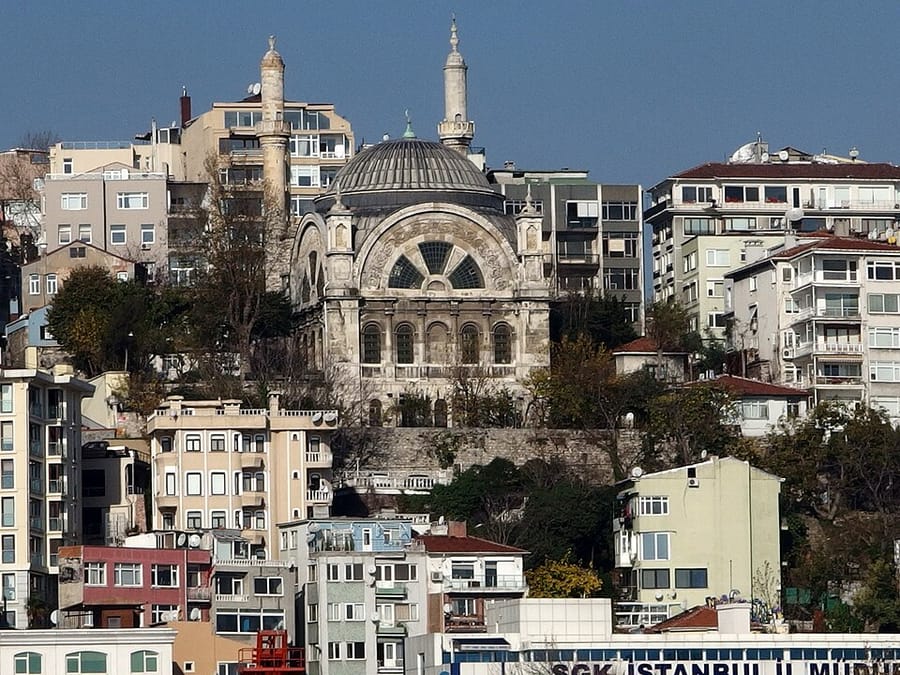

A mosque named after Prince Cihangir
The mosque stands on a hill overlooking the Bosphorus and the Sea of Marmara, in the district of Cihangir to which it gave its name. It is named after Prince Cihangir, son of Suleiman the Magnificent and Hürrem Sultan, who died in 1553 at the age of twenty-two. The first mosque, built by Mimar Sinan, was completed in 1559–60; according to its endowment deed it also had a primary school beside it. Evliya Çelebi describes it as square in plan, with a single dome and a single minaret. Over its history the mosque suffered five fires and was renewed each time.
The present mosque was rebuilt by Abdulhamid II in 1890. It too is square and single-domed, with a minaret at each corner of its three-bay portico. Its dome rests on the four corners, a design first used by Mimar Sinan at the Mihrimah Sultan Mosque at Edirnekapı, which allowed the walls to be pierced by many windows arranged in a fan-like pattern. The architect of the present building is not known for certain; its attribution to Sarkis Balyan should be treated with caution. Inside are thirty-nine calligraphic panels written between 1868 and 1890.
The prince and the dervish lodge
The mosque stands in the Pürtelaş quarter north of Fındıklı Hill. Prince Cihangir was buried together with Prince Mehmed in the tomb at the Şehzade Mosque. The founder and first sheikh of the dervish lodge at the corner of the courtyard was Hasan Burhaneddin Cihangiri (d. 1663), founder of the Cihangiriyye branch of the Halveti order; the lodge, also mentioned by Evliya Çelebi, burned in 1864–65.
Interior and calligraphic panels
The Cihangir Mosque is a restrained work in both plan and decoration; the painted ornament inside largely preserves the character of its period. The calligraphers of the thirty-nine panels in the interior include Mustafa Izzet, Hafız Ahmed Sünbüli, Sami, Rakım, Hasan Rıza, Muhammed Nazif, Mehmed Tahir, Seyyid Ali and Mısrizade Ali Rıza Üsküdari.
Surrounding structures and cemetery
Around the mosque are a fountain of 1638–39, a cistern of 1708 and taps. In the cemetery, a well dug in 1894–95, to which Gazi Osman Pasha had a pump fitted in 1900–1901, an ablution fountain and the tomb of Hasan Burhaneddin Cihangiri, now rebuilt in concrete, stand out. Twenty-eight notable graves and tombstones have been recorded in the cemetery and tomb, the oldest dated 1588–89 and the latest 1923.
Source: TDV Encyclopedia of Islam (TDV İslâm Ansiklopedisi), “CİHANGİR CAMİİ” (Ara Altun)
Related sultans
Cite as: Atlas of the Sultans, “Cihangir Mosque · Ottoman monuments”, https://padisahlaratlasi.com/en/monuments/cihangir-mosque/ (last updated 21 November 2026). Corrections · Image credits