TRENDEFRARAtlas of the Sultans · Ottoman monuments
Çırağan Palace
Monument · Waterfront palace, 1863–1871
- Type
- Palace and pavilion
- Built
- 1863–1871
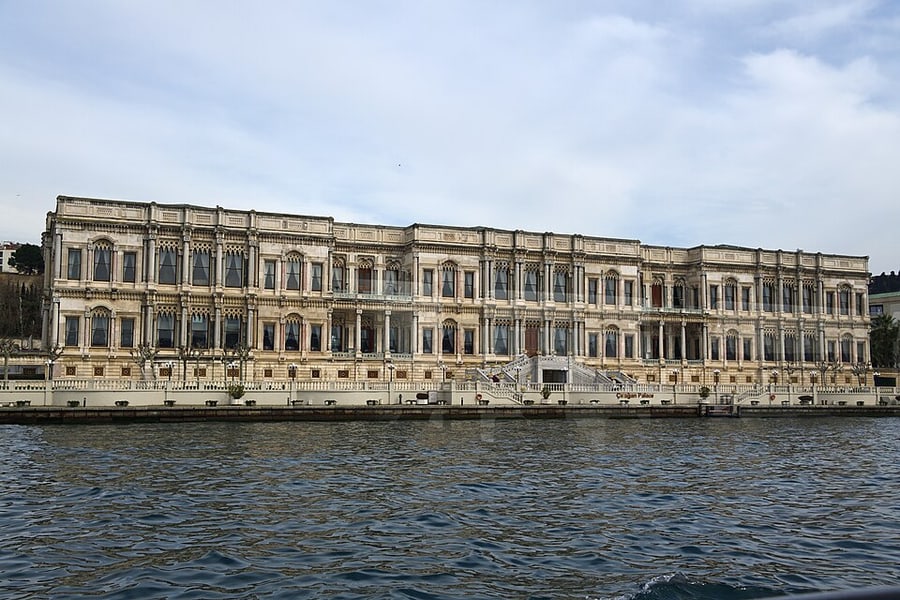

From the Kazancıoğlu Garden to Çırağan
In the 17th century the site of the palace was occupied by the Kazancıoğlu Garden; Evliya Çelebi relates that Murad IV gave this garden as a gift to his daughter Kaya Sultan and that she had a waterfront pavilion built here. Later, Nevşehirli Damad Ibrahim Pasha built a large palace here for his wife Fatma Sultan. Because of the çırağan (torchlight) festivities attended by Ahmed III and the dignitaries of the court, the building came to be called the Çırağan Palace.
Repaired in the reign of Mahmud I, the palace was used to entertain foreign ambassadors. Selim III had the palace enlarged and spent the last two summers of his reign here. The architect Garabet Balyan added wooden sections to the building, which was used as a summer palace under Mahmud II, and the palace was reopened in 1839. Abdulmejid abandoned it after Dolmabahçe was built and in 1859–60 had the old building completely demolished in order to build a masonry palace.
Abdulaziz's marble palace
The building of the new palace was taken up when Abdulaziz came to the throne. The plan drawn by Nikogos Balyan was carried out by his sons Sarkis and Agop Balyan; the Beşiktaş Mevlevi lodge in the middle of the plot was moved to Maçka and its old building demolished. Construction, begun in 1863, ended in 1871. Most of the materials were brought from abroad, and the building cost 5 million Ottoman gold pieces. Abdulaziz settled in the new palace, but a few months later returned to Dolmabahçe on the grounds that it was damp.
The main building in the neo-classical style has two storeys on a high basement; its façade facing the sea is 120 metres long. The double staircase in the middle of the richly decorated marble façade leads up to the entrance, emphasized by fluted paired columns. Inside, the walls were faced with coloured marble, marble and porphyry columns were used, and the doors and furnishings were decorated with inlays of mother-of-pearl, tortoiseshell and ivory. The palace was connected to the garden of Yıldız Palace by an overpass bridge.
Murad V, the Parliament and the fire
When Abdulhamid II came to the throne, he assigned the palace to his deposed elder brother Murad V; it was the residence of Murad and his family for twenty-eight years, until his death in 1904. On 20 May 1878 Ali Suavi and his companions raided the palace in order to rescue Murad V and put him back on the throne; the attempt was thwarted by the gendarmes (zaptiye) and the raiders were killed.
After the Second Constitutional Period (II. Meşrutiyet) began, the palace was given to the Chamber of Deputies (Meclis-i Mebusan); the halls on the upper floor were arranged for the sultan, the Chamber of Deputies and the Senate (Ayan Meclisi). Shortly after the opening of the Parliament's second term on 14 November 1909, the main building burned down completely in a five-hour fire that broke out on 19 January 1910. Together with the building, the fire also destroyed a valuable cultural treasure and the documents kept there.
The present state
After the fire only the outer walls of the main building remained. The palace, whose garden was used for many years as a football ground, has been restored and rearranged, as the author of the article notes, as part of a large modern hotel built in its garden. The surviving Harem Apartment has been allocated to the Beşiktaş Girls' High School, and the Aghas' Apartment is being prepared as a state guesthouse.
Source: TDV Encyclopedia of Islam (TDV İslâm Ansiklopedisi), “ÇIRAĞAN SAHİLSARAYI” (Selda Kalfazade)
Related sultans
Cite as: Atlas of the Sultans, “Çırağan Palace · Ottoman monuments”, https://padisahlaratlasi.com/en/monuments/ciragan-palace/ (last updated 21 November 2026). Corrections · Image credits