TRENDEFRARAtlas of the Sultans · Grand viziers
Kıbrıslı Kamil Pasha
Grand vizier four times, 1885–1913
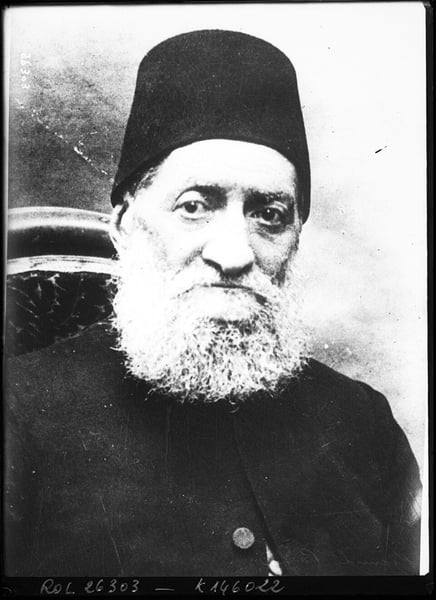

From Nicosia to the Egyptian court
He was born in 1832 in the town of Nicosia (Lefkoşe) in Cyprus. His family had migrated from Anamur; his father was the artillery captain Salih Ağa. Thanks to his interest in languages he learned Arabic, Persian, French and Greek. In 1845 he went to Egypt, entered the School of Languages (Elsine Mektebi) and graduated as a cavalry lieutenant. He became interpreter to the governor of Egypt, Abbas Hilmi Pasha, and then English tutor to his son Ilhami Bey. When Ilhami Pasha died young in 1860, he entered Ottoman service and became director of endowments (evkaf) in Cyprus.
From district governor to grand vizier
In the following years he served as mutasarrıf (district governor) in places such as Beirut, Jerusalem, Herzegovina and Chios, as governor of Aleppo, and as minister of endowments and of education. The reason for his dismissal from Aleppo was his obstruction of the British attempt to establish influence in the region and his struggle with the consuls. In Jerusalem he presided over the commission that resolved the Catholic-Orthodox dispute at the Church of Bethlehem. Because he favoured resolving the Eastern Rumelian question through negotiation rather than military force, he became grand vizier on 25 September 1885. In this first grand vizierate, which lasted five years and eleven months, he attached importance to the opening of new educational institutions, since he saw the salvation of the state in education. His long rivalry with Said Pasha also began in this way.
Dismissal, exile and refuge in a consulate
On 3 October 1895 he came to the grand vizierate for the second time. In a written reply he submitted to the sultan, he proposed the formation of a government responsible to the nation and endowed with authority, that the ministers be chosen by the grand vizier, and that members of the palace not interfere in government affairs. These proposals made Abdulhamid II suspicious, and he was dismissed on 7 November 1895. He was sent to the governorship of Aydın by an appointment amounting to exile; at the end of this post, which lasted eleven years, on hearing that he would be sent to Rhodes he took fright and sought refuge in the British Consulate in Izmir. On the guarantee given by the sultan he returned to Istanbul in 1907.
The constitutional era and last years
On 7 August 1908 he became grand vizier for the third time. The interference of the Committee of Union and Progress in state affairs and the dispute over the replacement of the ministers of war and of the navy put him in a difficult position; following a vote of no confidence by the Chamber of Deputies (Meclis-i Meb'usan) and telegrams from the army, he withdrew from office on 14 February 1909. In 1911, while he was in Egypt, his meeting on board ship with King George V of Britain at the latter's invitation drew heavy criticism in the pro-Union and Progress press. On 29 October 1912 he was appointed grand vizier for the fourth time; the Balkan War took place in this period, and in the peace negotiations no decision could be reached on the future of Edirne. In the Raid on the Sublime Porte (Babıali Baskını) the minister of war, Nazım Pasha, was killed and Kamil Pasha was forced to resign.
At the government's request he went to Nicosia and died there on 16 October 1913; he was buried in the burial ground of the Arap Ahmed Pasha Mosque. The author of the article, Atilla Çetin, presents him as a well-educated, intelligent, far-sighted and honest statesman who specialized in foreign policy. His three-volume Tarih-i Siyasi-i Devlet-i Aliyye-i Osmaniyye and his memoirs were published in his lifetime.
Source: TDV Encyclopedia of Islam, “KIBRISLI KÂMİL PAŞA” (Atilla Çetin)
Related sultans
City: Nicosia
Cite as: Atlas of the Sultans, “Kıbrıslı Kamil Pasha · Grand viziers”, https://padisahlaratlasi.com/en/grand-viziers/kibrisli-kamil-pasha/ (last updated 21 November 2026). Corrections · Image credits