TRENDEFRARAtlas of the Sultans · Grand viziers
Küçük Said Pasha
Grand vizier, 1879–1912 (eight terms, nine appointments)
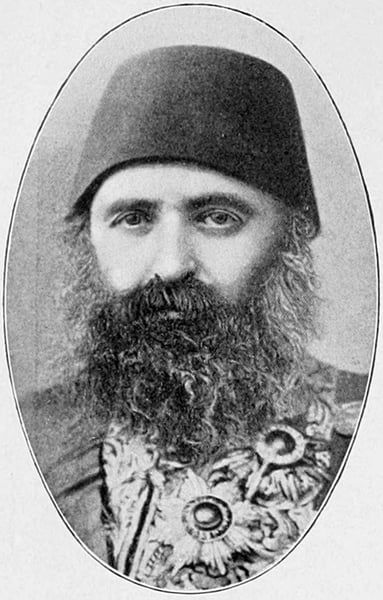

From Erzurum to the Sublime Porte
He was born in Erzurum in 1838; he belonged to the Seb'azade family of Ankara. His real name was Mehmed Said, and he was called “Küçük” (the Little) because of his short stature, so as not to be confused with the other Said Pasha. When he lost his father in 1853 he took a post in the correspondence office (Tahrirat Kalemi) of Erzurum to support his family. After coming to Istanbul he completed his education by studying for seven or eight years at the Hagia Sophia Mosque; he learned Arabic, Persian and French. He wrote for the Ceride-i Havadis; the dispute he engaged in with Şinasi is regarded as the first written polemic in the history of the Turkish press. In 1867 he became director of the Imperial Printing House (Matbaa-i Amire) and of the official gazette Takvim-i Vekayi', and at the Council of State he drafted many regulations and memoranda.
Abdulhamid II's adviser
When Abdulhamid II came to the throne in 1876 he became chief secretary of the palace (mabeyin başkatibi); he contributed to the preparation of the Constitution and himself wrote a draft constitution. The long reform memorandum he wrote while governor of Bursa impressed the sultan. As minister of justice he drafted the Regulation on the Organization of the Judiciary in 1878 and established for the first time the institution of public prosecution in the Ottoman judiciary.
On 18 October 1879 he came to the grand vizierate with the title of başvekil (prime minister). In the following years he was dismissed and reappointed many times; his removal in 1882 for opposing the measures the sultan had in mind in the face of the Urabi Pasha events is one example. In these grand vizierates he dealt with grave problems such as the establishment of the Public Debt Administration (Düyun-ı Umumiyye), the Tobacco Régie (Tütün ve Tekel Idaresi) and the questions of Tunisia and Egypt. His negotiations with the British, who had occupied Egypt, for an end to the occupation produced no result. In 1885 he was dismissed because he wanted military intervention in the events in Eastern Rumelia (Şarki Rumeli); Kıbrıslı Kamil Pasha was appointed in his place.
Refuge in an embassy and the constitutional era
In 1895 he became grand vizier for the fifth time, but was dismissed the same year on the grounds that he had failed to prevent the Armenian incidents in Istanbul. Fearing an unusual advisory post offered to him, on 4 December 1895 he took refuge with his son in the British Embassy, and he returned home once he had received guarantees. In 1901 he was appointed grand vizier for the sixth time. On 22 July 1908 he became the first grand vizier of the Second Constitutional Period, but he resigned shortly afterwards in the face of the opposition of the Committee of Union and Progress (Ittihat ve Terakki). His presiding, as president of the Senate (ayan reisi), over the National Assembly (Meclis-i Millî) that decided on the deposition of Abdulhamid II was interpreted as disloyalty. His last grand vizierates in 1911–1912 coincided with the Tripolitanian War and the “sopalı seçimler” (the “election of clubs”); he resigned on 16 July 1912. He died in 1914 and was buried in Eyüp.
Assessment
The author of the article, Zekeriya Kurşun, describes Said Pasha, who spent half a century in the service of the state, as a man of brilliant intelligence and strong memory but overly cautious and suspicious; he states that in this respect he resembled Abdulhamid II, and that his repeated appointments to the grand vizierate may have been connected with this affinity. He stresses that he made important contributions to the development of education; his taking refuge in the British Embassy, on the other hand, he sees as an example of the bitter situation into which the statesmen of the last period fell. In his private life he was thrifty to the point of stinginess, and very devoted to his family. His main works are his Hatırat (Memoirs), his replies to Kamil Pasha and Gazeteci Lisanı; although it is called memoirs, the Hatırat is rather a collection of documents consisting mostly of his own memoranda.
Source: TDV Encyclopedia of Islam, “SAİD PAŞA, Küçük” (Zekeriya Kurşun)
Related sultans
City: Erzurum
Cite as: Atlas of the Sultans, “Küçük Said Pasha · Grand viziers”, https://padisahlaratlasi.com/en/grand-viziers/kucuk-said-pasha/ (last updated 21 November 2026). Corrections · Image credits