TRENDEFRARAtlas of the Sultans · Grand viziers
Ahmed Tevfik Pasha
Grand vizier · Last Ottoman grand vizier, 1909–1922
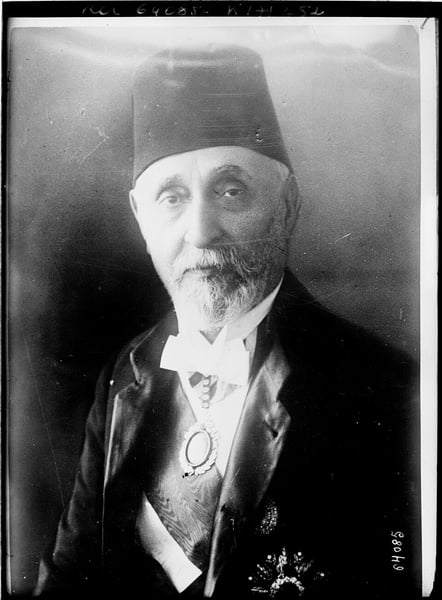

From the army to diplomacy
He was born in Üsküdar on 10 February 1845. He belonged to a noble and wealthy family descended from Crimean khanly princes (hanzade); he was the son of Ismail Hakkı Pasha, who had served as commander of the Danube and its surroundings. He studied at a military school and, while a cavalry lieutenant, left the profession and entered the Translation Office of the Sublime Porte. Through his merit and diligence he rose quickly; from 1872 to 1895 he served as second secretary and chargé d'affaires in Rome, Vienna, Berlin, Athens and St Petersburg. During fourteen years as minister of foreign affairs he won the confidence and esteem of Abdulhamid II.
First grand vizierate in the days of 31 March
In 1908, in addition to his ministry, he was also given membership of the Senate (Meclis-i A'yan); in February 1909, when the government broke up with the resignation of Kıbrıslı Kamil Pasha, he left office. While appointed ambassador in London, in the government crisis brought about by the 31 March events he was charged on 14 April 1909 with forming the government, as a figure attached to no party who had won everyone's confidence. After Abdulhamid II was deposed and Mehmed V became sultan, he left this first grand vizierate, which had lasted twenty-one days, on 5 May and returned to the London embassy; he remained in this post until 1914.
The armistice years
At the end of the war he declined to form a government in place of Talat Pasha because of the continuing interference of the Committee of Union and Progress. Vahdeddin (Mehmed VI) appointed him grand vizier on 11 November 1918 in place of Izzet Pasha, who had resigned after the Armistice of Mudros; on the second day of his grand vizierate the Entente fleet entered Istanbul, and the sultan, for various reasons and at the insistence of the Allies, dissolved parliament. Although he left office for a time because of changes he wanted to make in the cabinet, he was again charged with forming the government. Tevfik Pasha, who could get nothing done although he had formed the cabinet as he wished, resigned on 12 January 1919; the next day he was reappointed grand vizier, and on 3 March 1919 he gave way to Damad Ferid Pasha.
He then served for two years as president of the Senate and was present as a plenipotentiary at the peace conference in Paris. On 21 October 1920 he formed the last cabinet of the Ottoman state. He attended the London Conference, which met between 27 February and 12 March 1921, representing the Istanbul government alongside the Ankara government. Tevfik Pasha, who was very old and ill and was brought into the hall on someone's arm, said, when he was given the floor, that the right to speak belonged above all to the representatives of the nation, and yielded it to the Ankara delegation.
The end of the sultanate and assessment
When the sultanate was abolished on 1 November 1922, he resigned on 4 November and handed over the administration to Refet Pasha, the representative of the Ankara government. Tevfik Pasha came to the grand vizierate four times at short intervals and held the office for about two and a half years in all; the fact that his grand vizierates coincided with the deposition of a sultan, the occupation of Istanbul and the abolition of the sultanate has been put down by some to his ill fortune. The author of the article, Kemal Beydilli, presents him as decent, honest, patient, outspoken and trusted by all, and attributes his appointment to the grand vizierate at the most critical moments to these virtues. He died on 8 October 1936. His memoirs have been published by his grandson A. Şefik Okday together with a study of his life.
Source: TDV Encyclopedia of Islam, “AHMED TEVFİK PAŞA” (Kemal Beydilli)
Related sultans
Cite as: Atlas of the Sultans, “Ahmed Tevfik Pasha · Grand viziers”, https://padisahlaratlasi.com/en/grand-viziers/ahmed-tevfik-pasha/ (last updated 21 November 2026). Corrections · Image credits