TRENDEFRARAtlas of the Sultans · 38 / 39 · sultan
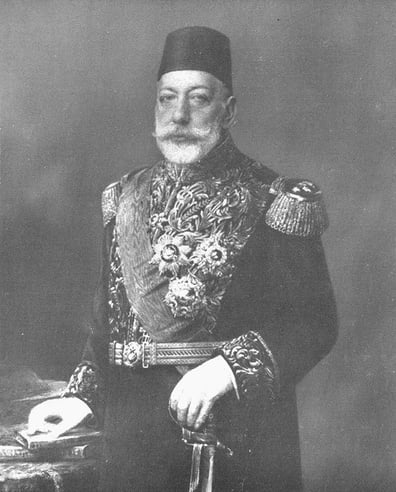
Photograph — Carl Pietzner · 1915
Mehmed V
Reşad
The first Ottoman sultan whose powers were limited by the constitution; real power lay with the Committee of Union and Progress. In nine years the African and Balkan territories were lost and the empire entered the First World War.
Open the reign of Mehmed V on the map▶ Watch the 1-minute video: YouTube · Instagram · TikTok
Interesting fact
In June 1911 he toured the Balkans, visiting Çanakkale, Salonica, Skopje, Pristina, Kosovo and Monastir (Bitola) and meeting people of every faith and nationality.
Source: TDV İslâm Ansiklopedisi (Turkish), article “MEHMED V”
Life
A long time as heir
Mehmed Reşad was born at Çırağan Palace on 2 November 1844. His father was Sultan Abdulmejid I and his mother Gülcemal Kadınefendi. He was raised according to palace traditions and learned Arabic, Persian and some religious knowledge. During the reigns of his father and his uncle Abdulaziz he lived a free and comfortable life.
When his elder brother Abdulhamid II came to the throne in 1876, he became heir apparent and was obliged to live under surveillance in the palace for thirty-three years. Having joined the Mevlevi order at a young age, he spent his years as a prince reading the Mesnevi; he enjoyed reading Ottoman history and the legends of his ancestors.
A constitutional sultan
After the 31 March Incident, the General National Assembly (Meclis-i Umumi-yi Millî), in which the Committee of Union and Progress held the majority, deposed Abdulhamid II and placed Reşad on the throne on 27 April 1909. He was sixty-four years old. According to the TDV article, he too, like his elder brothers Murad V and Abdulhamid II, came to the throne as the result of a coup; but unlike his predecessor, he was a sultan whose powers were limited by the constitution. The grand vizier and the government were responsible to parliament, the sultan's political role weakened and the palace ceased to be the center of political life.
Reşad wanted to speak with the people and get to know his country. From 5 to 26 June 1911 he made a tour of Rumelia, which was seething with revolts; he visited Salonica, Skopje (Üsküp), Priştine and Manastır (Bitola), and on the Plain of Kosovo, where the tomb of Murad I (Hüdavendigar) stands, he performed the Friday prayer with a large congregation. He also visited Bursa and Izmit.
Libya and the Balkan Wars
Reşad's reign was taken up by one war after another. In 1911 Italy attacked Tripolitania (Trablusgarp), and in October 1912 the loss of Tripolitania and Benghazi was accepted. Party rivalries within the army also led to heavy defeats in the Balkan War; the Aegean islands and all of Rumelia up to Edirne were lost. On 23 January 1913, with the “Raid on the Sublime Porte” (Babıali Baskını) led by Enver Bey, the Unionists seized power.
By the Treaty of London of May 1913, most of Rumelia, including Edirne, was given up. After Grand Vizier Mahmud Şevket Pasha was assassinated on 11 June 1913, the power of the Unionists grew even further. During the Second Balkan War, Edirne was recovered on 21 July 1913.
The First World War
Talat, Enver and Cemal Pashas became the real rulers of the state; even some appointments made by the sultan were overturned. A secret alliance was concluded with Germany on 2 August 1914, and on the same day parliament went into recess. This trio brought the country into the war without even some members of the cabinet knowing. According to the TDV article, although he did not want it at all, Reşad, faced with this fait accompli, issued a proclamation on 11 November 1914 announcing the declaration of war against the Entente powers, and with a proclamation of “cihad-ı ekber” (supreme holy war) called on all Muslims to join the war.
When Istanbul at one point faced the danger of occupation, he rejected the government's proposal to move the capital and stayed in Istanbul; by a fatwa of the office of the şeyhülislam he was given the title of gazi. In his speech at the opening of parliament in 1916 he spoke with satisfaction of the successes on the Gallipoli (Çanakkale) and Iraq fronts; but in his 1917 speech he no longer mentioned victories. The gazel (poem) he wrote on the victory at Gallipoli (Çanakkale) passed from mouth to mouth in the days it was written and was set to music.
His death
The TDV article portrays Reşad as a sound-minded, compassionate, pious and courteous ruler. Most of his life was spent under constraint, and his reign was filled with great crises. In his last months his illness advanced; he was able to make his June 1918 visit to the Holy Mantle (Hırka-i Saadet) only with difficulty, and then withdrew to his palace and signed state papers in bed.
Mehmed V (Reşad) died on 3 July 1918, without living to see the signing of the Armistice of Mudros, and was buried in the tomb he had built during his lifetime at Eyüp. He was succeeded by his brother Mehmed VI (Vahdeddin), the last sultan of the Ottomans.
Source: TDV Encyclopedia of Islam (TDV İslâm Ansiklopedisi), “Mehmed V” (Cevdet Küçük); Halid Ziya Uşaklıgil's Saray ve Ötesi, Ali Fuad Türkgeldi's Görüp Işittiklerim, the minutes of the Chamber of Deputies (Meclis-i Mebusan) and Ottoman archival documents are the main sources of this article.
Meanwhile in the world
Contemporary rulers
- George VKing of the United Kingdom · 1910–1936King who renamed the royal house Windsor in 1917
- Wilhelm IIGerman Emperor, King of Prussia · 1888–1918Germany's last emperor; abdicated in 1918 and went into Dutch exile
- Nicholas IIEmperor of Russia · 1894–1917Last Russian tsar, who abdicated in 1917
- Franz JosephEmperor of Austria, King of Hungary · 1848–1916Emperor who reigned some 68 years until his death in 1916
- TaishōEmperor of Japan · 1912–1926Sickly emperor during whose reign representative government expanded
- Ahmad Shah QajarShah of Iran (Qajar dynasty) · 1909–1925Last shah of the Qajar dynasty, enthroned at age eleven
- Woodrow WilsonPresident of the United States · 1913–1921President who championed the League of Nations; 1919 Nobel Peace laureate
What was happening in the world?
- 1911A revolution beginning in October topples China's Qing dynasty; the emperor abdicates in 1912.
- 1912The Titanic sinks on its maiden voyage after striking an iceberg; about 1,500 people die.
- 1914The Panama Canal opens, allowing ships to pass directly between the Atlantic and Pacific.
- 1917The Bolsheviks seize power in Russia; Lenin heads the Council of People's Commissars.
Sources: kids.britannica.com [1] · britannica.com [1] [2] [3] [4] [5] [6] [7] [8] · history.state.gov [1] · rmg.co.uk [1] · pancanal.com [1]
Family
| Father | Abdulmejid I |
|---|---|
| Mother | Gülcemal Kadın |
| Consorts | Kamures Kadın, Dürriaden Kadın, Mihrengiz Kadın, Nazperver Kadın |
| Children | Mehmed Ziyaeddin, Ömer Hilmi, Mehmed Necmeddin, Refia Sultan |
Major achievements
- The constitution restored and, with the 1909 amendments, the sultan's powers limited by the constitution for the first time
- Accepted a symbolic role as monarch under the constitutional order
- Royal visits to Rumelia and Egypt
- The Ottoman Navy League and ships bought with public donations
- The Italo-Turkish and Balkan Wars; Edirne retaken in the Second Balkan War
- Alliance with Germany and entry into the First World War
Treaties
- Treaty of Ouchy (1912, Italy)
- Treaty of London (1913)
- Treaties of Bucharest and Constantinople (1913)
- Treaty of alliance with Germany (1914)
Grand viziers
| Name | From | To | Length |
|---|---|---|---|
| Ahmed Tevfik Pasha | April 14, 1909 | May 5, 1909 | 21 days |
| Hüseyin Hilmi Pasha (term 2) | May 5, 1909 | December 28, 1909 | 237 days |
| Ibrahim Hakkı Pasha | December 28, 1909 | September 29, 1911 | 1 year, 275 days |
| Küçük Said Pasha (term 8) | September 30, 1911 | July 16, 1912 | 290 days |
| Gazi Ahmed Muhtar Pasha | July 21, 1912 | October 29, 1912 | 100 days |
| Kıbrıslı Kamil Pasha (term 4) | October 29, 1912 | January 23, 1913 | 86 days |
| Mahmud Şevket Pasha | January 23, 1913 | June 11, 1913 | 139 days |
| Said Halim Pasha | June 12, 1913 | February 3, 1917 | 3 years, 236 days |
| Talat Pasha | February 1917 | October 8, 1918 | 1-2 years |
Battles and treaties
| Year | Event | Result / parties |
|---|---|---|
| 1911 | Revolt: Yemeni revolt (Imam Yahya) | Ahmed Izzet Pasha raised the siege of Sanaa; under the agreement of 13 October 1911 the Zaydi highlands, including Sanaa, were left to the administration of … |
| 1912 | Treaty: Treaty of Ouchy | Opponent: Kingdom of Italy |
| 1912 | Battle: Kumanovo | The Ottoman Western Army was defeated; the region passed to Serbia |
| 1912 | Naval battle: Kunfuda Bay | Seven Ottoman gunboats sunk or destroyed; the yacht Fuad captured |
| 1912 | Naval battle: Elli (Imbros) | Indecisive; the Ottoman fleet withdrew into the Straits |
| 1912 | Revolt: Albanian revolts (1908–1912) | The Ottoman government accepted Albania's demands for autonomy (4 September 1912); after the Balkan War began, Ismail Qemali proclaimed independence at Vlorë … |
| 1912 | Battle: Battles of Kirk Kilisse and Lule Burgas (1912) | The Eastern Army was defeated and fell back to the Çatalca line |
| 1913 | Campaign: Recapture of Edirne | Edirne was recovered without resistance and kept by the Treaty of Constantinople of 29 September 1913 |
| 1913 | Naval battle: Lemnos (Mudros) | Indecisive; the Aegean islands stayed in Greek hands |
| 1913 | Treaty: Treaty of London | |
| 1913 | Treaty: Treaty of Bucharest | Bulgaria, Romania, Serbia, Greece, Montenegro |
| 1913 | Treaty: Treaty of Constantinople | Ottoman Empire, Kingdom of Bulgaria |
| 1913 | Siege: Siege of Ioannina (1912–1913) | After a defence of about six months the city passed to the Greeks |
| 1913 | Treaty: Treaty of Athens (1913) | Ottoman Empire, Kingdom of Greece |
| 1913 | Revolt: Raid on the Sublime Porte (1913) | Kamil Pasha's government was overthrown; Mahmud Şevket Pasha became grand vizier and the Unionists returned to power |
| 1914 | Naval battle: Black Sea raid | Russia declared war on 2 November 1914; the Ottoman state entered the First World War |
| 1914 | Treaty: Treaty of alliance with Germany | |
| 1914 | Battle: Battle of Sarikamish (1914–1915) | The offensive ended in a heavy defeat; 60,000 of 112,000 men were lost |
| 1915 | Battle: Gallipoli campaign | The Entente forces withdrew; the Straits were not forced. British losses alone were 213,980; Turkish losses are given as 190,000–350,000 |
| 1915 | Naval battle: 18 March naval victory at the Dardanelles | The Entente fleet withdrew; it became clear that the Straits could not be forced by naval power alone |
| 1915 | Battle: Raid on the Suez Canal (1915) | The attempt to cross the canal failed; the forces returned to Beersheba |
| 1916 | Siege: Siege of Kut | A British force of 13,309 men surrendered |
| 1916 | Revolt: Arab Revolt | Jeddah (16 June) and Taif (17 September 1916) fell and the main towns of the Hejaz except Medina passed to the rebels; Medina stayed Ottoman until January 1919 |
| 1917 | Battle: Palestine front and the fall of Jerusalem (1917) | Jerusalem fell to the British; Syria was evacuated the following year |
| 1918 | Naval battle: Battle of Imbros (1918) | Two British monitors sunk; the cruiser Midilli (Breslau) sank on mines and Yavuz (Goeben) was heavily damaged |
Full infoboxes are in the site’s “Battles and Treaties” tab; source: TDV Encyclopedia of Islam.
Death
He died of diabetes and heart failure in Yıldız Palace in 1918 — he did not live to see the end of the war.
Territorial change
| Year | Region | Event | Source |
|---|---|---|---|
| 1912 | − Tripolitania | Italo-Turkish War (1911–12) and the Treaty of Ouchy — to Italy | TDV İA, “MEHMED V” |
| 1912 | − Benghazi–Barca | Italo-Turkish War and the Treaty of Ouchy (1912) — Benghazi and Barca to Italy | TDV İA, “MEHMED V” |
| 1912 | − Fezzan | Italo-Turkish War and the Treaty of Ouchy (1912) | TDV İA, “MEHMED V” |
| 1912 | − Macedonia (Skopje–Bitola) | First Balkan War — Skopje, Thessaloniki and Bitola fell (October–November 1912); Treaties of London and Bucharest (1913) | TDV İA, “MEHMED V” |
| 1912 | − Thessaloniki–Chalkidiki–Mount Athos | First Balkan War — Skopje, Thessaloniki and Bitola fell (October–November 1912); Treaties of London and Bucharest (1913) | TDV İA, “SELÂNİK” |
| 1912 | − Kosovo | First Balkan War — Skopje, Thessaloniki and Bitola fell (October–November 1912); Treaties of London and Bucharest (1913) | TDV İA, “KOSOVA” |
| 1912 | − Southern and Central Albania (Vlorë–Berat–Elbasan) | Albania's declaration of independence (28 November 1912) and occupation by the Balkan states; Treaty of London (1913) | TDV İA, “MEHMED V” |
| 1912 | − Aegean Islands (Lesbos–Lemnos–Samos) | First Balkan War — Lemnos and Lesbos were taken by the Greek fleet and Samos joined Greece (1912); Treaty of London (1913) | TDV İA, “MEHMED V” |
| 1912 | − Western Thrace (Komotini–Kavala) | First Balkan War — the Bulgarian army took western Thrace (November 1912); the Western Thrace Government of 1913 was independent, while Edirne was retaken in the Second Balkan War | TDV İA, “MEHMED V” |
| 1912 | − Rhodopes (Kardzhali–Smolyan) | First Balkan War — Kardzhali, Smolyan (Paşmaklı) and the other Rhodope districts were joined to Bulgaria (TDV, Bulgaristan) | TDV İA, “BULGARİSTAN” |
| 1912 | − Rhodes and the Dodecanese | Italian occupation (April–May 1912); the Treaty of Ouchy did not cede the islands, the legal transfer came with the Treaty of Lausanne (1923) | TDV İA, “RODOS” |
| 1913 | − Chios | First Balkan War (1912–13) — the Aegean islands pass to Greece | TDV İA, “SAKIZ ADASI” |
| 1913 | − Northern Albania (Krujë–Shkodër) | Albania's declaration of independence (1912) and the Treaty of London (1913) | TDV İA, “MEHMED V” |
| 1913 | − Ioannina (Epirus) | First Balkan War (1912–13) and Treaty of London (1913) — Ioannina to Greece | TDV İA, “YANYA” |
| 1913 | − Lahsa (Eastern Arabia–Qatar) | Ibn Saud took Qatif and Hofuf and the Ottoman garrison withdrew (May 1913); the governorship granted in the 1914 treaty was nominal | TDV İA, “LAHS” |
| 1916 | − Hejaz (Mecca–Medina) | Arab Revolt (June 1916) — Mecca, Jeddah and Taif fell and the Kingdom of Hejaz was proclaimed; Medina held out under Fahreddin Pasha until January 1919 | TDV İA, “HİCAZ” |
| 1917 | − Baghdad–Basra | Fall of Basra (1914) and Baghdad (11 March 1917) — Iraq came under British occupation; Armistice of Mudros (1918) | TDV İA, “BAĞDAT” |
| 1918 | + Kars–Ardahan–Artvin | Treaty of Brest-Litovsk (3 March 1918) — Kars, Ardahan and Batumi recovered | TDV İA, “KARS” |
| 1918 | + Batumi (Adjara) | Treaty of Brest-Litovsk (3 March 1918) — Kars, Ardahan and Batumi recovered | TDV İA, “BATUM” |
| 1918 | + Akhaltsikhe (Childir) | Treaty of Batumi (4 June 1918) — Akhaltsikhe and Akhalkalaki | TDV İA, “AHISKA” |
The lands that changed hands in this period, and the battles or treaties that brought the changes, can be seen on the map: map of the reign of Mehmed V.
Cite as: Atlas of the Sultans, “Mehmed V (Reşad): Reign Map, Wars and Conquests (1909–1918)”, https://padisahlaratlasi.com/en/sultans/v-mehmed/ (last updated 21 November 2026). Corrections · Image credits
Terms on this page: Committee of Union and Progress
Grand viziers of this reign: Küçük Said Pasha · Kıbrıslı Kamil Pasha · Ahmed Tevfik Pasha · Mahmud Şevket Pasha · Talat Pasha
Monuments of this reign: Stone Bridge (Skopje) · Tomb of Sultan Murad · Bahariye Mevlevi Lodge · Monument of Liberty · Tomb of Mehmed V