TRENDEFRARAtlas of the Sultans · Grand viziers
Midhat Pasha
Grand vizier, 1872, 1876–1877
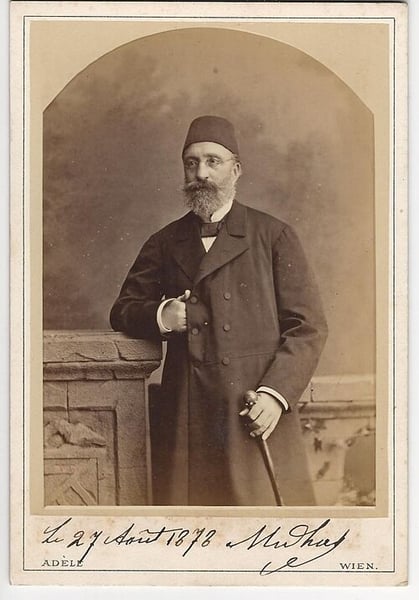

From the chancery to provincial governor
He was born in Istanbul in October-November 1822; his real name was Ahmed Şefik. His father was Hacı Hafız Mehmed Eşref Efendi of Ruse. In 1834 he entered the office of the Imperial Council (Divan-ı Hümayun Kalemi) and received the pen name “Midhat” there; at the same time he continued to attend lessons at the Fatih Mosque. His work at the Supreme Council (Meclis-i Vala) and his inspection mission in Damascus attracted the attention of Reşid, Ali and Fuad Pashas. In 1858 he spent six months in Europe and improved his French.
In 1861 he became governor of Niš with the rank of vizier; he had roads and bridges built and established security. This success made him one of the architects of the new provincial system. In the Danube province (Tuna vilayeti), the model application of the Provincial Regulation (Vilayat Nizamnamesi) of 1864, he improved communications, founded the public benefit funds (menafi-i umumiyye sandıkları) regarded as the origin of the Agricultural Bank (Ziraat Bankası), and published the Turkish-Bulgarian newspaper Tuna. As governor of Baghdad in 1869–1872 he arranged for land to be distributed with title deeds, organized river transport, and opened schools and hospitals. The coming of Kuwait, with the status of a kaza (district), and of the mutasarrıflık of Najd, attached to Basra, under Ottoman rule was counted among his achievements.
Two grand vizierates and the Constitution
After the dismissal of Mahmud Nedim Pasha he became grand vizier on 31 July 1872; but owing to disagreements with the palace and Russian influence he was dismissed on 19 October 1872. In the spring of 1876 he became the focus of the circles advocating the idea of a constitution and a parliament, and on 30 May 1876 he was among the “erkân-ı hal'” (the dignitaries of the deposition) who deposed Abdulaziz.
After Abdulhamid II's accession he became grand vizier again on 19 December 1876. By making a concession on the clause that left the power of exile to the sultan, he secured the proclamation of the Constitution (Kanun-ı Esasi) on 23 December 1876, the day the Tersane Conference convened. His expectation was to remove the justification for foreign intervention by granting equal rights to all subjects; but the European envoys continued their meetings, and the general assembly (meclis-i umumi) he convened rejected the conference's decisions on 18 January 1877. When tension with the palace grew, on the forty-ninth day of his grand vizierate, 5 February 1877, he was dismissed and exiled abroad.
Trial and Taif
In exile he refrained from activity against Abdulhamid II and during the Ottoman-Russian War wrote articles defending the Ottoman state before European public opinion. In 1878 he was permitted to return home; he served as governor of Syria and of Aydın. In 1881, on the charge of complicity in the death of Abdulaziz, he was tried before a special court set up at Yıldız Palace and sentenced to death; Abdulhamid II, taking domestic and foreign objections into account, commuted the sentence to life imprisonment. Midhat Pasha, who was sent to Taif, was, according to the article, strangled in his cell on the night of 7-8 May 1884. In 1951 his bones were brought to Istanbul and laid in the grave at the Monument of Liberty (Abide-i Hürriyet) square.
Assessment
According to the author of the article, Gökhan Çetinsaya, Midhat Pasha's political thought was built on Ottomanism, constitutionalism and extended decentralization. Whereas he was successful as a provincial governor, his uncompromising attitude and his weakness in diplomacy are counted among the main reasons for his failure in his posts at the centre; there is also criticism that his measures in the Danube province and Syria served separatism. Nevertheless, he is regarded as a historic symbol of the constitutional and parliamentary regime in Turkish political life.
Source: TDV Encyclopedia of Islam, “MİDHAT PAŞA” (Gökhan Çetinsaya)
Related sultans
Cite as: Atlas of the Sultans, “Midhat Pasha · Grand viziers”, https://padisahlaratlasi.com/en/grand-viziers/midhat-pasha/ (last updated 21 November 2026). Corrections · Image credits