TRENDEFRARAtlas of the Sultans · Ottoman monuments
Bajrakli Mosque
Monument · Mosque, Belgrade, 16th–17th century
- Type
- Mosque
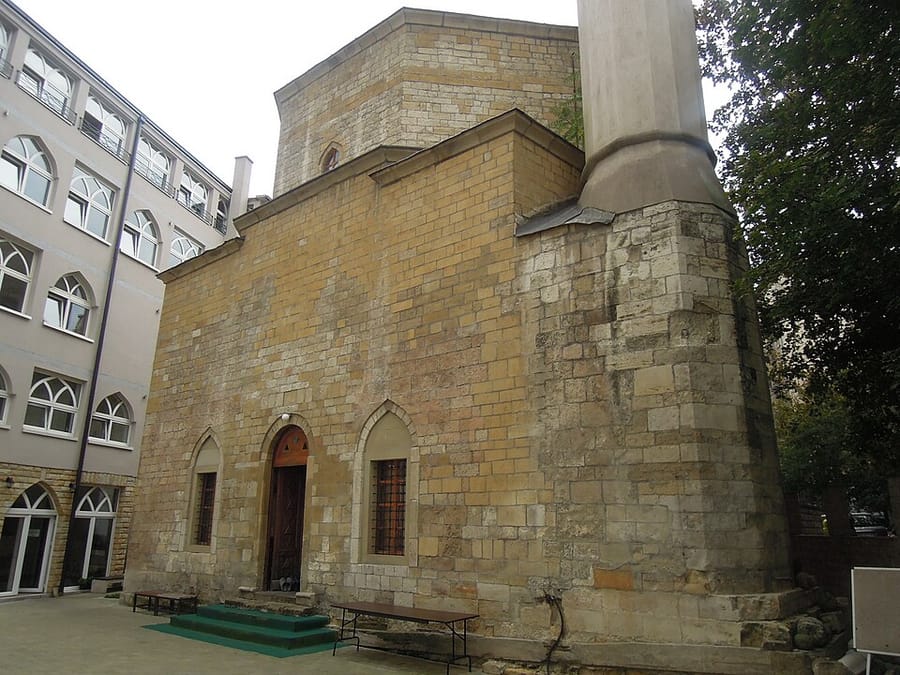

Belgrade's last surviving mosque
When and by whom the mosque was built is not known for certain. The date on a damaged inscription found above the minaret door has been read as either 1522 or 1580; if 1522 is correct, it was the first mosque built in Belgrade immediately after the city's conquest. Another view dates it to between 1660 and 1688. During the Austrian occupation of 1717–1739 it was converted into a Catholic church; after the city was recovered, Hüseyin Kethüda restored and revived it in 1741. Because it also served as a timekeeper's house and a flag was raised on its minaret at set hours, it became known as the Bayraklı ('with the flag') Mosque.
It was repaired again in 1893–94 under pressure from Sultan Abdulhamid II. Built of dressed stone, the square building, 12.80 m per side externally, is covered by a dome 10.20 m in diameter. A restoration in 1953–1963 removed the portico, raised the drum excessively and made other changes at odds with the original style. The last surviving mosque of a city that once had nearly 250, it is still in use for worship.
Names and founder
A 1959 issue of the newspaper Bayrak, published in Skopje, stated without citing a source that the mosque was built in 1524 by Ali Bey, a descendant of Hacı Evrenos. Another tradition attributes it to Sultan Suleiman II, and the building is also known as the Çuhacı Hacı Ali Bey Mosque. Not mentioned by Evliya Çelebi, the mosque appears in an 18th-century endowment register as the endowment of Hüseyin Kethüda, “known as the Bayraklı Mosque”. During the Austrian occupation it was given to the Jesuits; two skeletons found beneath the portico during the 1953–1963 restoration proved to be Christian burials. After its revival in 1741 it was also called the Hüseyin Kahya or Kahya Bey Mosque, and on a plan of 1789 the street beside it is marked with the name Bayraklı.
Under Serbian rule
The Muslim community used the mosque until 19 September 1867, when Belgrade was finally lost; by a decree of Prince Mihailo Obrenović dated 18 May 1868, it was officially allocated to the Islamic community, with its staff paid by the Serbian state. The chronogram poem recording the repairs of 1893–94 thanks Abdulhamid II, King Aleksandar Obrenović of Serbia and the municipality. Crown Prince Yusuf Izzeddin Efendi presented a carpet to the mosque during the First World War. Damaged by shellfire in the Second World War, the mosque became after 1930 also the venue of important religious gatherings such as the investiture of the head of the Islamic community (reis-ul-ulema).
During the 1953–1963 restoration, window grilles without parallel in Turkish architecture were fitted, the lower windows, which should be rectangular, were given pointed arches, a round-arched door was opened, and an impractical new ablution fountain was built.
Source: TDV Encyclopedia of Islam (TDV İslâm Ansiklopedisi), “BAYRAKLI CAMİ” (Semavi Eyice)
Related sultans
Cite as: Atlas of the Sultans, “Bajrakli Mosque · Ottoman monuments”, https://padisahlaratlasi.com/en/monuments/bajrakli-mosque/ (last updated 21 November 2026). Corrections · Image credits