TRENDEFRARAtlas of the Sultans · Ottoman monuments
Tomb of Sultan Murad
Monument · Tomb, Pristina, 17th century
- Type
- Mausoleum (türbe)
- Built
- 1660
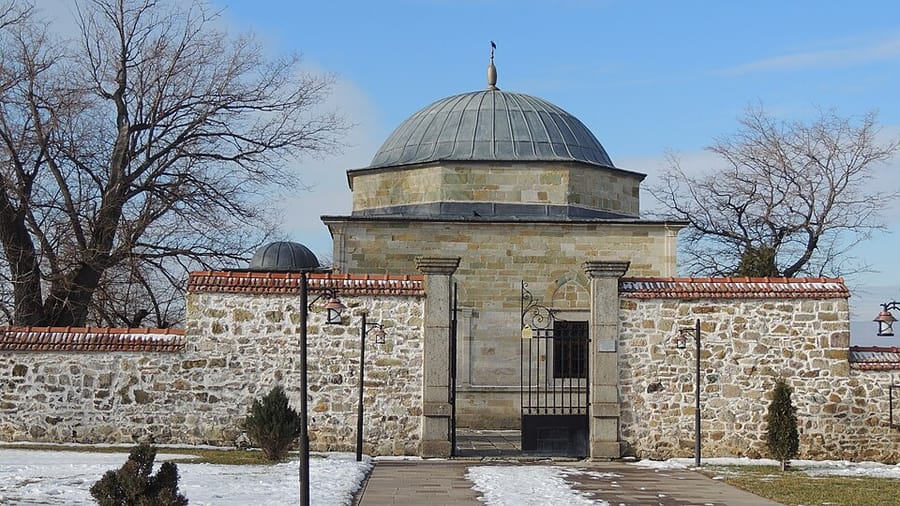

A memorial of the Battle of Kosovo
Also known as the Meşhed-i Hüdavendigar, the tomb (türbe) stands near Pristina on the plain where the First Battle of Kosovo was fought in 1389. It is generally accepted that after the Ottoman victory a symbolic tomb was built where the internal organs of Murad I, killed on the battlefield, were buried, while his body was taken to Bursa. The date of the first building is unknown; its architecture probably took shape after the Second Battle of Kosovo in 1448. The present building was probably erected around 1660 by Melek Ahmed Pasha, who found the site neglected.
In 1845 the governor of Rumelia, Hurşid Pasha, carried out a thorough restoration, and the tomb was repaired again in 1866; a reception building (selamlık) was added during a repair under Abdulhamid II. In the early 20th century, a restoration ordered by Sultan Mehmed V Reşad replaced the outer facing and gave the building its present appearance. On 16 June 1911 the sultan visited the tomb and performed the Friday prayer here with a large congregation. The tomb was lost in 1912; the Ottoman–Serbian peace treaty of 1914 included a clause protecting it. The square building of cut stone is covered by a lead-clad dome on an octagonal drum.
The shrine's surroundings and visits
According to Neşri, after taking the fortress of Novo Brdo during his Serbian campaign of 1455, Mehmed II camped at the spot where Murad I had fallen and made donations for the souls of Murad and the other martyrs. The Vučitrn district tax register of 1544 shows that Muslim settlers were placed around the shrine and exempted from taxes. Evliya Çelebi relates that when he came here with Melek Ahmed Pasha around 1660, the pasha had the tomb cleaned, enclosed it with a wall within a week, planted vines and 500 fruit trees in its courtyard and appointed a keeper; he also records that some 10,000 martyrs lay in the area. A house for the tomb keeper was built in 1848. During Sultan Mehmed V Reşad's visit in 1911, an imperial rescript intended to calm the population was read to a congregation estimated at about 100,000.
Inscriptions and graveyard
The three-couplet inscription above the door states that the tomb was restored by order of Sultan Reşad; its chronogram gives the year 1327 (1909). In the courtyard, on the wall facing the tomb entrance, stands a small fountain made entirely of marble; its four-line inscription is dated 1329 (1911) and shows that it was revived on the site of an older fountain during the sultan's visit. Both poems were composed by Yenişehirli Hüseyin Şevket Efendi, deputy judge of Kosovo. The so-called selamlık fountain in the second courtyard bears a marble inscription of 1316 (1898) naming its builder, Ali Hacı, a merchant from Gjakova. The graveyard contains the tombs of Rifat Pasha (d. 1859–60), a former commander of the imperial army, and Hafız Mehmed Pasha (d. 1903–1904), governor of Kosovo.
The round-arched, domed entrance porch, with columns on high pedestals and carved marble door jambs, is in a style foreign to the Turkish architectural tradition. Semavi Eyice notes that the core structure hidden behind the outer facing must have the features of a classical Ottoman tomb.
The tomb in the 20th century
In 1952 some Istanbul newspapers reported that the tomb had been demolished. Visiting the site in 1961, Eyice found the historic setting preserved and noted that a 15-metre modern monument to Miloš had been erected on the rise between the tomb and the Gazi Mestan Tomb on the hill. The interior was clean but extremely poor, with no carpet and no proper cover on the cenotaph. A pair of valuable candlesticks said to belong to the tomb, a gift from a Mamluk sultan, was put up for sale in Athens and bought by Ruşen Eşref Ünaydın, then ambassador there. A dervish lodge building seen in old photographs has left no trace today.
Source: TDV Encyclopedia of Islam (TDV İslâm Ansiklopedisi), “HUDÂVENDİGÂR MEŞHEDİ” (Semavi Eyice)
Related sultans
Cite as: Atlas of the Sultans, “Tomb of Sultan Murad · Ottoman monuments”, https://padisahlaratlasi.com/en/monuments/tomb-of-sultan-murad/ (last updated 21 November 2026). Corrections · Image credits