TRENDEFRARAtlas of the Sultans · Ottoman monuments
Beylerbeyi Palace
Monument · Palace, 1861–1865
- Type
- Palace and pavilion
- Built
- 1861–1865
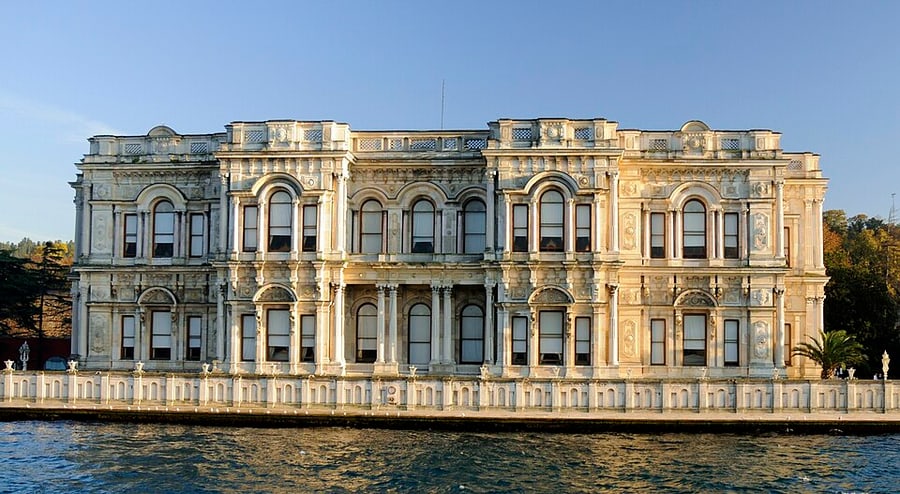

From Mahmud II's wooden palace to Abdulaziz's palace
This area on the Asian shore of the Bosphorus was called Istavroz in the Byzantine period; it later took the name Beylerbeyi from the waterfront mansion (yalı) here of Mehmed Pasha, the beylerbeyi (governor-general) of Rumelia. In the Ottoman period the area was used for a time as a royal garden; all the buildings on it were demolished in the time of Mustafa III and the land was sold to the public.
In 1829 Mahmud II built a wooden palace here. Consisting of Mabeyin and harem apartments, pavilions, waterfront mansions, baths, kitchens and stables, these buildings formed the largest waterfront palace of their time. Most of the palace burned in 1851; Abdulaziz had the remaining buildings demolished and built the present Beylerbeyi Palace in their place between 1861 and 1865. Its architect is Sarkis Balyan.
An architecture where East meets West
The palace was built by blending Western and Eastern styles; with its harem and Mabeyin sections it bears the planning features of the Turkish house. It has three storeys including the basement; its sea and side façades are each arranged in three parts with projecting central sections. The roof is hidden by a balustrade running along the edge of the façades. On the two floors there are six halls and twenty-five rooms in all. The fabrics used in the furnishings were specially woven in the Hereke factories. The ceilings of many rooms and halls are decorated with oil paintings of ships flying the Turkish flag and with verses written in thuluth and ta'liq script.
At the two ends of the wall running along the garden façade stand the Harem and Mabeyin pavilions, which with their tent-shaped roofs show Eastern influence. At the top of the terraced gardens behind are the Yellow Pavilion (Sarı Köşk) and the Marble Pavilion (Mermer Köşk); in front of them stretches a pool measuring 80 × 30 metres. The Stable Pavilion (Ahır Köşkü), built for the palace horses, with its ceiling decorated with coloured coats of arms and animal depictions, is according to the author of the article the richest example of its kind.
The palace's guests
The palace's first major guest was the Empress of the French Eugénie, the wife of Napoleon III. King Nikola of Montenegro and the Shah of Iran Naser al-Din also stayed here during their visits to Istanbul; Grand Duke Nicholas, who came to Istanbul after the Treaty of San Stefano, and the Austro-Hungarian Emperor Franz Joseph were also hosted in the palace for a time.
Abdulhamid II, who after his deposition had been obliged to live in the Alatini Villa in Thessaloniki, was brought to Istanbul in 1912 when the Balkan War broke out and lived in this palace until his death in 1918. In the Republican period too the palace was reserved for state guests; the Shah of Iran Reza Pahlavi, who came as Atatürk's guest, stayed here.
The present state
The main building, the waterfront pavilions, the pavilions in the terraced gardens, the pool and the Stable Pavilion are the units of the palace that have survived. The deer park (Geyiklik), the royal stables, the lion house (Aslanhane), the poultry house (Tavukluk), and the apartments of the Pashas, the band (Muzika) and the aghas (Agavat) no longer exist. The palace, whose gardens were divided by the construction of the Bosphorus Bridge and some sections of which lost their authenticity or disappeared while in the use of various institutions, has according to the author of the article lost much of its integrity.
Source: TDV Encyclopedia of Islam (TDV İslâm Ansiklopedisi), “BEYLERBEYİ SARAYI” (Metin Sözen)
Related sultans
Cite as: Atlas of the Sultans, “Beylerbeyi Palace · Ottoman monuments”, https://padisahlaratlasi.com/en/monuments/beylerbeyi-palace/ (last updated 21 November 2026). Corrections · Image credits