TRENDEFRARAtlas of the Sultans · 6 / 39 · sultan
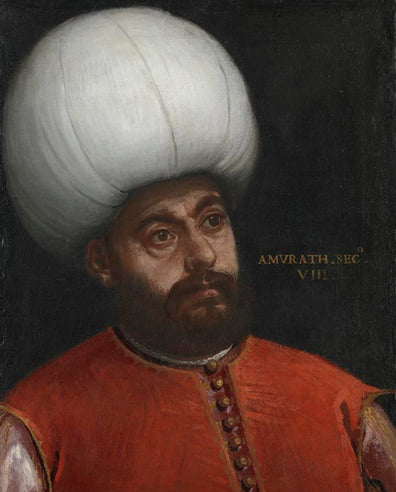
Imaginary portrait (made later) — circle of Paolo Veronese · 16th c.
Murad II
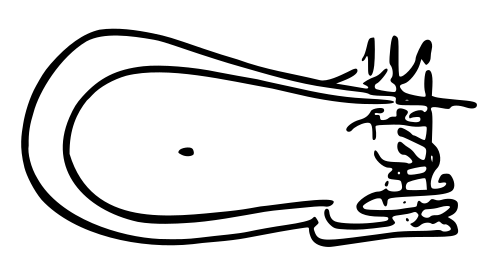
He restored Ottoman rule after the Interregnum: Thessalonica was taken, Germiyan joined and the Eastern Roman Empire (Byzantium) again paid tribute. In 1444, after the peace of Edirne–Szeged, he abdicated and withdrew to Manisa; recalled to lead the army at Varna, he returned to the throne in 1446.
Open the reign of Murad II on the map▶ Watch the 1-minute video: YouTube · Instagram · TikTok
Interesting fact
He gave up the throne of his own free will: in 1444 at Mihalıç he formally abdicated in favour of his son Mehmed II and withdrew near Bursa. Two years later (1446) he returned to the throne.
Source: TDV İslâm Ansiklopedisi (Turkish), article “MURAD II”
Life
A prince in Amasya
Murad was born in Amasya in June 1404. He was the son of Mehmed I (Çelebi Mehmed) by a concubine; according to one record his mother was Şehzade Hatun, daughter of Divitdar Ahmed Pasha, one of the notables of Amasya. When he turned twelve he was sent as bey to the province of Rum, which included Amasya, Tokat, Sivas, Çorum and Osmancık. In 1416 he was dispatched with the forces of Amasya towards Saruhan and Izmir to suppress the revolt of Börklüce Mustafa; the revolt was put down by Bayezid Pasha, who accompanied him.
A difficult accession: the two Mustafas
His father, on his deathbed, summoned Murad to Bursa; but Mehmed I died in Edirne (Adrianople) before the prince arrived (June 1421). The viziers kept the death secret, fearing that Murad's uncle Mustafa, held by Byzantium, would make his move. Murad ascended the throne in Bursa but refused to hand his younger brothers over to Byzantium as his father's agreement with the emperor required. Byzantium then released Mustafa, whom the Ottoman chronicles call “Düzme” (the False), and recognized him as the legitimate sultan. Mustafa seized Rumelia and in January 1422 crossed from Gallipoli to Anatolia with 12,000 sipahis and 5,000 infantry.
To block the road to Bursa, Murad had the bridge at the outflow of Lake Ulubat destroyed, and he secured ships and troops from the Genoese of Yeni Foça (New Phocaea). Mustafa's forces scattered; he himself fled to Rumelia, where he was captured and killed. In June 1422 Murad besieged Constantinople to punish Byzantium; the siege, which lasted more than fifty days, was lifted when his thirteen-year-old brother Küçük (“Little”) Mustafa, backed by the beys of Karaman and Germiyan, laid siege to Bursa. Küçük Mustafa's revolt was also quickly put down.
Thessaloniki, Germiyan and the Balkans
In May 1423 Murad's frontier commander Turahan Bey broke through the Hexamilion (Germe) wall and entered the Morea. Byzantium's handing over of Thessaloniki to Venice started the Ottoman-Venetian war of 1425–1430. Murad took Thessaloniki in a general assault on the morning of 29 March 1430; the Venetian fleet failed to arrive in time. A year earlier, in 1429, the principality (beylik) of Germiyan had passed to the Ottomans without a war, by the will of its last bey.
In 1433 the Serbian Despot Đurađ Branković sent his daughter Mara to Murad as a wife, with a large dowry. In 1439 Murad took Smederevo (Semendire), the despot's seat. In 1440 he besieged Belgrade, the stronghold of the Serbian inheritance held by the Hungarians; but the siege, which lasted six months, failed. The TDV article counts musket fire, used against the Turks for the first time, among the reasons for this failure. In Albania, meanwhile, the Albanian question, which would keep the Ottomans busy for half a century, arose when Davud Çelebi, son of Prince Yakub who had been executed at Kosovo, was secretly brought into the region by the Hungarians.
Hunyadi, abdication and Varna
In October 1443 the Hungarian commander John Hunyadi crossed the Danube together with King Ladislas of Hungary and the Serbian despot and took Niš and Sofia. Murad stopped them on 24 November 1443 at the Izladi (Zlatitsa) Pass in the Balkan Mountains; but this “Long Campaign” shook the Ottomans and fanned the revolt of Skanderbeg (Iskender Bey) in Albania. In those same days Murad's much-loved son Alaeddin Ali Çelebi died in Amasya; this loss wounded him deeply. Çandarlı Halil Pasha was seeking peace on every front; with the mediation of Mara Sultan as well, envoys of the Hungarian king, Hunyadi and the Serbian despot came to Edirne, and a treaty was concluded on 12 June 1444: the Serbian Despotate would be returned to Đurađ Branković, and neither side would cross the Danube.
Believing he had secured peace on every side, Murad abdicated in August 1444 at Mihalıç, before the kapıkulu troops and the beys, in favour of his twelve-year-old son Mehmed II, and withdrew to a life of worship and seclusion near Bursa. But the Hungarians broke the peace and crossed the Danube in September 1444; the Venetian fleet also blocked the Dardanelles. At the insistence of Çandarlı Halil Pasha, Murad returned to the army as commander-in-chief, while Mehmed II formally remained sultan. In the Battle of Varna on 10 November 1444, the charge of the Hungarian heavy cavalry at first broke the Ottoman lines and came close to Murad's headquarters; but the battle ended in an Ottoman victory, and King Ladislas was killed on the battlefield.
Second reign and death
The leading men of the state considered Murad's return to the throne necessary for internal and external security. At Halil Pasha's secret summons, Murad set out from Manisa in 1446 and, reaching Edirne at the end of August, took the throne back. In the summer of 1448 he recaptured Kocacık Hisarı in Albania, which Skanderbeg had taken. He then defeated Hunyadi's army on the plain of Kosovo in a hard-fought battle lasting three days (17-20 October 1448).
After the splendid wedding in Edirne of his son Mehmed and Sitti Hatun of the Dulkadir dynasty, he fell ill and died on 3 February 1451 at the age of forty-eight. In his will he had asked to be buried in Bursa beside his son Ali and for his tomb to be left open to the sky, “so that rain may fall upon me”; his tomb in the Muradiye in Bursa was built in accordance with this wish.
In Murad's time the Üç Şerefeli Mosque was built in Edirne, and the Uzunköprü bridge over the Ergene; Halil Inalcık regards the Üç Şerefeli as the first example of the great mosque type of the classical period. Yazıcızade Mehmed's Muhammediyye and the Selçukname that Yazıcızade Ali presented to Murad are Turkish works of this era. This sultan, who preferred peace to war and gave up the throne of his own free will, left his son a state strong enough to take Constantinople.
Source: TDV Encyclopedia of Islam (TDV İslâm Ansiklopedisi), “Murad II” (Halil Inalcık); Âşıkpaşazâde, Neşri, Doukas, Venetian and Ragusan documents and the Gazavat-ı Sultan Murad are the main sources of this article.
Meanwhile in the world
Contemporary rulers
- Charles VIIKing of France · 1422–1461Crowned at Reims in 1429 with Joan of Arc's help
- Henry VIKing of England · 1422–1461Became king of England before his first birthday
- SigismundHoly Roman Emperor, King of Hungary · 1387–1437Last emperor of the House of Luxembourg
- Shah RukhTimurid Ruler · 1405–1447Patron of miniature painting and literature in Herat
- BarsbayMamluk Sultan · 1422–1438Conquered Cyprus in 1426
- SejongKing of Joseon (Korea) · 1418–1450Oversaw the creation of the Korean alphabet, Hangul
- Xuande EmperorMing Emperor (China) · 1425–1435His reign was a high point of Ming porcelain and lacquer
What was happening in the world?
- 1429French forces joined by Joan of Arc lifted the English siege of Orléans.
- 1434Returning from exile, Cosimo de' Medici began his family's long dominance of Florence.
- 1436Brunelleschi's dome was completed and Florence Cathedral was consecrated.
- 1443The Korean alphabet, Hangul, was created under King Sejong.
- 1449At Tumu, a Ming army was defeated by the Oirats and the Zhengtong Emperor was captured.
Sources: britannica.com [1] [2] [3] [4] [5] [6] [7] [8] [9] [10] [11] [12] · worldhistory.org [1]
Family
| Father | Mehmed I |
|---|---|
| Mother | Emine Hatun |
| Consorts | Hüma Hatun, Mara Branković (daughter of the Serbian despot), Yeni Hatun (Candarid), Halime Hatun |
| Children | Mehmed II (the Conqueror), Alaeddin Ali, Ahmed, Orhan, Hatice Hatun, Şehzade Hatun |
Major achievements
- Thessalonica taken from Venice (1430)
- Germiyan principality joined by bequest (1429)
- Siege of Constantinople (1422) and renewed tribute from the Eastern Roman Empire (Byzantium)
- Üç Şerefeli Mosque and the Muradiye complexes in Edirne
- Abdication in favour of his twelve-year-old son Mehmed II after the peace of Edirne–Szeged (1444)
Treaties
- Treaty of Edirne-Szeged (1444) — a ten-year peace with Hungary and Serbia
Viziers
| Name | From | To | Length |
|---|---|---|---|
| Bayezid Pasha | 1413 | 1421 | |
| Çandarlı Ibrahim Pasha | 1421 | 1429 | |
| Çandarlı Halil Pasha | 1429 | 1453 |
These names and years come from traditional vizier lists compiled later and are approximate.
Battles and treaties
| Year | Event | Result / parties |
|---|---|---|
| 1421 | Revolt: Revolt of Mustafa the Pretender | Suppressed; Mustafa Çelebi was caught while fleeing and executed at Edirne |
| 1422 | Siege: Siege of Constantinople (1422) | The city was not taken; the siege was relaxed after the younger Mustafa's revolt |
| 1428 | Siege: Siege of Golubac | The Hungarian siege was broken; the fortress stayed Ottoman |
| 1430 | Siege: Conquest of Thessalonica | The city passed to the Ottomans; Venetian rule ended |
| 1439 | Siege: First capture of Smederevo | Smederevo taken; Serbia came under Ottoman rule (restored in 1444) |
| 1440 | Siege: Siege of Belgrade (1440) | The siege failed |
| 1442 | Battle: Battle of the Ialomița | Şehabeddin Pasha's army was scattered; the way opened to the crusade of 1443 |
| 1443 | Revolt: Revolt of Skanderbeg | Skanderbeg resisted until his death; afterwards the Ottomans drove the Venetians, who claimed his inheritance, out of Albania |
| 1443 | Battle: Battle of Zlatitsa (Long Campaign) | The crusaders' advance was halted at the pass; peace talks followed |
| 1444 | Treaty: Treaty of Edirne-Szeged | Ottoman state, Hungary, Serbian Despotate |
Full infoboxes are in the site’s “Battles and Treaties” tab; source: TDV Encyclopedia of Islam.
Death
He died in Edirne in 1451; the sources speak of a sudden illness, probably a stroke.
Territorial change
| Year | Region | Event | Source |
|---|---|---|---|
| 1423 | + Teke–Hamid (Antalya–Isparta–Burdur) | Siege of Antalya and recovery of Teke (1423) | TDV İA, “TEKEOĞULLARI” |
| 1428 | + Morava Serbia (Niš–Kruševac) | After the death of Despot Stefan Lazarević, Niš and Kruševac were taken (1428); by the Treaty of Edirne–Szeged (1444) they were returned to Despot Đurađ Branković and the Despotate again became a tributary vassal | TDV İA, “NİŞ” |
| 1429 | + Germiyan (Kütahya–Afyon–Uşak) | Joined by the will of Yakub II of Germiyan (1429) | TDV İA, “GERMİYANOĞULLARI” (one-year difference: TDV: bequest 1428; 1429 death of Yakub Bey) |
| 1430 | + Thessaloniki–Chalkidiki–Mount Athos | Capture of Thessaloniki from Venice (29 March 1430) | TDV İA, “SELÂNİK” |
| 1430 | + Ioannina (Epirus) | Ioannina surrenders to Sinan Pasha (1430) | TDV İA, “YANYA” |
| 1439 | + Smederevo–Šumadija | After a three-month siege Smederevo was taken (27 August 1439) and the Despotate annexed; under the peace of Edirne–Szeged (August 1444) Smederevo and the other fortresses were returned to Đurađ Branković | TDV İA, “SEMENDİRE” |
| 1439 | + Kosovo | With the capture of Smederevo (1439) Kosovo also came under direct Ottoman rule, Pristina being governed by Gazi Isa Bey; it was returned to the Despot under the peace of Edirne–Szeged (1444) | TDV İA, “PRİŞTİNE” |
| 1443 | − Northern Albania (Krujë–Shkodër) | Skanderbeg's revolt (1443) — Krujë and the mountainous north were lost; Vlorë and the south stayed Ottoman | TDV İA, “MURAD II” |
| 1444 | − Morava Serbia (Niš–Kruševac) | After the death of Despot Stefan Lazarević, Niš and Kruševac were taken (1428); by the Treaty of Edirne–Szeged (1444) they were returned to Despot Đurađ Branković and the Despotate again became a tributary vassal | TDV İA, “NİŞ” |
| 1444 | − Smederevo–Šumadija | After a three-month siege Smederevo was taken (27 August 1439) and the Despotate annexed; under the peace of Edirne–Szeged (August 1444) Smederevo and the other fortresses were returned to Đurađ Branković | TDV İA, “SEMENDİRE” |
| 1444 | − Kosovo | With the capture of Smederevo (1439) Kosovo also came under direct Ottoman rule, Pristina being governed by Gazi Isa Bey; it was returned to the Despot under the peace of Edirne–Szeged (1444) | TDV İA, “PRİŞTİNE” |
The lands that changed hands in this period, and the battles or treaties that brought the changes, can be seen on the map: map of the reign of Murad II.
Cite as: Atlas of the Sultans, “Murad II: Reign Map, Wars and Conquests (1421–1444)”, https://padisahlaratlasi.com/en/sultans/ii-murad/ (last updated 21 November 2026). Corrections · Image credits
Terms on this page: Şehzade
Grand viziers of this reign: Çandarlı Halil Pasha
Monuments of this reign: Emir Sultan Mosque · Çelebi Sultan Mehmed Mosque · Stone Bridge (Skopje) · Gazi Mihal Bey Mosque · Ishak Fakih Complex · Muradiye Complex (Bursa) · Uzunköprü Bridge · Beylerbeyi Mosque (Edirne) · Kutlu Bey Mosque · Muradiye Mosque (Edirne) · Üç Şerefeli Mosque
Capital in this reign: Bursa · Edirne
State organisation: The Imperial Council (Divan-ı Hümayun) · The Nişancı and the Scribal Service (Kalemiye) · The Office of Şeyhülislam · The Timar System · The devshirme system · The Enderun and the palace organisation
Myths and misconceptions: Did fratricide begin with Mehmed the Conqueror's law code? · Did the sultan preside over meetings of the Imperial Council (Divan-ı Hümayun)? · Did the devshirme take every Christian child?