TRENDEFRARAtlas of the Sultans · Ottoman monuments
Uzunköprü Bridge
Monument · Bridge, Uzunköprü, 1426–1443
- Type
- Bridge
- Location
- Turkey
- Built
- 1426–1443
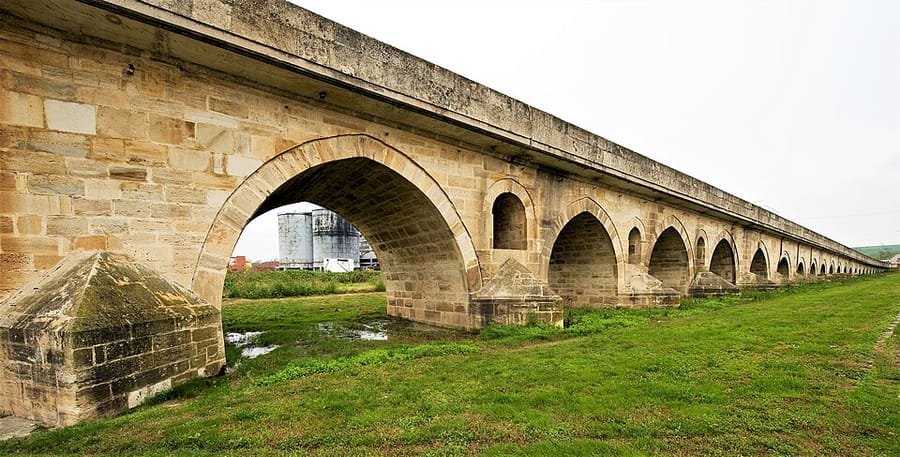

A 174-arch bridge over the Ergene
The bridge that gave its name to the town of Uzunköprü (“Long Bridge”), formerly called Ergene, was begun in 1426 according to Aşıkpaşazade, or in 1427–28 according to another source, and completed in 1443. Built in the reign of Murad II under the supervision of Timurtaş Bey, Osman Çelebi and Gazi Ishak Bey, it was the work of the architect Muslihuddin and master Mehmed. It was opened in the presence of Murad II on his return from the victory at Varna, with victory and torchlight processions. The bridge was part of the settlement of Cisr-i Ergene, where Murad II also built a mosque, a soup kitchen, a madrasa, a caravanserai and a bath.
Its building inscription records the name of Murad II, the date 1443 and the note that the bridge has 174 arches; during a repair under Abdulhamid II it was moved onto a nearby fountain. Originally 1,392 m long, the bridge now measures 1,238.55 m in length and 6.90 m in width; as the ground has risen, 164 arches remain open. Figures of eagles, elephants and lions and the name “Ali” carved on its piers and keystones are notable. It was repaired under Mehmed II, Bayezid II, Osman II, Mahmud II and Abdulhamid II and again in 1928, 1964 and 1972, and in the 1970s it was widened to take two vehicles abreast.
Stones and inscriptions
The stone for the bridge was brought from quarries at the villages of Eskiköy, Kuleliburgaz and Taşçıarnavut and at Kestanbolu and Süleymaniye; its construction took sixteen or eighteen years. The two-line foundation inscription, written in monumental celi thuluth script on marble, has rosettes at its corners. On the upstream side an inscribed column is set among the parapet stones, but its text cannot be read because of damage. The architect's inscription that Ismail Hakkı Balkas reported above one of the arches over the Kırkkavak stream no longer exists.
Arches and repairs
The bridge, 5.24 m wide when first built, has a largest arch span of 14 m. The arches are pointed and round; the 147th and 148th arches are wider and higher than the rest. Seven relief openings stand above the triangular cutwaters. Above the main arch is a chronogram kiosk, and above arches 40-41 and 102-103 there are two balconies. Crossing the Ergene river and the Şoldrak and Kırkkavak streams, the bridge rises and falls six times because of the terrain and technical necessity.
According to Evliya Çelebi, one arch that collapsed fourteen years after construction was repaired. The repair under Osman II is known from the inscription of the Muradiye Mosque. The repair inscription of the reign of Mahmud II in the chronogram kiosk was chiselled off during the Greek occupation and later replaced by a new one; the constitution tower at the left end of the bridge also relates to this repair. In the 1970s the Highways Directorate enlarged the deck brackets, widening the bridge by about 1.70 m overall. In 1908 the municipality removed some of the parapet stones on the right side and used them to build fountains in the town.
Decoration and surroundings
On the keystones, the initial letters of the name “Ali”, repeated three times in Kufic script within a hexagonal frame, meet in the centre; one keystone bore the phrase “el-Mülkü lillah” (Sovereignty belongs to God). Besides the figure of three lions whose heads meet in a round frame, workers carved another lion relief on the parapet of the triangular bay above the great arch during the 1972 repair. A mill stood on each side of the great arch; the upstream one was destroyed in the flood of 1956. The Mahmud Baba Sultan dervish lodge stood at the head of the bridge. Of the buildings Murad II erected at Cisr-i Ergene, including thirty-three shops, an oil press, a boza house, a candle workshop, three fountains and two water mills, only the Muradiye Mosque, an ablution fountain, the bath and the Gazi Mahmud Bey Fountain survive besides the bridge.
Source: TDV Encyclopedia of Islam (TDV İslâm Ansiklopedisi), “UZUNKÖPRÜ” (Nesrin Çiçek Akçıl)
Related sultans
Cite as: Atlas of the Sultans, “Uzunköprü Bridge · Ottoman monuments”, https://padisahlaratlasi.com/en/monuments/uzunkopru-bridge/ (last updated 21 November 2026). Corrections · Image credits