TRENDEFRARAtlas of the Sultans · Ottoman monuments
Muradiye Complex (Bursa)
Monument · Mosque complex, Bursa, 1425–1426
- Type
- Complex (külliye)
- Built
- 1425–1426
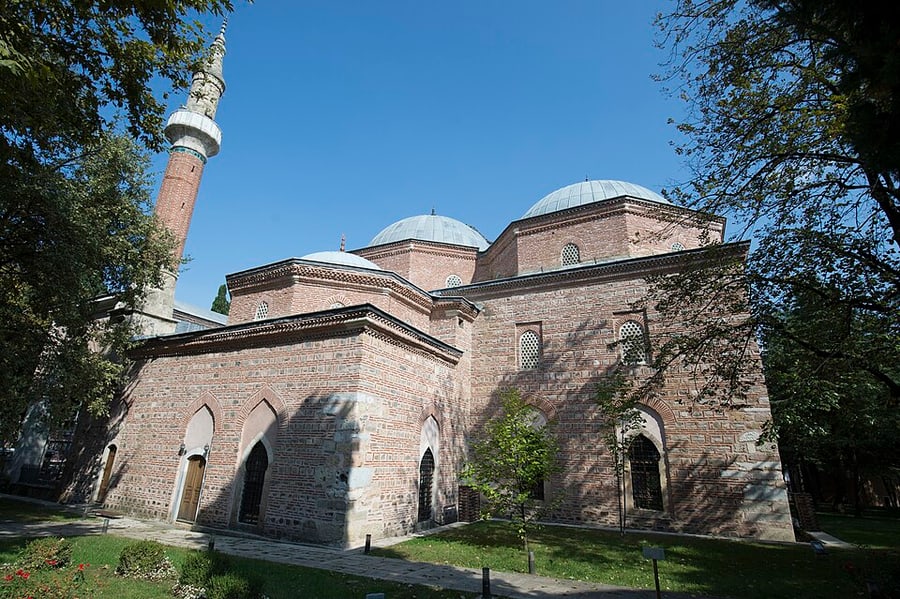

Murad II's complex in Bursa
The complex, which gave its name to the quarter of Bursa where it stands, was built by Murad II. Consisting of a mosque, a madrasa, a bath, an imaret, a fountain and the sultan's tomb, the group grew with new tombs as many princes and members of the court were buried in its cemetery. According to the Arabic inscription above the main portal, construction of the mosque began in Rajab 828 (May 1425) and ended in Muharram 830 (November 1426).
Mosque and madrasa
With its five-bay portico, its prayer hall of two large domes one behind the other, and the domed tabhane rooms on either side, the mosque follows the early Ottoman plan. Its walls are built of three courses of brick alternating with one course of rubble stone; the façade of the portico is enlivened with fifteen different geometric brick patterns and turquoise-glazed bricks. According to the article, the fact that the emerald-green hexagonal tiles and borders inside were also used in the Green Mosque (Yeşilcami) shows that the same group of masters from Tabriz worked here as well. The wooden door leaves in the kündekari technique date from the time of construction.
The madrasa west of the mosque, with its sixteen cells, its arcaded courtyard with an octagonal fountain and its summer classroom iwan, is a typical early madrasa. The building, which had lost its lead roofing and was in ruins, was restored in 1951 and is used as a tuberculosis dispensary. The brick fountain at the western corner of the madrasa is original, but its inscription panel is empty and it no longer runs. The bath at the western end of the complex is a plain building with a domed cold room 10 m in diameter, a hot room with two iwans and two private cubicles; the imaret northeast of the mosque measures 13 × 40 m and is built of rubble stone with a tiled roof.
The open-topped tomb and the cemetery
The Tomb of Murad II, built in 855 (1451), was left open in the middle in accordance with the sultan's will so that rain might fall on him, and it was surrounded by a gallery so that hafizes could recite the Qur'an; the sultan was buried directly in the earth. The tomb has no decoration inside, but its wooden eaves with painted ornament are notable. In the Tomb of Sultan Alaeddin to its east lie three sons and a daughter of Murad II. The cemetery contains the tombs of members of the dynasty such as Prince Ahmed, Cem Sultan, Prince Mustafa, Prince Mahmud, Gülşah Hatun and Hüma Hatun, the mother of Mehmed the Conqueror. The body of Mustafa, the son of Suleiman the Magnificent (Kanuni) who was strangled at Ereğli near Konya in 960 (1553), was transferred to the tomb with Iznik tiles that Selim II had built in 981 (1573).
From the earthquake to the present
In the earthquake of 1855 the mosque was slightly damaged, its minaret split, the dome of the tomb separated, and the classroom and walls of the madrasa were also damaged; for this reason the complex underwent a major restoration. The present plaster mihrab was made in the rococo style after the earthquake, and the burned minbar was replaced by a plain wooden one dated 1315 (1897–98). Of the two minarets, the eastern one is old; the western one is new and bears the date April 1904 on its base. The bath, used as a foundry until 1986, was repaired and returned to its original form, and the imaret, which had long served as a storehouse, was restored in December 1996 and opened as a “darüzziyafe” (banqueting house).
Source: TDV Encyclopedia of Islam (TDV İslâm Ansiklopedisi), “MURÂDİYE KÜLLİYESİ” [Bursa] (Doğan Yavaş)
Related sultans
Cite as: Atlas of the Sultans, “Muradiye Complex (Bursa) · Ottoman monuments”, https://padisahlaratlasi.com/en/monuments/muradiye-complex-bursa/ (last updated 21 November 2026). Corrections · Image credits