TRENDEFRARAtlas of the Sultans · 5 / 39 · sultan
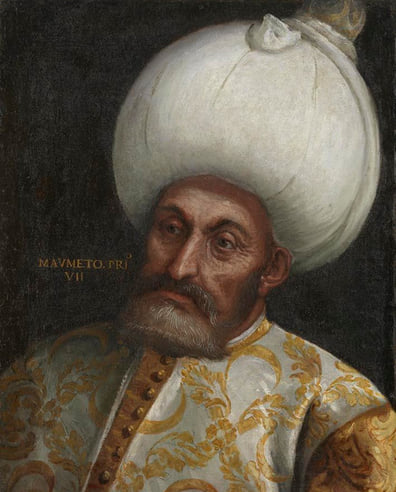
Imaginary portrait (made later) — artist and date unknown
Mehmed I
Çelebi (“the Gentleman”)
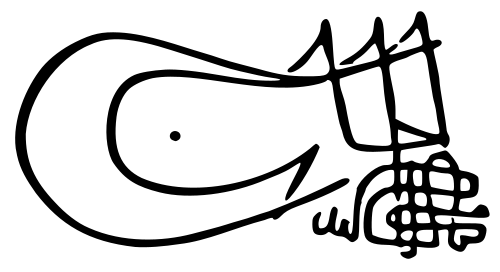
He reunited the shattered state and is therefore counted its ‘second founder’. His peaceful policy and the repair of internal order laid the ground for the great age of conquest that followed.
Open the reign of Mehmed I on the map▶ Watch the 1-minute video: YouTube · Instagram · TikTok
Interesting fact
His mosque (1419) and tomb (1421) in Bursa are known today as the Green Mosque and the Green Tomb. The Old Mosque (Eskicami) in Edirne was also completed in his reign (1414).
Source: TDV İslâm Ansiklopedisi (Turkish), article “MEHMED I”
Life
Youth and Amasya
Mehmed was born in 1386 or 1387. He was the fourth son of Bayezid I the Thunderbolt, born of a concubine named Devlet Hatun. He is also known by the epithet “Çelebi” and by the name “Kirişçi”, derived from a Greek word meaning “young lord”. He had six brothers, named Ertuğrul, Mustafa, Süleyman, Musa, Isa and Kasım.
In June 1399, when he was only twelve or thirteen, he was sent as governor to the province of Rum, which included Amasya, Tokat, Sivas and Ankara. Mehmed was in this region when his father was defeated by Timur at Ankara in 1402 and taken prisoner together with Musa. His elder brother Mustafa was also captured by Timur and taken to Samarkand.
The Interregnum: eleven years among brothers
After the defeat at Ankara the Ottoman realm fell apart. While Süleyman Çelebi (1402–1411) and then Musa Çelebi (1411–1413) ruled Rumelia from Edirne (Adrianople), Mehmed made Tokat and Amasya his base in Anatolia. Like his brothers, he too recognized Timur's sovereignty. The beys of the Candarids, the Karamanids, Germiyan, Saruhan and Aydın, who had recovered their old principalities (beyliks) with Timur's support, took an active part in the struggle over who would hold Bursa, regarded as the capital; the Byzantine Emperor Manuel II and Voivode Mircea of Wallachia also played the princes off against one another.
Mehmed first fought his brother Isa, who had seized Bursa; Isa was eliminated in these clashes and, according to the sources, was killed around 1403. Next he came up against Süleyman Çelebi; in 1403–1404 he lost Bursa and Ankara to him and was forced to withdraw to Tokat-Amasya. He then encouraged Musa to go to Rumelia. At Mircea's invitation Musa crossed by sea to Wallachia in 1406, forced Süleyman to leave Bursa for the sake of Rumelia, and finally, on 17 February 1411, took Edirne in a sudden raid and killed Süleyman. Once Süleyman had left Anatolia, Mehmed took Bursa again.
Musa, who did not abide by the agreement among the brothers, set up a centralizing and harsh regime in Rumelia; this attitude turned the frontier beys against him. After two unsuccessful attempts against Musa in 1411, Mehmed formed an alliance with the frontier beys and the vassal states; on 5 July 1413 he defeated Musa and eliminated him. The conciliatory attitude Mehmed adopted towards the Byzantine emperor, whom he addressed as “father”, played a large part in his success.
The state reunited
Having ascended the throne in Edirne in 1413 as the sole ruler of the Ottoman realm, Mehmed received envoys from Byzantium, Serbia, Wallachia, the Despotate of the Morea and the Duchy of Athens and gave them assurances of peace. He then turned to punishing the beys who had helped Musa: in 1414 he defeated Cüneyd, who had re-established his principality at Izmir, took the whole of western Anatolia and made the land of Aydın an Ottoman sanjak. In 1415 he defeated the lord of Karaman and besieged Konya; from Karaman, which sued for peace, the land of Hamid (the Isparta area) and the land of Said were annexed to the Ottoman state.
The reunification of the state prompted Byzantium, the Papacy and Venice to call for a Crusade. In response to the raids Mehmed sent against the Venetian islands in the Aegean in 1415, the Venetian fleet under Pietro Loredano made a surprise attack on the Ottoman fleet at Gallipoli on 29 May 1416 and wrecked it.
Two great trials: Mustafa and Sheikh Bedreddin
His brother Mustafa, whom Timur had taken to Samarkand, was released and reached Trebizond in 1415, where he opened negotiations with Venice and Byzantium. He crossed into Rumelia together with Cüneyd of Aydın; although they took Serres in Macedonia in 1416, they failed to win the support of the frontier beys. Mehmed forced them to take refuge in Byzantine-held Thessaloniki; the emperor undertook to keep Mustafa and Cüneyd under watch in return for an annual payment.
In the same year, in the summer and autumn of 1416, Mehmed had to deal with the uprising started by Sheikh Bedreddin in western Anatolia and in Deliorman in Rumelia. Voivode Mircea of Wallachia, who was protecting the sheikh, occupied Deliorman and attacked Silistra. Mehmed finally had Sheikh Bedreddin captured at Zağra and executed at Serres; he then marched against Isfendiyar Bey of the Candarids, who had helped the sheikh cross into Wallachia, and made him acknowledge his sovereignty.
Last years and death
In 1417 Mehmed fell seriously ill; Bayezid Pasha led the Karaman campaign in his place, and the lord of Karaman was captured. In the last years of his life Mehmed watched with concern as Timur's son Shahrukh advanced into eastern Anatolia, and he established friendly relations with the Mamluks, whom Shahrukh was threatening.
Mehmed died in Edirne on 25 June 1421; his son Murad II ascended the throne in Bursa and refused to hand his younger brothers over to Byzantium, as the agreement his father had made with the emperor required. According to the Menakıbname in Neşri, Mehmed ruled alone for seven years and eleven months. In Bursa he built a mosque (1419), a madrasa, a soup kitchen (imaret) and a tomb (1421) and attached endowments to them; these buildings, known as the Green Mosque (Yeşil Cami) and the Green Tomb (Yeşil Türbe), are associated with his name. The Old Mosque (Eskicami) in Edirne was also completed in his time (1414), and a covered market (bedesten) was built to provide income for the mosque.
According to Halil Inalcık, the central task of Mehmed's reign was to re-establish the Ottoman order in Anatolia and the Balkans after the catastrophe of 1402. Because he reunited his father's state after an eleven-year war with his brothers, historians also call him the “second founder” of the state.
Source: TDV Encyclopedia of Islam (TDV İslâm Ansiklopedisi), “Mehmed I” (Halil Inalcık); the Menakıbname in Neşri, Doukas, Idris-i Bitlisi and Venetian documents are the main sources of this article.
Meanwhile in the world
Contemporary rulers
- Yongle EmperorMing Emperor (China) · 1402–1424Launched Zheng He's great maritime expeditions
- Shah RukhTimurid Ruler · 1405–1447Son of Timur; made Herat a center of arts and learning
- Henry VKing of England · 1413–1422After Agincourt he was named heir to the French throne
- SigismundKing of Hungary, German King · 1387–1437Became German king in 1411; crowned emperor in 1433
- Władysław II JagiełłoKing of Poland · 1386–1434Defeated the Teutonic Knights at Grunwald
- Martin VPope · 1417–1431His election ended the Western Schism
What was happening in the world?
- 1405Admiral Zheng He set out with a Ming fleet on the first of seven great voyages into the Indian Ocean.
- 1410At the Battle of Grunwald, a Polish-Lithuanian army heavily defeated the Teutonic Knights.
- 1415At the Battle of Agincourt, Henry V's English army defeated a much larger French army.
- 1415Czech reformer Jan Hus was condemned for heresy at the Council of Constance and burned at the stake.
- 1417The election of Martin V at the Council of Constance ended the Western Schism.
- 1420The Treaty of Troyes named King Henry V of England heir to the French throne.
Sources: britannica.com [1] [2] [3] [4] [5] [6] [7] [8] [9] [10] [11] [12]
Family
| Father | Bayezid I |
|---|---|
| Mother | Devlet Hatun |
| Consorts | Emine Hatun (Dulkadir), Kumru Hatun, Şehzade Hatun |
| Children | Murad II, Küçük Mustafa, Ahmed, Yusuf, Mahmud, Selçuk Hatun, Sultan Hatun |
Major achievements
- End of the Interregnum; sole ruler after the Battle of Çamurlu (1413)
- Unity of Anatolia restored: Saruhan, Aydın, Menteşe, the province of Rum
- Revolt of Sheikh Bedreddin suppressed (1420)
- Affair of the pretender ‘Düzmece’ Mustafa resolved
- Green Mosque and Green Tomb in Bursa
- First Ottoman naval battle with Venice (1416)
Treaties
- Peace with Venice (1419)
- Peace agreements with the Eastern Roman Empire (Byzantium) and Karaman
Viziers
| Name | From | To | Length |
|---|---|---|---|
| Imamzade Halil Pasha Interregnum, while Mehmed Çelebi was still a prince | 1406 | 1413 | |
| Bayezid Pasha | 1413 | 1421 |
These names and years come from traditional vizier lists compiled later and are approximate.
Battles and treaties
| Year | Event | Result / parties |
|---|---|---|
| Treaty: Peace agreements with the Eastern Roman Empire (Byzantium) and Karaman | ||
| 1413 | Battle: Çamurlu | Victory for Mehmed Çelebi; Musa Çelebi killed, end of the Interregnum |
| 1416 | Naval battle: Battle of Gallipoli (1416) | Venetian victory; the Ottoman fleet suffered heavy losses |
| 1416 | Revolt: Revolt of Sheikh Bedreddin | Suppressed; Börklüce Mustafa and Torlak Kemal were defeated, Sheikh Bedreddin was captured and executed at Serres |
| 1419 | Treaty: Peace with Venice |
Full infoboxes are in the site’s “Battles and Treaties” tab; source: TDV Encyclopedia of Islam.
Death
He died of illness (probably a stroke) in Edirne in 1421. His death was kept secret for forty days until his son Murad II, governor of Amasya, reached Bursa and took the throne.
Territorial change
| Year | Region | Event | Source |
|---|---|---|---|
| 1414 | + Aydın–Saruhan–Menteşe | Aydın, Saruhan and Menteşe recovered (1414–1416), submission of Izmiroğlu Cüneyd | TDV İA, “MEHMED I” |
| 1415 | + Northern Albania (Krujë–Shkodër) | After war with Venice most of Albania was taken and the sanjak of Arvanid-ili was created (1415–1417); Krujë too passed to the Ottomans after Nikola Thopia's death (1415) | TDV İA, “ARNAVUTLUK” |
| 1419 | + Canik (Samsun–Ordu) | Canik campaign (1417–1418) and capture of Samsun (1420) | TDV İA, “SAMSUN” (one-year difference: TDV: Canik campaign 1417–1418, Samsun 1420) |
| 1419 | + Northern Dobruja (Constanța–Tulcea) | Conquest of the Dobruja fortresses (1416–1419) | TDV İA, “DOBRUCA” |
| 1419 | + Southern Dobruja (Dobrich–Silistra) | Conquest of the Dobruja fortresses (1416–1419) | TDV İA, “DOBRUCA” |
The lands that changed hands in this period, and the battles or treaties that brought the changes, can be seen on the map: map of the reign of Mehmed I.
Cite as: Atlas of the Sultans, “Mehmed I (Çelebi (“the Gentleman”)): Reign Map, Wars and Conquests (1413–1421)”, https://padisahlaratlasi.com/en/sultans/i-mehmed/ (last updated 21 November 2026). Corrections · Image credits
Terms on this page: Şehzade · Sanjak
Monuments of this reign: Old Mosque (Edirne) · Emir Sultan Mosque · Green Mosque Complex (Yeşil Külliye) · Bayezid Pasha Mosque · Çelebi Sultan Mehmed Mosque
Capital in this reign: Bursa · Edirne
State organisation: The devshirme system
Myths and misconceptions: Were Crimea, Wallachia and Moldavia Ottoman territory? · Did the devshirme take every Christian child?