TRENDEFRARAtlas of the Sultans · Ottoman monuments
Muradiye Mosque (Edirne)
Monument · Mosque, Edirne, 1435–1436
- Type
- Mosque
- Built
- 1435–1436
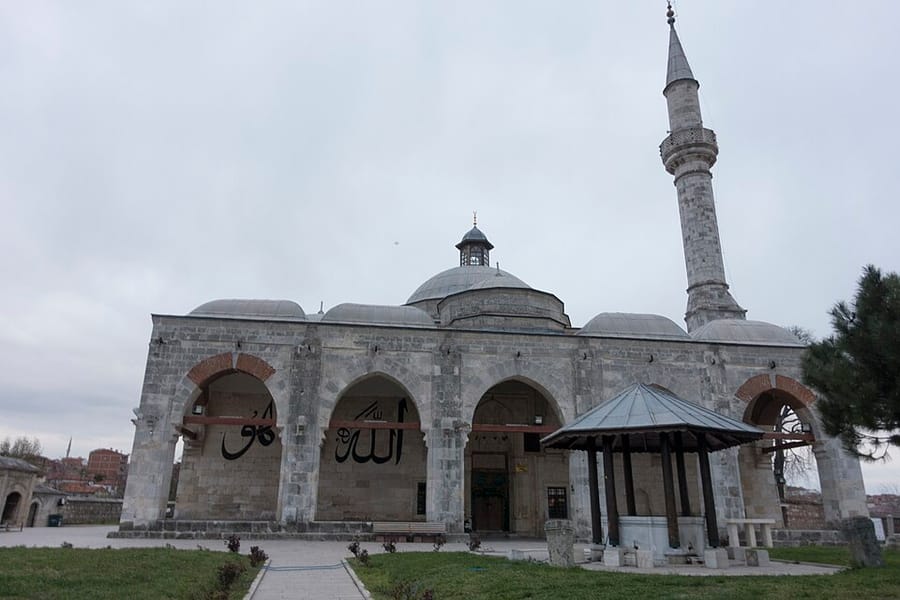

An Edirne mosque famed for its tiles
The Muradiye complex, on a hill overlooking the Saray plain in Edirne, consisted of a mosque, a Mevlevi lodge, a soup kitchen (imaret), a fountain and a school. The inscription over the mosque's door gives the year 1435–36, while the now-lost endowment deed of Murad II is known to have been dated 1427. The architect is not known, though the building is thought to be the work of the architect Şehabeddin. Built of cut stone, the mosque follows the plan with guest rooms (tabhane or zaviye type): two domed spaces follow one another, flanked by guest rooms with hearths.
Plain on the outside, the mosque is known for its blue-and-white hexagonal tiles and its 3.65 × 6.35-metre mihrab of polychrome glazed tiles, considered in technique and style the finest example after the Green Mosque (Yeşilcami) in Bursa. Many of the tiles were damaged and stolen in 2001. The green-tiled minaret, destroyed in the earthquake of 1752, was rebuilt plainly under Mahmud I, collapsed again in the 1957 earthquake and was renewed. A restoration was completed in 2005. The Mevlevi lodge was demolished after 1935 and the other buildings of the complex have also disappeared; the mosque is open for worship today.
Courtyard and layout
The main entrance to the complex, enclosed by terrace walls, is through the monumental gate on the south; this Empire-style gate bears the tughra of Sultan Mahmud signed by the calligrapher Rakım. The five round-arched bays of the brick portico are covered by a tall dome in the centre and two coved vaults on each side. Beyond the marble portal with its muqarnas hood one enters the first domed space, resting on prismatic triangles and fitted with a lantern, and then the domed main prayer space carried on Turkish triangles. Each of the side hospice rooms (tabhane) has a fireplace and four wall niches; during the 2005 restoration a fountain was uncovered in the north-east pier.
Tiles, painted decoration and symbols
Turquoise triangles filling the gaps between the blue-and-white hexagonal tiles form stars. On the mihrab the name of Murad II appears in a cartouche, together with verses from Surat Al Imran in thuluth and Kufic script. The building has painted decoration from four periods: the oldest consists of white, yellow and dark-blue ornament with black outlines on a red ground; a layer thought to date from after the 1752 earthquake survives in the hospice rooms, and a 19th-century layer depicting imaginary architecture on the upper part of the mihrab wall. Because the framed stone west of the mihrab is popularly known as the Kaaba stone, the mosque became the second most important place of pilgrimage in Edirne after the Eskicami. The red stone inlay in the shape of a Mevlevi headdress (sikke) at the apex of the portal arch is significant as a Sufi symbol.
Mevlevi lodge, imaret and graveyard
The Mevlevi lodge north of the mosque comprised a hall for the whirling ceremony (semahane), family quarters, dervish cells, rooms for senior dervishes, a kitchen, a tomb and a library; some of its books are now in the Mevlana Lodge in Konya and some in the library of the Selimiye Mosque. The imaret fed the dervishes, students and guests, and every day fodla bread, and on Thursdays pilaf and zerde, were distributed to the houses as far as the minaret's shadow reached. The tomb of the lodge's sheikhs was demolished in 1925 and the graves moved to the mosque graveyard. The graveyard contains the graves of the lodge's first two sheikhs, Celaleddin Çelebi and Cemaleddin Çelebi, and of the Şeyhülislam Musa Kazım Efendi.
Related sultans
Cite as: Atlas of the Sultans, “Muradiye Mosque (Edirne) · Ottoman monuments”, https://padisahlaratlasi.com/en/monuments/muradiye-mosque-edirne/ (last updated 21 November 2026). Corrections · Image credits