TRENDEFRARAtlas of the Sultans · Ottoman monuments
Dolmabahçe Palace
Monument · Palace, 1842–1856
- Type
- Palace and pavilion
- Built
- 1842–1856

From a bay to a royal garden
Before the conquest, the site of the palace was a small bay. It is claimed that Mehmed the Conqueror's attempt to bring his ships down into the Golden Horn started from here. After the conquest the bay became the place where the fleet assembled before putting to sea and where the grand admirals (kaptanpaşa) took part in the ceremonies of departure on campaign. The sources say different things about when the bay was filled in: Evliya Çelebi points to the reign of Osman II, Eremya Çelebi to that of Ahmed I; another tradition attributes the work to captives set to work on the orders of Barbaros. According to the author of the article, the main, extensive filling was most probably carried out in the first half of the 17th century, and the area obtained became a royal garden named “Dolma bahçe” (the Filled-in Garden).
Over time the garden filled up with the sultans' pavilions. After a pavilion belonging to Selim II, Ahmed I, Mehmed IV, Ahmed III and Mahmud I also built pavilions here. The buildings burned in the fire of 1775, and under Selim III a summer palace was built by the architect Melling. The first sultan to conceive of it as a palace for permanent residence was Mahmud II; the buildings were overhauled in 1809, and under the name Beşiktaş Waterfront Palace (Beşiktaş Sahilsarayı) it was on its way to becoming the new centre of government.
Abdulmejid's new palace
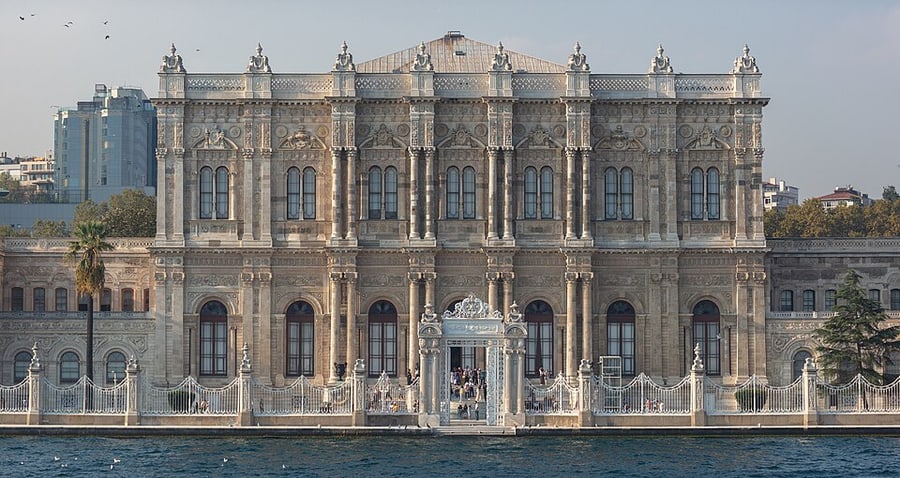
Abdulmejid, brought up with a Western education, ordered on coming to the throne that the wooden waterfront palace be demolished and a masonry palace built in its place. Construction began when the sultan moved temporarily to the Yıldız pavilions in 1842; the palace was opened on 7 June 1856. Its construction was undertaken by Garabet and Nikogos Balyan, father and son, and the interior decoration was done by Ch. Séchan, the decorator of the Paris opera house. The author of the article regards this building, built in the style of European palaces to a plan completely different from Topkapı, as an indication of the sultan's desire for Westernization.
The palace extends over an area of 110,000 square metres. The main building consists of the Mabeyin (selamlık, the men's and official quarters), the Ceremonial Hall (Muayede Salonu) and the harem; around it are units such as a mosque, the royal stables, a theatre, a clock tower, the departure pavilions (hareket köşkleri), the Hereke Weaving Workshop and the kitchens. In the middle of the Mabeyin rises the staircase with crystal balusters. The Ceremonial Hall, where the festival greeting ceremonies were held, measures 25 × 37 metres. The corridor connecting the Mabeyin to the harem is about 300 metres long.
Losses and changing use
Because it was not used during the long reign of Abdulhamid II, and because of earthquakes, fires and misguided urban planning, the theatre, the boathouse and the apartments of the serasker (commander-in-chief) disappeared completely, and the royal stables and the kitchens partly. The Mithat Pasha Stadium was built on the site of the royal stables; the boathouse was demolished in 1956 and the harbour in front of it was partly filled in.
From its opening until 1924, when the Caliph Abdulmejid Efendi left, the palace was used for thirty-five of those sixty-eight years; six sultans and the last caliph lived here. In the Republican period it was included among the national palaces; in Atatürk's time it became the president's summer workplace and hosted the first Language and History congresses.
The present state
As a result of the work carried out under the decisions taken at the National Palaces Symposium held in 1984, the palace became, in the words of the author of the article, an important example of a “museum within a museum”. The objects used by the sultans and their close circle are displayed in the Harem and Mabeyin sections. The Kuşluk and Camlı (Glass) pavilions from the time of Sultan Mehmed Reşad (Mehmed V) have been restored; the Glass Pavilion and the corridor connected to it have been turned into an exhibition space, and the departure pavilions into exhibition halls.
Source: TDV Encyclopedia of Islam (TDV İslâm Ansiklopedisi), “DOLMABAHÇE SARAYI” (Metin Sözen)
Related sultans
Cite as: Atlas of the Sultans, “Dolmabahçe Palace · Ottoman monuments”, https://padisahlaratlasi.com/en/monuments/dolmabahce-palace/ (last updated 21 November 2026). Corrections · Image credits