TRENDEFRARAtlas of the Sultans · Grand viziers
Ali Pasha
Grand vizier five times, 1852–1871
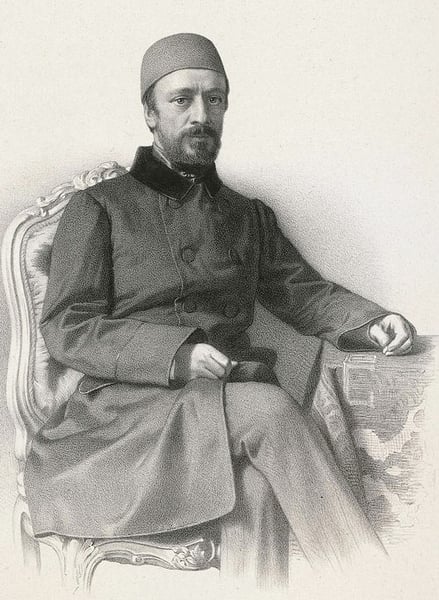 AI

From the Spice Bazaar to the Translation Office
He was born in 1814 at Mercan in Istanbul. His father, Ali Rıza Efendi, was a herbalist (aktar) in the Spice Bazaar (Mısır Çarşısı) and also acted as the bazaar's gatekeeper. On his father's death he broke off his education; in 1830 he entered the office of the Imperial Council (Divan-ı Hümayun Kalemi), where he received the pen name “Ali” under which he would later become famous. In 1833 he moved to the Translation Office (Tercüme Odası); staying in Vienna for a year and a half, he improved his French and his diplomatic skills. In 1838 he went to London with Mustafa Reşid Pasha; his attachment to Reşid Pasha was the most important reason for his rapid rise. After serving as undersecretary for foreign affairs and ambassador in London, he became minister of foreign affairs when Reşid Pasha became grand vizier in 1846.
Grand vizierate and the Treaty of Paris
In 1852, when he was only thirty-eight, he became grand vizier in place of Reşid Pasha. His forming of a new team by bringing his friend Fuad Efendi to the Ministry of Foreign Affairs was the beginning of his estrangement from his patron. In May 1855 he came to the grand vizierate for the second time; representing the Ottoman state at the conference in Paris, he signed the Treaty of Paris dated 30 March 1856. He was severely criticized, especially by Reşid Pasha, over the Reform Edict and on the charge that he had not adequately defended the state's interests at the conference, and he was dismissed.
After Reşid Pasha's death he became grand vizier for the third time in 1858; his failure to find a remedy for the financial straits and his criticism of the palace's extravagance led to his dismissal. After his brief fourth grand vizierate in 1861 he served for six years as minister of foreign affairs during Fuad Pasha's grand vizierate.
A conciliatory foreign policy
In 1867 he became grand vizier for the fifth time. He settled the question of the Serbian fortresses in accordance with the Serbs' wishes; during the Cretan revolt he went to the island in person and granted the population wide privileges. These concessions drew heavy criticism from his opponents such as Ziya Pasha and Ali Suavi. The author of the article, however, states that he followed a conciliatory course because he knew well the changes in Europe and the weakness of the state. By resisting the attempts of the governor of Egypt, Ismail Pasha, to extend his powers, he prevented Egypt from breaking away from the state altogether. He long resisted the Bulgarians' establishing a separate exarchate; even after it was accepted, by delaying the berat (patent) he ensured that the matter was resolved in the way most favourable to the state's interests. While insistently supporting railway construction, he opposed Abdulaziz's naval policy. Unlike Reşid Pasha, who did not depart from British policy, he favoured French policy. When Fuad Pasha died in 1869 he took over the Foreign Ministry as well, and he kept a firm hold on the administration of the state until his death. After France's defeat in 1870 he sensed in advance that Russia would embark on a great war.
Death and assessment
He died on 7 September 1871 and was buried in the burial ground of the Süleymaniye Mosque. According to the author of the article, Kemal Beydilli, the grave developments in foreign policy, the growing financial difficulties, the opposition of the Young Ottomans and his own desire to be the sole man in charge made Ali Pasha's political life highly controversial; his failure to build a solid cadre also meant that affairs rested on the shoulders of a few people. Nevertheless, he is described as a statesman whose worth was understood only after his death, and who with his vast experience could have averted the disasters the state would later face.
Source: TDV Encyclopedia of Islam, “ÂLÎ PAŞA, Mehmed Emin” (Kemal Beydilli)
Related sultans
Cite as: Atlas of the Sultans, “Ali Pasha · Grand viziers”, https://padisahlaratlasi.com/en/grand-viziers/ali-pasha/ (last updated 21 November 2026). Corrections · Image credits