TRENDEFRARAtlas of the Sultans · 35 / 39 · sultan
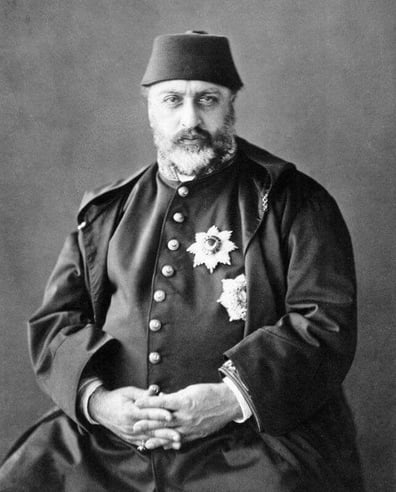
Photograph — Abdullah Frères · before 1876
Abdulaziz
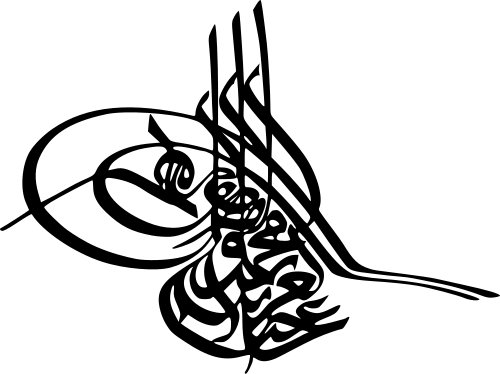
He expanded the navy and the railways and founded modern judicial and educational institutions; he reattached Lahsa and Yemen. But these investments were made on credit; in 1875 the state declared it could not pay its debts, and a year later he was deposed in a coup.
Open the reign of Abdulaziz on the map▶ Watch the 1-minute video: YouTube · Instagram · TikTok
Interesting fact
He is the only Ottoman sultan who travelled to foreign countries: in 1867 he visited France and England and also stopped in Belgium, Prussia and Austria. In his spare time he painted, and he was a good calligrapher in the celi sülüs script.
Source: TDV İslâm Ansiklopedisi (Turkish), article “ABDÜLAZİZ”
Life
A free life as a prince
Abdulaziz was born on the night of 7–8 February 1830. He was the son of Mahmud II and the brother of Abdulmejid I; his mother was Pertevniyal Valide Sultan. Throughout his elder brother's reign, unlike the confined princes of earlier centuries, he lived a rather free life and received a careful education. He studied Arabic language and literature and the religious sciences with Hasan Fehmi Efendi of Akşehir, and music with Yusuf Pasha, a ney player and composer.
He loved sports: at his pavilion in Kurbağalıdere he went hunting, wrestled, swam and played cirit (javelin throwing). Unlike his elder brother, he kept away from drink and dissipation, which raised hopes among those troubled by the extravagance of Abdulmejid's last years. The fact that the conspirators of the Kuleli Incident in 1859 wanted to put him on the throne was also a sign of this hope.
Austerity and reform
When his elder brother died, he came to the throne on 25 June 1861. The state was at the very worst point of its financial crisis; the Montenegrin uprising was about to turn into a war, and Herzegovina was in turmoil. Abdulaziz cut palace expenses and the number of officials; with these measures the financial situation improved for a time. In the first period of his reign the state was largely run by Fuad Pasha and Ali Pasha.
In this period provincial administration was reorganized by the Provincial Regulation (Vilayet Nizamnamesi) of 1864, and the people took part indirectly in government by electing members to the provincial councils. In 1868 the Meclis-i Vala was split in two, creating the Council of State (Şura-yı Devlet) and the Divan-ı Ahkam-ı Adliyye; the TDV article regards this as an important step toward constitutional government. In the same year, at France's insistence, the Mekteb-i Sultani (Galatasaray High School) was opened, teaching according to the French educational system, with Muslim and non-Muslim children studying together. In 1869 the educational organization was restructured by the Regulation on Public Education (Maarif-i Umumiyye Nizamnamesi); in 1870 the first women's teachers' college was opened under the name Darülmuallimat, and the first university, the Darülfünun-ı Osmani, opened its doors on 8 February 1870 in its new building in Çemberlitaş (today's Press Museum), but it was closed at the end of 1871. Through the ten-year work of the Mecelle Commission chaired by Cevdet Pasha, the Mecelle-i Ahkam-ı Adliyye, based on Islamic law and serving as a civil code, was prepared. A law dated 10 June 1868 granted foreigners the right to own property in Ottoman lands outside the Hejaz. The railway network grew from 452 kilometers to 1,344 kilometers, the concession for the line that would connect Istanbul to Europe was given to Baron Hirsch, and the telegraph was extended to all the provinces.
The sultan who toured Europe
On 3 April 1863 Abdulaziz went to Egypt, where he was received with great enthusiasm. On 21 June 1867, accepting the invitations of Napoleon III to the Paris Exposition and of Queen Victoria to London, he set out on a journey to Europe. According to the TDV article, he is the only Ottoman sultan to have traveled to foreign countries in this way.
He attached great importance to the navy. To have a fleet on a par with those of Britain and France, he spent money beyond the means of the budget; ironclad ships that could not be built in domestic shipyards were bought abroad. After the European journey, under pressure from the Western powers, Carol's princely title in Romania was recognized and Ottoman troops were withdrawn from the Serbian fortresses (1867). Crete, which had risen in revolt in 1866, was not allowed to join Greece; the island received a special administration under a regulation prepared by Ali Pasha. In 1870 the Bulgarians, who wished to separate from the Greek Orthodox church, were given permission to establish an independent church (the Exarchate); this was an important step on the Bulgarians' road to autonomy. In Egypt, however, Ismail Pasha secured acceptance of the title of “khedive” and of hereditary succession to the governorship, and began to act more and more independently.
Debts and deposition
After Ali Pasha's death in 1871, Mahmud Nedim Pasha and Midhat Pasha held sway in the government. The state's debts rose to 200 million gold liras, and annual debt and interest payments to fourteen million gold liras; debt was being paid off with more debt. The 1875 budget showed a deficit of five million gold liras; Grand Vizier Mahmud Nedim Pasha announced, by a decision dated 6 October 1875, that half of the annual debt installments and interest would not be paid for five years. This decision provoked a strong reaction in Europe among holders of Ottoman bonds. The uprising that began in Herzegovina in 1875 spread to Bosnia and, in 1876, to Bulgaria; the killing of two consuls in Salonica spurred the European powers into action.
Midhat Pasha and the serasker (commander-in-chief) Hüseyin Avni Pasha regarded Abdulaziz as harmful both to the state and to themselves. In a coup carried out on 30 May 1876, Abdulaziz was deposed and his nephew Murad V was placed on the throne. The Berlin Memorandum prepared by the Western powers, for its part, was never delivered to the Sublime Porte.
His death
At his own request Abdulaziz was moved to the Fer'iye Palace. On 4 June 1876 he was found in his room with the veins of his wrists cut. Hüseyin Avni Pasha, the first to arrive on the scene, did not allow the doctors to examine the body in detail; the doctors wrote a vaguely worded report stating that the scissors shown to them could have caused these wounds. The death was announced in the newspapers as suicide. He was buried in the Tomb of Mahmud II.
In 1881, following the revelations of a palace servant, Abdulhamid II ordered an investigation; the court set up at Yıldız Palace and known as the “Yıldız Tribunal” ruled that Abdulaziz had been murdered. The debate over whether his death was suicide or murder continues to this day.
The greatest building of his reign is Çırağan Palace, which cost four million Ottoman gold liras; Beylerbeyi Palace was also built in this period. The Valide Mosque in Aksaray, built by his mother Pertevniyal Valide Sultan, was completed in 1871. Abdulaziz painted in his spare time; his paintings are found in the Topkapı Palace Museum and elsewhere. He was also interested in music.
Source: TDV Encyclopedia of Islam (TDV İslâm Ansiklopedisi), “Abdülaziz” (Cevdet Küçük); Mahmud Celaleddin Pasha's Mir'at-ı Hakikat, Cevdet Pasha's Tezakir, Lutfi Efendi and the records of the Yıldız Tribunal (Yıldız Mahkemesi) are the main sources of this article.
Meanwhile in the world
Contemporary rulers
- VictoriaQueen of the United Kingdom · 1837–1901Queen under whom the monarchy's political role became ceremonial
- Alexander IIEmperor of Russia · 1855–1881Tsar who freed the serfs and launched sweeping reforms
- Napoleon IIIEmperor of the French · 1852–1870France's last monarch, who lost his throne after Sedan in 1870
- William IKing of Prussia, German Emperor · 1861–1888King proclaimed first emperor of a united Germany in 1871
- Franz JosephEmperor of Austria, King of Hungary · 1848–1916Ruler who created the Austro-Hungarian Dual Monarchy in 1867
- MeijiEmperor of Japan · 1867–1912Emperor of the era of Japan's rapid westernization and modernization
- Naser al-Din ShahShah of Iran (Qajar dynasty) · 1848–1896Qajar shah who began as a reformer but grew increasingly conservative
What was happening in the world?
- 1865The Thirteenth Amendment is ratified in the United States, formally abolishing slavery nationwide.
- 1867The Compromise between Austria and Hungary creates the Austro-Hungarian Dual Monarchy.
- 1868Meiji Restoration in Japan: the Tokugawa shogunate ends and power passes to the emperor.
- 1869Dmitri Mendeleev presents his periodic table of the chemical elements to the Russian Chemical Society.
- 1871The German Empire is proclaimed at Versailles; King William I of Prussia becomes emperor.
Sources: britannica.com [1] [2] [3] [4] [5] [6] [7] [8] [9] [10] [11]
Family
| Father | Mahmud II |
|---|---|
| Mother | Pertevniyal Sultan |
| Consorts | Dürrinev Kadın, Hayranidil Kadın, Edadil Kadın, Neşerek Kadın, Gevheri Kadın |
| Children | Yusuf Izzeddin, Abdulmejid II (the last caliph), Mahmud Celaleddin, Mehmed Şevket, Emine Sultan, Nazime Sultan, Esma Sultan, Saliha Sultan |
Major achievements
- The navy made the third largest in the world
- The first sultan to travel officially to Europe (1867)
- Opening of the Mekteb-i Sultani (Galatasaray) (1868)
- Council of State and Court of Justice founded (1868) — separation of the judiciary from the administration
- Work on the Mecelle civil code begun
- Railway network in Rumelia and Anatolia extended
- Lahsa (1871) and Yemen (1872) reattached to the state
- First Ottoman exhibitions, coinage reform
Treaties
- London Conference (1871) — revision of the Black Sea clauses of the Treaty of Paris
Grand viziers
| Name | From | To | Length |
|---|---|---|---|
| Kıbrıslı Mehmed Emin Pasha (term 3) | May 28, 1860 | August 6, 1861 | 1 year, 70 days |
| Ali Pasha (term 4) | August 6, 1861 | November 22, 1861 | 108 days |
| Keçecizade Fuad Pasha | November 22, 1861 | January 2, 1863 | 1 year, 41 days |
| Yusuf Kamil Pasha | January 5, 1863 | June 1, 1863 | 147 days |
| Keçecizade Fuad Pasha (term 2) | June 1, 1863 | June 5, 1866 | 3 years, 4 days |
| Mütercim Mehmed Rüşdü Pasha (term 2) | June 5, 1866 | February 11, 1867 | 251 days |
| Ali Pasha (term 5) | February 11, 1867 | September 7, 1871 | 4 years, 208 days |
| Mahmud Nedim Pasha | September 8, 1871 | July 31, 1872 | 327 days |
| Midhat Pasha | July 31, 1872 | October 19, 1872 | 80 days |
| Mütercim Mehmed Rüşdü Pasha (term 3) | October 19, 1872 | February 15, 1873 | 119 days |
| Ahmed Esad Pasha | February 15, 1873 | April 15, 1873 | 59 days |
| Şirvanizade Mehmed Rüşdü Pasha | April 16, 1873 | February 13, 1874 | 303 days |
| Hüseyin Avni Pasha | February 15, 1874 | April 25, 1875 | 1 year, 69 days |
| Ahmed Esad Pasha (term 2) | April 25, 1875 | August 26, 1875 | 123 days |
| Mahmud Nedim Pasha (term 2) | August 26, 1875 | May 11, 1876 | 259 days |
| Mütercim Mehmed Rüşdü Pasha (term 4) | May 12, 1876 | December 19, 1876 | 221 days |
Battles and treaties
| Year | Event | Result / parties |
|---|---|---|
| 1866 | Revolt: Cretan Revolt (1866–1869) | Union with Greece was proclaimed (2 September 1866) but the revolt was suppressed; a new statute was issued for the island in 1868; after the warning of the … |
| 1871 | Treaty: London Conference | |
| 1875 | Revolt: Herzegovina Uprising | It led to Great Power intervention and to the Russo-Ottoman War of 1877–78; the Treaty of Berlin (1878) placed Bosnia and Herzegovina under Austro-Hungarian … |
| 1876 | Revolt: April Uprising (Bulgaria) | Suppressed with great difficulty by a force of 18,000 men; it caused an outcry in Europe and hastened the road to the Russo-Ottoman War of 1877–78 |
Full infoboxes are in the site’s “Battles and Treaties” tab; source: TDV Encyclopedia of Islam.
Death
Deposed in a coup in 1876, he was found five days later in Feriye Palace with his wrists cut. Whether it was suicide or murder is still debated.
Territorial change
| Year | Region | Event | Source |
|---|---|---|---|
| 1867 | − Smederevo–Šumadija | The Ottoman garrisons were withdrawn from the fortresses of Belgrade, Smederevo, Šabac and Kladovo (1867); from then on Serbia was only an autonomous, tribute-paying principality | TDV İA, “SIRBİSTAN” |
| 1867 | − Belgrade–Šabac | The last Ottoman garrison left Belgrade fortress (1867) and the city passed wholly to the Serbs; until 1878 the Ottoman flag still flew on the fortress beside the Serbian one | TDV İA, “BELGRAD” |
| 1871 | + Lahsa (Eastern Arabia–Qatar) | Midhat Pasha's Najd campaign (1871) — Lahsa reattached | TDV İA, “LAHS” |
| 1872 | + Yemen–Asir | Ahmed Muhtar Pasha's Yemen campaign (1872) — Sana'a and the highlands reattached | TDV İA, “YEMEN” |
The lands that changed hands in this period, and the battles or treaties that brought the changes, can be seen on the map: map of the reign of Abdulaziz.
Cite as: Atlas of the Sultans, “Abdulaziz: Reign Map, Wars and Conquests (1861–1876)”, https://padisahlaratlasi.com/en/sultans/abdulaziz/ (last updated 21 November 2026). Corrections · Image credits
Terms on this page: Caliphate
Grand viziers of this reign: Ali Pasha · Keçecizade Fuad Pasha · Mahmud Nedim Pasha · Midhat Pasha
Monuments of this reign: Emir Sultan Mosque · Yıldız Palace · Beylerbeyi Palace · Adile Sultan Palace · Aziziye Mosque (Tulcea) · Çırağan Palace · Tomb of Osman Gazi · Tomb of Orhan Gazi · Altunizade Mosque · Pertevniyal Valide Sultan Mosque · Aziziye Mosque (Konya) · Bahariye Mevlevi Lodge
Women of the dynasty in this reign: Pertevniyal Valide Sultan
State organisation: The Province and Sandjak System · The Tanzimat and the renewal of government